

 Facebook
 X
X
 Pinterest
 Copy Link
How Could a Recession in 2025 Affect the Housing Market?
As talk about economic slowdowns runs wild, worries about a potential recession in 2025 are on the rise. ...
Read More 
If you’ve felt priced out of the market or stuck waiting on the sidelines, there’s finally some encouraging news:
Buying a home is finally becoming more affordable.
Monthly payments have started to come down thanks lower interest rates, and buyers are starting to feel pricing pressures ease. That doesn’t mean homeownership is suddenly easy for everyone, but after a tough stretch, small improvements are meaningful.
One of the clearest ways to track this change is to look at how much of a household’s income goes toward owning a home.
According to Zillow, housing is typically considered affordable when total housing costs take 30% or less of your monthly income. That includes your mortgage payment, property taxes, insurance, and basic maintenance.
For the past few years, many buyers were well above that mark, which pushed homeownership out of reach for a lot of households. But that’s starting to shift. Zillow research shows it’s taking less of a typical household’s income to buy a home than it did just a few years ago (see graph below):
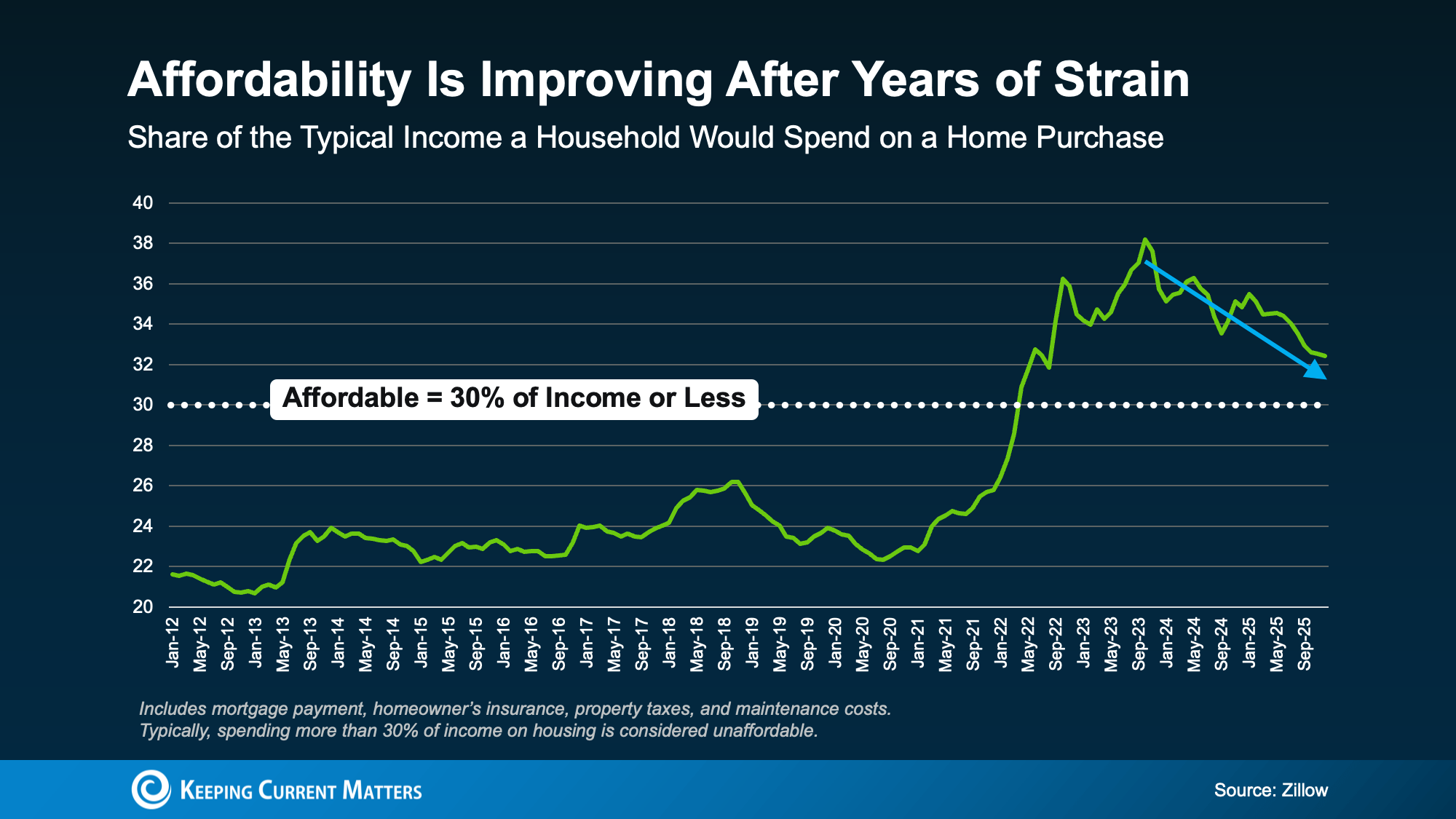
We’re not all the way back to Zillow’s 30% threshold yet, so affordability is still tight in many markets. But the trend is improving, and that’s a big change from what buyers have been up against.
Mortgage rates get most of the attention, and yes, rate movement plays a major role in monthly payment size. But it’s not the only reason affordability is improving. Three key trends are working in buyers’ favor right now:
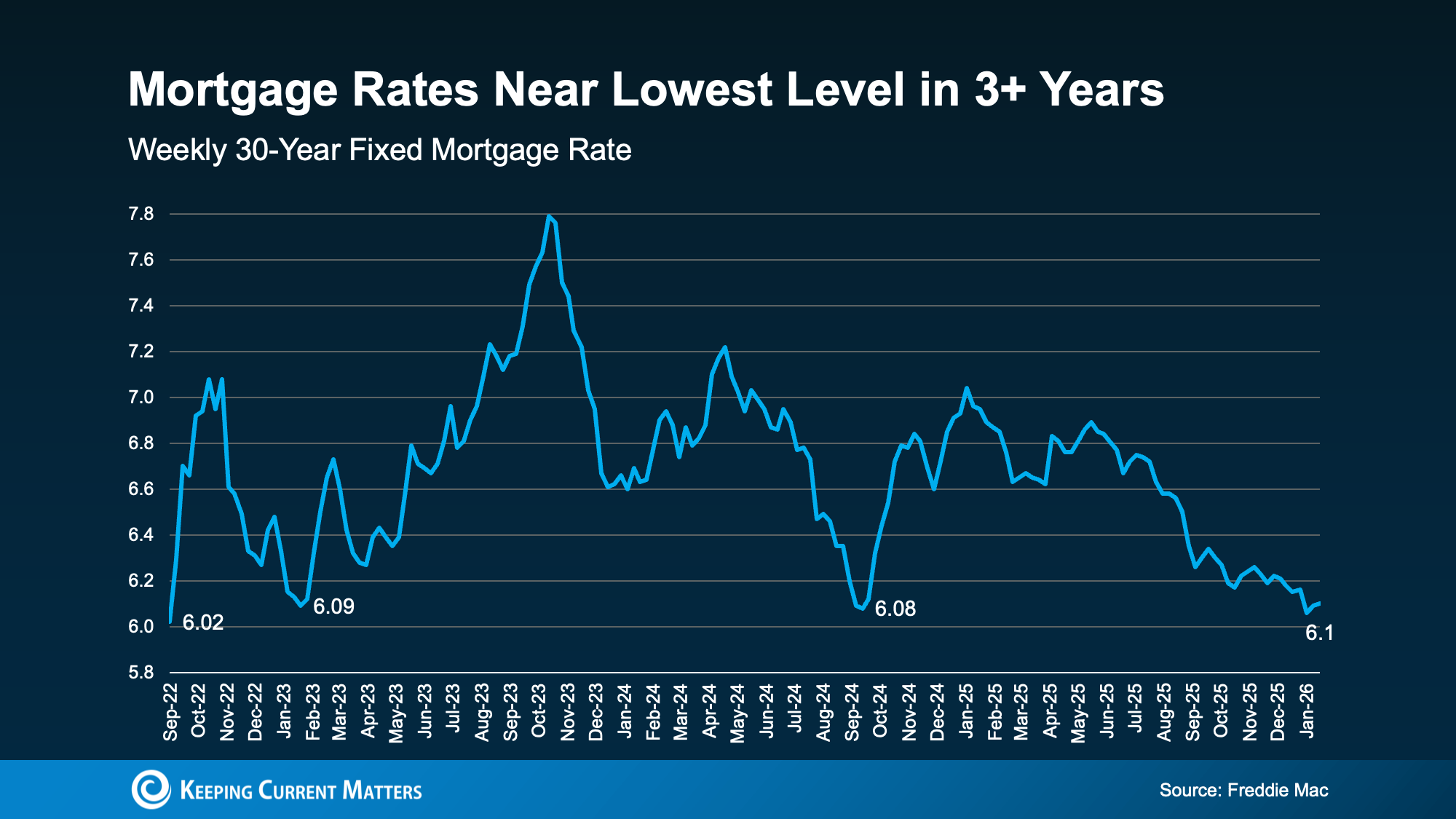
Rates are near their lowest level in more than three years, which can reduce monthly payments and expand buying power (see graph below):
Home prices aren’t falling nationally, but they’re rising more slowly than they were a few years ago. That matters because slower price growth helps keep purchase prices from jumping as sharply, which can make payments feel more manageable and the overall buying process more predictable.
This is a major factor that often gets overlooked. When incomes rise faster than home prices, buyers can start catching up. Mark Fleming, Chief Economist at First American, explains:
“When income growth exceeds house price growth, house-buying power improves—even if mortgage rates don’t decline meaningfully.”
None of this makes homes “cheap,” but it does help explain why the math is starting to work a bit better than it did even a year ago. In short, some of the forces that curbed affordability are finally easing. As Fleming again explains:
“Affordability remains challenging, but for the first time in several years, the underlying forces are finally aligned toward gradual improvement. Mortgage rates may drift down only slowly, but income growth exceeding house price appreciation will provide a boost to house-buying power — even in a higher-rate world. Affordability won’t snap back overnight, but like a ship finally catching a steady tailwind, it’s now sailing in the right direction.”
Because of these combined shifts, many economists expect affordability to continue improving in 2026.
So how much will affordability improve, and where will it show up first? In some places, the difference could be noticeable. Zillow says some markets are expected to fall back under their affordability threshold (30% of income or less) by the end of the year (see graph below):
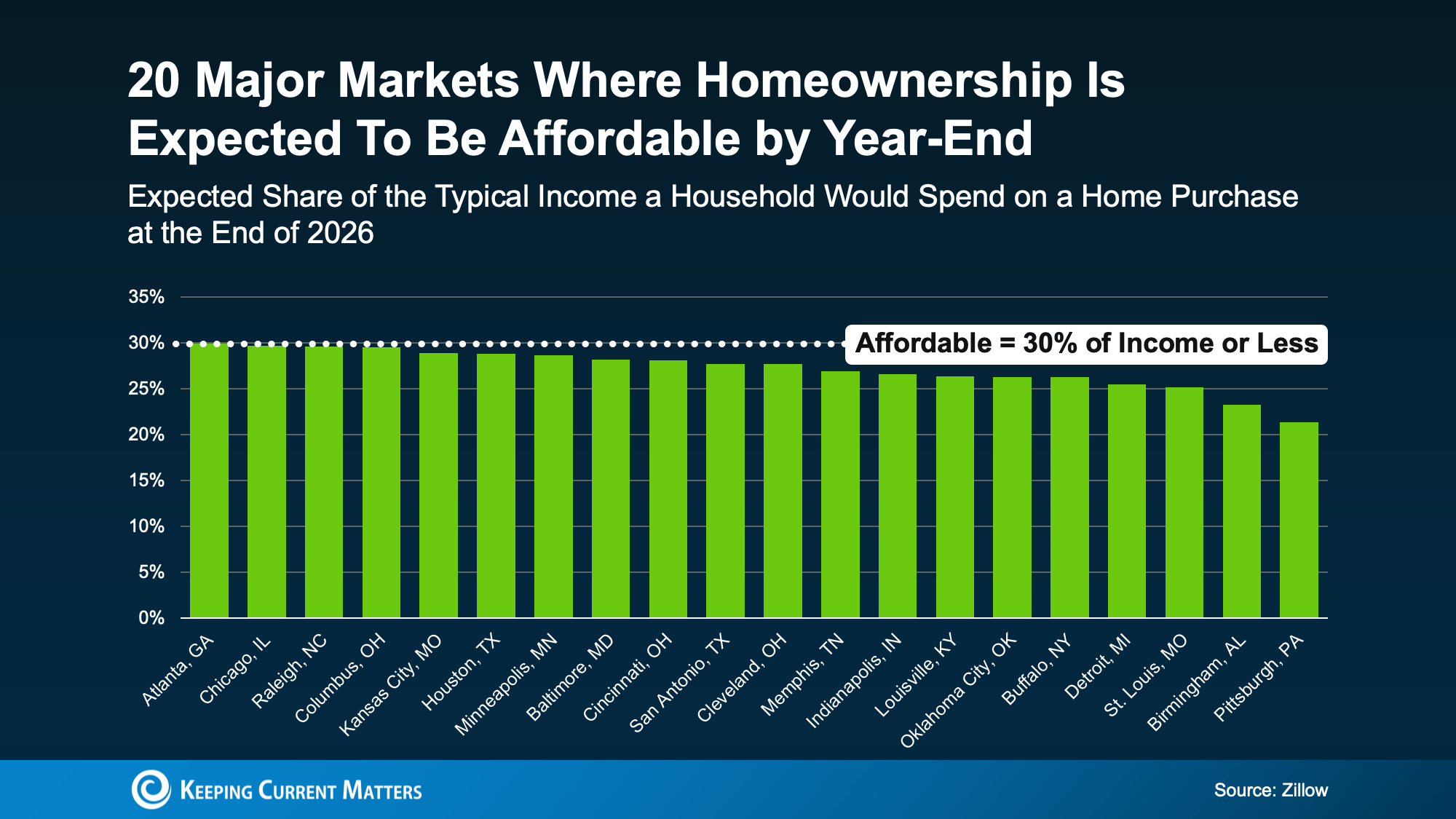
But you don’t have to live in one of those specific markets, and you may not have to wait until year-end to see improvement. Many areas are already trending in a better direction.
That’s why your next best step is local: talk to a real estate agent who understands what’s happening in your market. The national headlines don’t always reflect what’s going on neighborhood by neighborhood, and you might be closer to buying than you think.
For the first time in a while, home affordability is easing, and that’s an important shift for buyers.
And because the pace of improvement varies by location, understanding what’s changing locally can make all the difference. If you want to see how these trends are playing out where you live, connect with a local real estate agent to talk through your options.
If you’ve been watching mortgage rates and waiting for a “better time” to buy, here’s your chance. Rates just dipped below 6% for the first time in more than three years. Even modest rate movement can change what you can afford, how competitive you can be, and whether buying feels realistic again, especially if last year’s higher rates pushed you to the sidelines.
With rates finally easing up into 2026, here’s a fresh take on why lower mortgage rates are still a big deal, plus what to do next if you’re thinking about making a move.
A mortgage rate isn’t just a number on a lender’s website. It shapes the entire homebuying experience because it affects:
When rates jump, affordability tightens fast. That’s why many buyers (especially first-time homebuyers) feel the pinch first. When rates ease, the reverse happens: budgets get a little more breathing room, and choices open up.
One of the easiest ways to understand why rate declines matter is to look at a simple example.
When rates are closer to 7%, monthly payments rise sharply. When rates move closer to 6% (or below), payments can drop meaningfully. On a typical loan amount, that can translate into hundreds of dollars per month in savings compared to the higher-rate environment.
That difference can help you:
Stretch your budget without stretching your lifestyle
Consider more homes in a neighborhood you actually want
Keep cash available for repairs, furnishing, or future goals
In practical terms, the change isn’t just “cheaper interest.” It can be the difference between compromising on your wish list and finding a home that fits.
When borrowing costs come down, three things usually happen for homebuyers:
A lower rate can reduce the monthly principal-and-interest payment, which helps many buyers feel more confident about moving forward.
When the payment drops, you may qualify for more home at the same monthly budget. That can mean a better location, an extra bedroom, or a property that needs fewer updates.
More budget flexibility can help you compete without taking on a payment that makes you uncomfortable. That matters in markets where inventory is still tight and desirable homes move quickly.
Rate changes don’t only affect you. They affect everyone who has been waiting, too.
Industry research suggests that when rates sit around certain thresholds, millions more households can afford a median-priced home. In fact, research from the National Association of Realtors (NAR) points to 5.5 million additional households being able to afford the median-priced home when rates are at 6% or below, and it estimates roughly 550,000 of those households could buy within the next 12 to 18 months.
That matters because it signals something important: pent-up demand can return quickly when affordability improves.
If you’re home-searching now (or preparing to), you may be able to act before competition fully ramps back up.
Lower rates help, but they don’t magically make every home affordable. Your true monthly cost depends on several moving pieces, including:
Home price
Local inventory and competition
Property taxes
Homeowners insurance (which can vary widely by state and ZIP code)
HOA dues
Your down payment and credit profile
That’s why the smartest next step isn’t guessing. It’s running real numbers to figure out what “affordable” looks like for you.
If you’ve been waiting for rates to improve, here’s a simple, practical plan:
Get pre-approved (not just pre-qualified).
Pre-approval gives you a clearer budget and shows sellers you’re serious.
Calculate your comfortable payment range.
Decide what fits your life, not just what a lender says you can qualify for.
Compare scenarios with your lender.
Ask for payment examples at different price points, down payments, and rate options.
Watch inventory in your target neighborhoods.
The best “deal” is the home that works for your needs and your budget.
Mortgage rates easing from last year’s highs isn’t just an attractive headline. For many buyers, it can be the shift that turns “maybe someday” into “this could actually work.”
If you paused your search when rates were higher, it’s worth revisiting your numbers now. A quick conversation with a trusted lender can show what today’s rate environment means for your payment, your buying power, and your options.
If you’re thinking of buying, or need help finding a lender, reach out to us today. We can connect you with local agents and lenders to make your journey as simple as possible.

As spring winds down and June approaches, we typically anticipate a familiar surge in housing market activity across the United States. This seasonal trend is especially pronounced in regions like the Midwest, where warmer weather traditionally brings buyers and sellers out in force. But this year, something feels different. The energy we expect to accompany spring’s closing weeks has been muted. The 2025 spring market, it seems, is stalling.
There are a number of likely culprits behind this pause. Mortgage interest rates, while slightly lower than last year, are still hovering in the high 6% range—making monthly payments a challenge for many would-be buyers. Combined with lingering concerns over global trade tensions and general market conditions, both buyers and sellers appear to be proceeding with caution.
This caution is reflected in national data. According to the National Association of REALTORS® (NAR), existing-home sales dropped by 0.5% in April, totaling a seasonally adjusted annual rate of 4 million homes—a 2.0% decline compared to April 2024. While these figures aren’t catastrophic, they do suggest a cooling from the more aggressive pace we saw last spring.
Regionally, the story is mixed. In the Midwest, sales actually rose slightly by 2.1% month-over-month, though they’re still down 1.0% compared to last year. The median home price in this region climbed to $313,300—a 3.6% increase, suggesting that demand hasn’t vanished, but is perhaps more measured. In contrast, sales in the West declined 3.9% from March.
Yet, within this slowdown, there are glimmers of opportunity. Inventory is growing—a crucial signal for future momentum. The number of unsold existing homes jumped 9.0% from March to April, now sitting at 1.45 million units. More listings mean more choices, and more choices may nudge hesitant buyers off the fence.
Consumer attitudes are also evolving. We’re seeing increased willingness among sellers to embrace strategic price reductions. Buyers, in turn, are responding to those reductions and showing renewed interest in properties they might have previously dismissed. First-time homebuyers are stepping back into the market as well, accounting for 34% of April’s purchases—an encouraging uptick from earlier this year.
Optimism is bubbling in some corners of the industry. There’s talk that the second half of 2025 could bring a notable rebound, especially if mortgage rates stabilize or even soften. NAR projects total existing-home sales to reach 4.5 million by year’s end, with the national median price expected to hover around $410,700.
Of course, time will tell. But whether that optimism materializes into a midyear boom or not, one thing remains clear: preparation matters. In today’s uncertain environment, the professionals who stay engaged—those who nurture their networks, prospect consistently, and understand the shifting behaviors of both buyers and sellers—will be best positioned for success.

So, while this spring may not be delivering the surge we expected, it’s far from a lost season. It’s a moment of reset—a chance to watch the signals, adjust strategies, and get ready for what’s next.
That’s all for now,
Dan

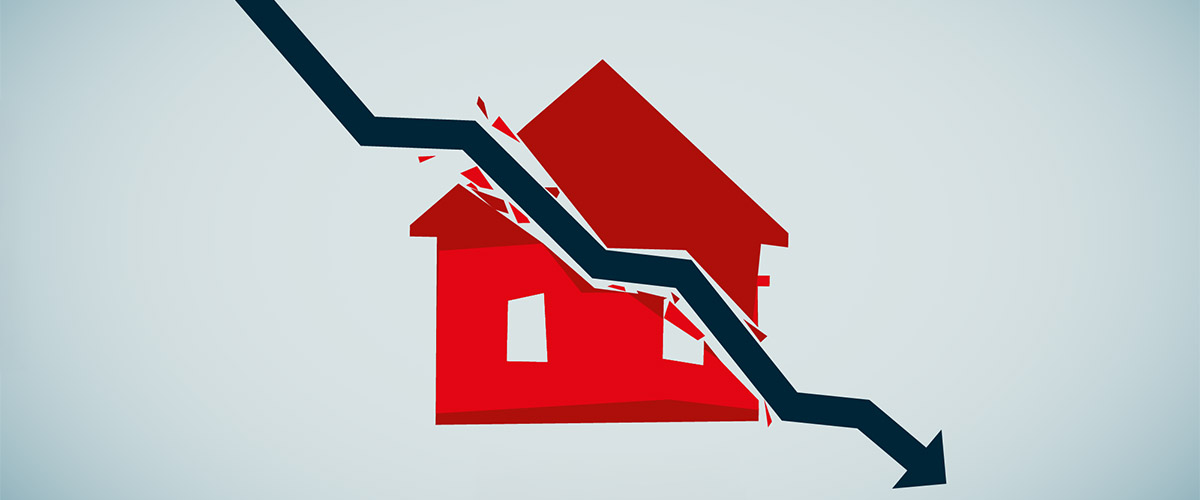
As talk about economic slowdowns runs wild, worries about a potential recession in 2025 are on the rise. Naturally, many homeowners are wondering what a recession could do to the value of their home, and their buying power.
Using historical data from recessions of decades past, let’s see how a recession might affect the housing market in 2025.
It’s a common misconception that a recession will cause home prices to crash, like they did in 2008. In reality, 2008 was the only time the housing market saw such an extreme, dramatic drop in prices. Overflowing home inventory caused that price crash, and conversely, low inventory has prevented a similar crash in the years since.
Even in markets where housing inventory is up, it’s still far below the listing oversupply that caused the 2008 crash. Indeed, according to data from Cotality, home prices actually increased during four of the last six major recessions.
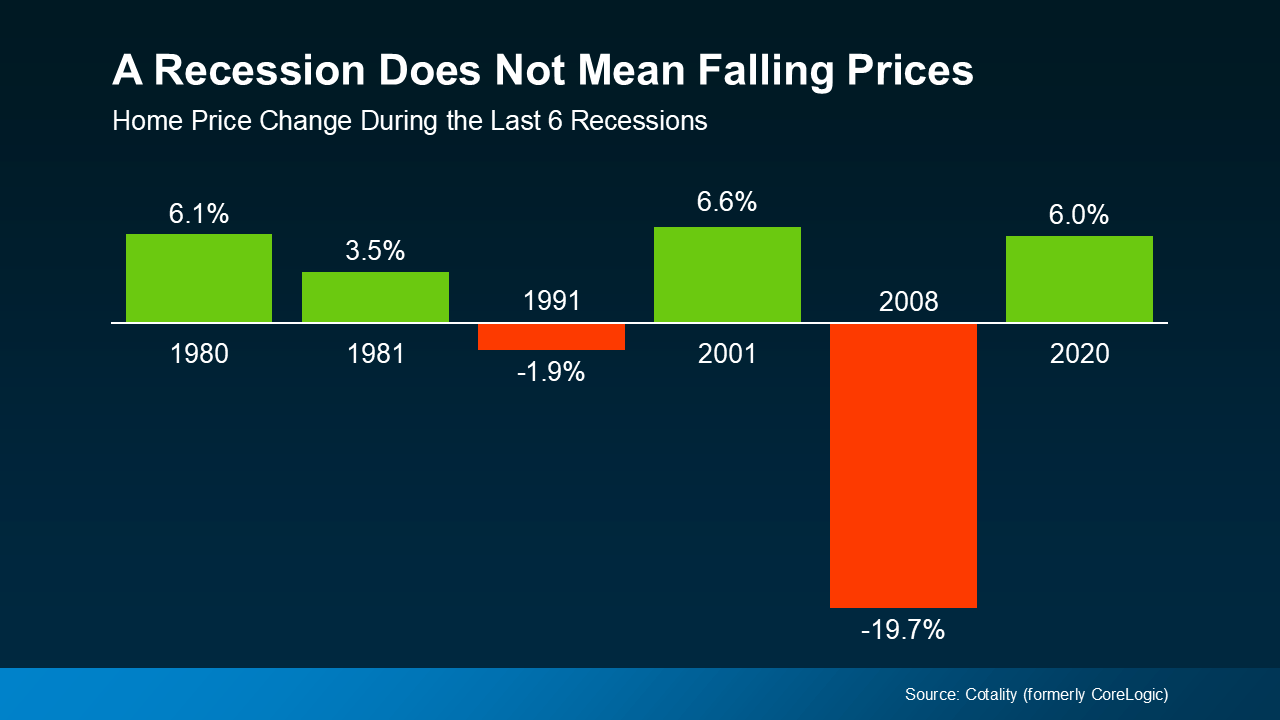
As the graph shows, a recession doesn’t necessarily mean that home prices will crash, or even drop. In reality, historical data shows that home prices usually continue along their current trajectory when a recession hits. And at the moment, home prices are still rising nationally, but at a more normalized rate. So, as the market stands now, a recession in 2025 would most likely drive prices even higher.
Home prices may stay their path during economic slowdowns, but mortgage rates actually tend to drop. Looking again at historical data from the last six recessions, this time from Freddie Mac, mortgage rates fell each time.
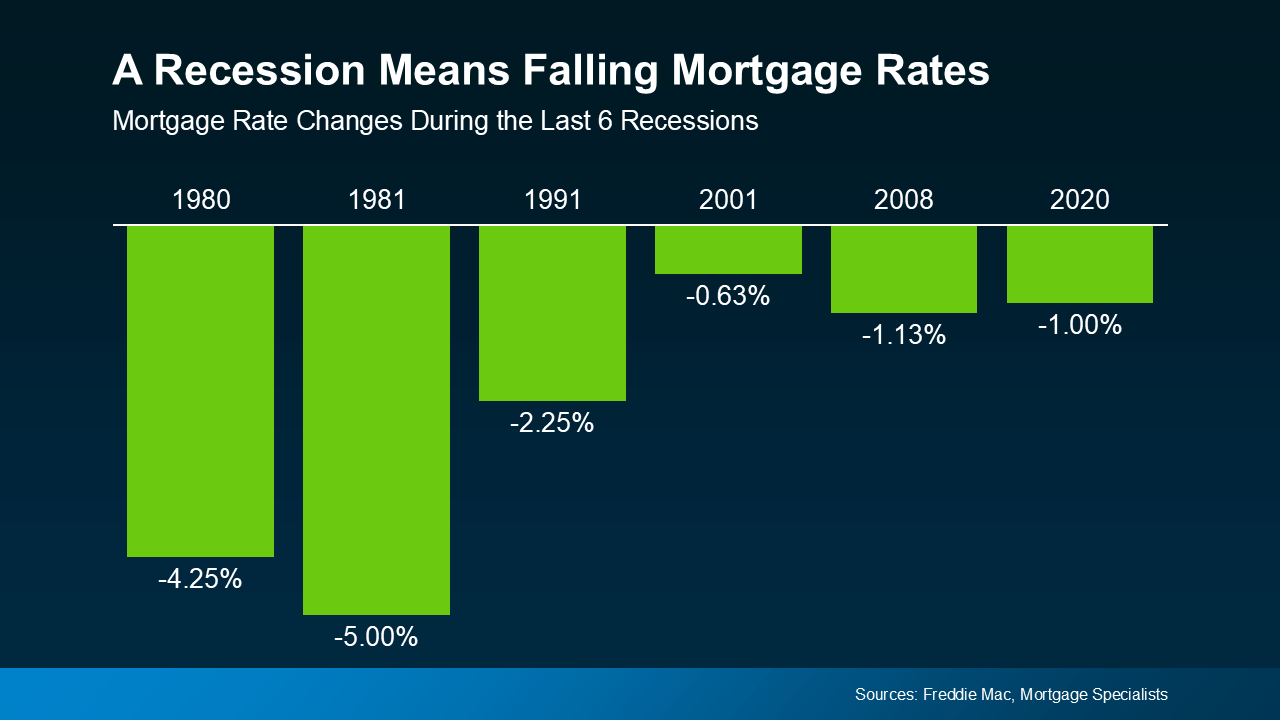
Historically speaking, a recession could mean that mortgage rates may even decline this year. However, the last time a recession dramatically lowered mortgage rates was over three decades ago in 1991. So with that said, even if a recession does happen, don’t expect a game-changing drop in mortgage rates.
Nobody ever truly knows what the economy will do, but the odds of a recession in 2025 have increased. Still, a recession doesn’t mean you need to worry about the housing market or the value of your home. The historical data tells us that a recession may even drive home prices higher and mortgage rates lower.
Wondering how an economic slowdown could impact your local market? Connect with us to get the info you need to plan ahead.

With everyday costs seemingly rising across the board, the state of the housing market is a natural concern. When basic living expenses rise, even critical financial responsibilities like mortgage payments start to slip, leading to increased foreclosures. Unsurprisingly, new data shows filings for foreclosures rose in Q1 2025, stirring worries about another housing crash like in 2008.
But as it turns out, there’s less cause for worry than you might think. When contextualized correctly, it’s clear these new number don’t point to a repeat of the last big housing crash.
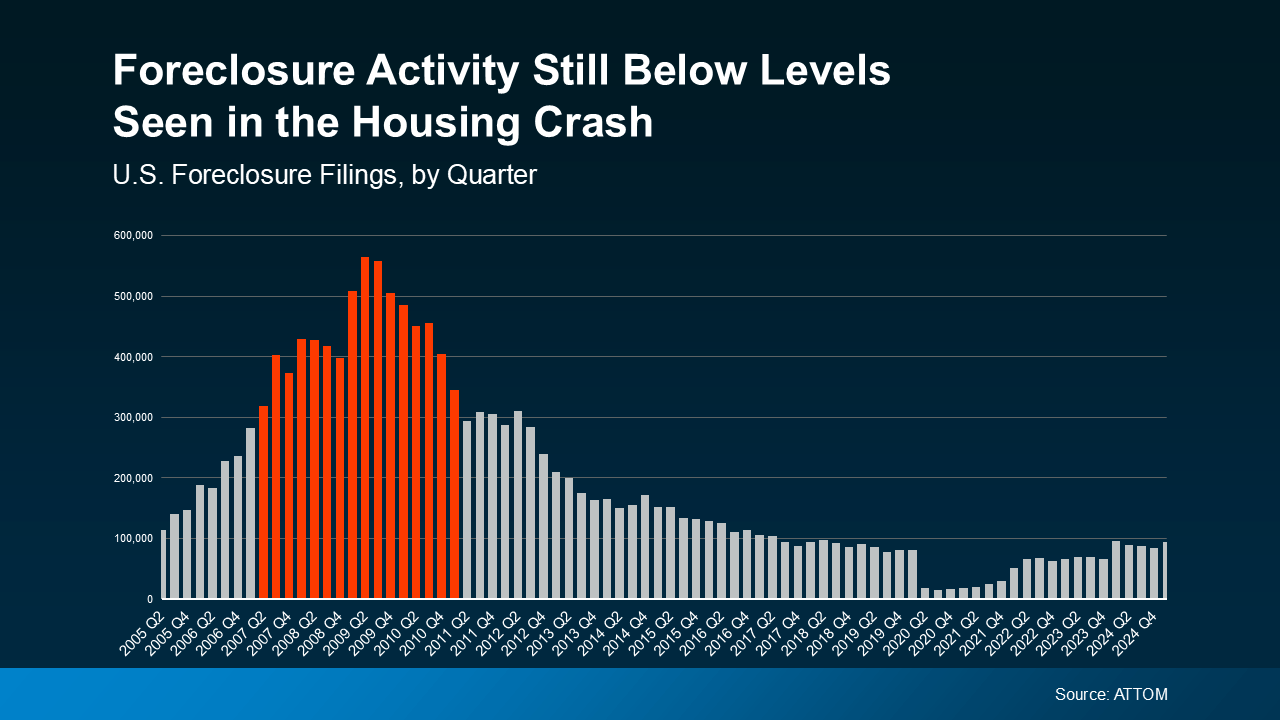
The latest quarterly report from ATTOM shows that foreclosures did rise in Q1 2025, which is concerning at first glance. However, foreclosure filings were still lower than the normal historical average, and far below the levels seen in 2008. When plotted visually, it’s easy to see the huge difference between 2008 and 2025.
Compare the foreclosure filings in Q1 2025 to the years surrounding the 2008 crash on the graph below. Even in the years preceding and following the 2008 crash, foreclosures were dramatically higher than what we’re seeing now.
Back in 2008, lenders were approving loans using much riskier practices, saddling many homeowners with mortgages they couldn’t afford. This flooded the market with distressed properties, surplus housing inventory, and free-falling home prices that collectively caused the crash.
In the years that followed, lending standards became much stricter and stronger to prevent such a crash from happening again. Today, most homeowners are in a much better financial position, and foreclosures have stabilized as a result.
The graph may appear to show foreclosures ramping up since the lows of 2020 and 2021, but this is deceiving. Foreclosures during those years were unusually low thanks to a moratorium designed to help millions of homeowners through the pandemic. That moratorium has since ended, which has caused foreclosure filings to return to the more normal levels we see now.
Compared to pre-pandemic years like 2017-2019, foreclosures overall are actually relatively down from what’s considered normal. So while foreclosures rose in Q1 2025, this doesn’t point to a troubling surge in the market.
Another reassuring difference in today’s real estate market is the power of increased homeowner equity. As home prices have exploded over these past few years, homeowners have enjoyed a welcome boost to their wealth. According to Rob Barber, CEO at ATTOM:
“While levels remain below historical averages, the quarterly growth suggests that some homeowners may be starting to feel the pressure of ongoing economic challenges. However, strong home equity positions in many markets continue to help buffer against a more significant spike . . .”
In short, if a homeowner can’t make their mortgage payments, they may be able to sell their home to avoid foreclosure. During 2008, many people owed more than their homes were worth and had no choice but to foreclose. Today, most homeowners have much stronger equity that protects them from being forced into foreclosing. As Rick Sharga, Founder and CEO of CJ Patrick Company, recently explained in a Forbes article:
“ . . . a significant factor contributing to today’s comparatively low levels of foreclosure activity is that homeowners—including those in foreclosure—possess an unprecedented amount of home equity.”
It’s true that foreclosures rose in Q1 2025, but they’re nowhere near the levels seen during the 2008 crash. Even as home prices continue rising, strong equity is protecting existing homeowners and bolstering their wealth. This doesn’t discount the struggles some homeowners are facing, but it’s a reassuring fact for the market at large.
If you’re a homeowner facing foreclosure, ask your mortgage provider about what options are available to you. Are you a first time buyer eager to build your equity? Contact us today for the info you need to get started.
As we continue navigating a rapidly evolving real estate landscape, I wanted to take a moment each quarter to connect directly with you—our agents, staff, and leadership team—to share what I’m seeing in the market, what it means for our business, and how we can continue moving forward together.
This new quarterly message is meant to offer perspective, spark conversation, and keep us aligned on the bigger picture. Whether you’re helping clients buy and sell every day, or supporting our operations behind the scenes, we’re all part of what makes this company strong, and what makes this company continue to succeed.
Let’s take a look at where things stand today and where I believe we’re headed next.
This is the major question everyone in the industry is asking. With January and February sales numbers coming in weaker than expected—per the latest NAR data—and no significant movement in interest rates, many are beginning to second-guess 2025’s ability to rebound after two consecutive years of significantly low home sales in the U.S.
While I don’t have a crystal ball, we are beginning to see encouraging signs in many local markets. Our internal data shows March’s open business was up year-over-year, and listing inventory is starting to grow. As a company, we remain bullish that the summer of 2025 could be one of the stronger selling seasons we’ve experienced in recent years.

That being said, it may be a long time before we return to the 6 million-plus annual home sales we saw during the boom years of 2020 and 2021. Companies need to continue reinventing themselves in markets like this. The real challenge lies in this: how do we provide outstanding service to consumers and best-in-class support to our agents, all while maintaining an expense structure that allows organizations to thrive?
This is the question we all need to be asking to stay ahead of market trends. Personally, I don’t believe these types of markets are to be feared—but rather embraced. They push us to innovate, to adopt new technologies, and to develop new services that will make our businesses more resilient and better equipped to serve our clients in the long run.
That’s all for now,
Dan

Between low inventory, high home prices, and unpredictable mortgage rates, 2024 was a rocky year for real estate. It should come as no surprise then that 70% of buyers stopped their home search last year. If you were one of them and are still waiting to buy in 2025, this spring could be your time.
Many homeowners who put their move on pause last year are reentering the market this year. This means higher, stronger listing inventory, and with builders finishing more homes, new construction inventory is growing as well. Together, this creates more options for buyers like you, and better chances of finding the home you’ve waited for.
But that’s only part of the story. When you’re selling, you want to feel confident that you’ll find a home you’ll be thrilled to move into. At the same time, you don’t want housing inventory so high that your current house sits on the market. Fortunately, the spring 2025 market is striking a balance between supply and demand that many have waited for.
According to research from Realtor.com, housing inventory has jumped 28.5% year-over-year, making March the 17th straight month of inventory growth. This is still below pre-pandemic levels in most markets, but it’s a sweet spot for anyone waiting to buy.
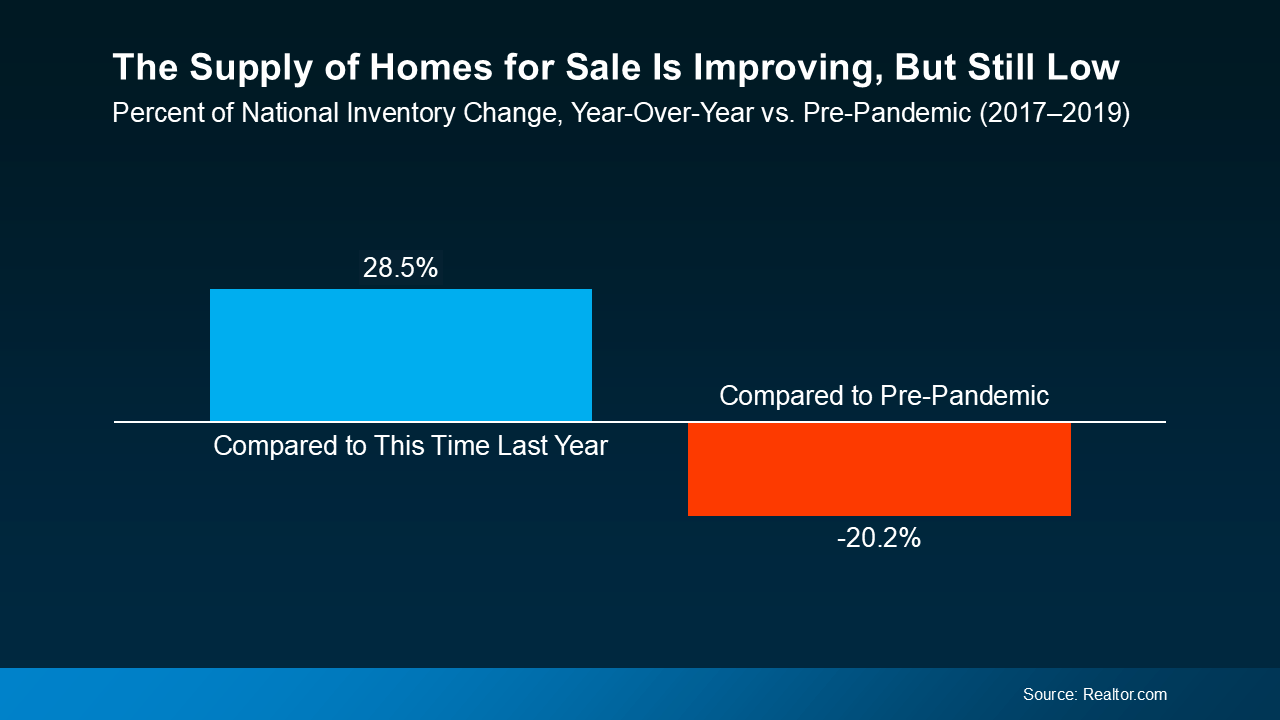
For patient buyers, this means you’ll have more options when moving, but not so many that your current house won’t sell. As long as there’s a healthy demand for homes in your area, your house should still sell relatively quickly. Especially if you work with a local agent to make sure it’s priced right and fixed up to maximize value.
Here’s another promising point to think about. As we said, Realtor.com‘s March 2025 data shows that housing inventory has been rising for 17 consecutive months. What’s better, industry experts agree that listing inventory is likely to continue climbing through 2025. According to Lance Lambert, the Co-Founder of ResiClub:
“The fact that inventory is rising year-over-year . . . strongly suggests that national active housing inventory for sale is likely to end the year higher.”
If this prediction proves correct, this spring may be a better time to sell than you think. Listing now could help your house may stand out more than it would later in the year as inventory grows. With more homeowners reentering the market, waiting too long could make it all the more difficult to stand out.
If you’re one of the many who have been waiting to buy a house this past year, here’s your chance. Housing supply is growing but hasn’t caught up to demand yet, meaning new listings are still getting extra buyer attention. Meanwhile, increasing inventory is giving current homeowners more opportunities to scale up, further driving supply and activating buyers.
For both first time buyers and homeowners waiting to sell, this spring’s market is trending toward an ideal sweet spot. If you have questions keeping you from making your move, reach out to us for answers today. We can get you the info you need, or connect you with an agent to navigate your unique local market.

If you’re waiting for the best time to list your house this year, then wait no longer. Experts have looked at the data, and the best week to list your house in 2025 is almost here.
A recent study from Realtor.com analyzed years of housing market trends and found that April 13–19 is expected to be the best week this year to list your house:
“. . . we’ve identified April 13-19 as the best week to list for sellers . . . a seller listing a well-priced, move-in ready home is likely to find success. Because spring is generally the high season for real estate activity and buyers are more plentiful earlier rather than later in the year, listing earlier in the spring raises a seller’s odds of a successful sale.”
Spring is typically a strong season for sellers and when the housing starts to really take off every year. But according to Realtor.com, this window could be particularly advantageous in 2025 thanks to a few key factors. Here are the biggest influences that make April 13-19 the ideal week for new listings:
Only a couple weeks are left before the year’s prime listing week, but you can still make the deadline. If you’ve been planning to list for a while, a smart plan and quick action can make it happen. This is where working with a great local real estate agent can make all the difference between selling and not. An expert agent can help you:
If your house is already in good repair and condition, your focus should be on quick, value-adding updates. The idea is to eliminate any potential dealbreakers for interested buyers, as Investopedia says:
“You won’t have time for any major renovations, so focus on quick repairs to address things that could deter potential buyers.”
With the April 13-19 window fast approaching, the quicker you can finish these projects, the better. Here are some small projects recommended by Redfin you can do that can make a big difference to interested buyers:
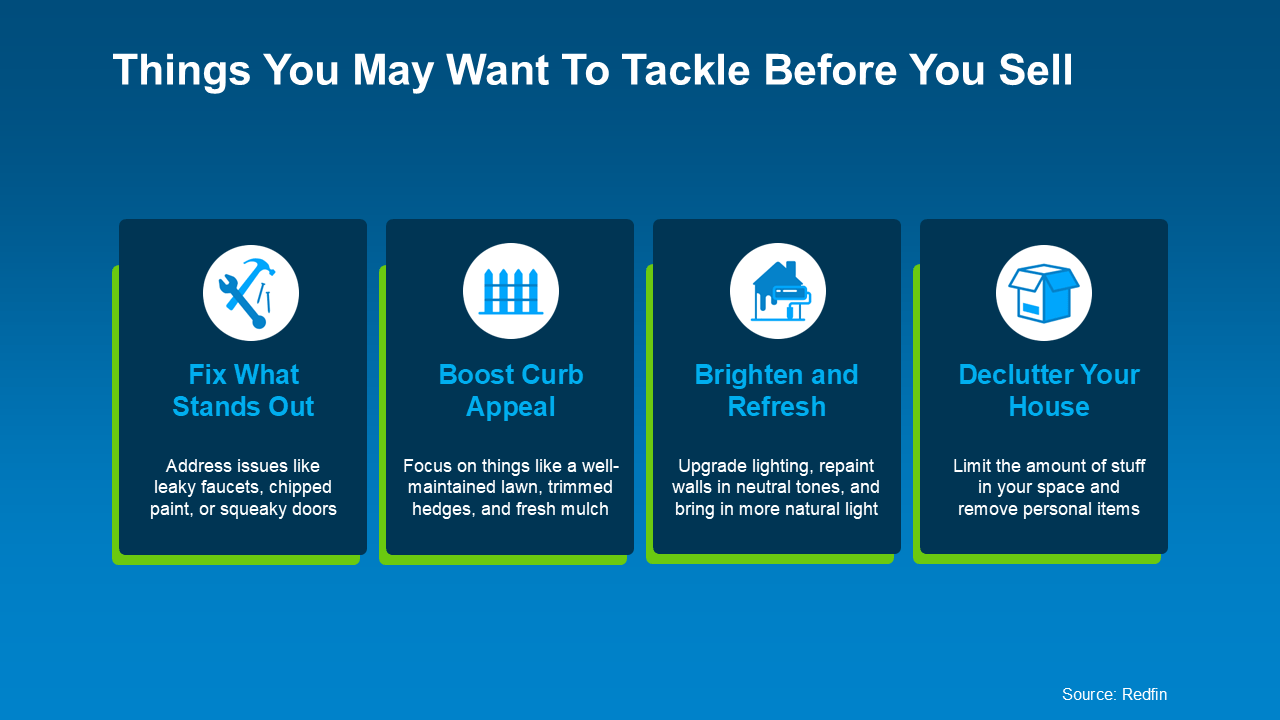
If you don’t think you’ll be ready to list before this windows passes, then don’t worry. Even though Realtor.com expects April 13–19 to be the best time to list, it’s not the only good time to sell. What’s most important is getting your home ready to maximize its attractiveness to buyers when you do decide to list. Even if you list a bit late, there’s still plenty of opportunity before prime homebuying season is over.
If you’ve been waiting for just the right moment to sell, April 13-19 could be the perfect time. Realtor.com projects this as the best time to list your house this year, but there’s a bit more to consider. Making sure your home is fully prepped and priced competitively for your local market can make the difference.
Ready to list but need a real estate agent’s advice and expertise first? Reach out today and we’ll connect you with a local expert who can help you list and sell your home fast.

Spring is in full swing, and the spring 2025 housing market is swinging along with it. Wondering whether now is the right time to finally buy a house or sell your home? Here are four trends you can expect in the market this year, and what they mean for you.
After years of housing shortages nationwide, the number of homes for sale is finally improving. According to recent national data from Realtor.com, active home listings are up 27.5% compared to this time last year. Housing inventory took a tremendous dive in 2020, but at long last, it’s close to reaching pre-pandemic levels this spring.
The graph below shows monthly active listing count for each year dating back to 2017. As you can see, even though inventory levels still haven’t quite returned to pre-pandemic norms, they’ve improved over last year. In fact, they’re almost at 2020 levels, and will likely exceed them this summer if their upward trend continues.
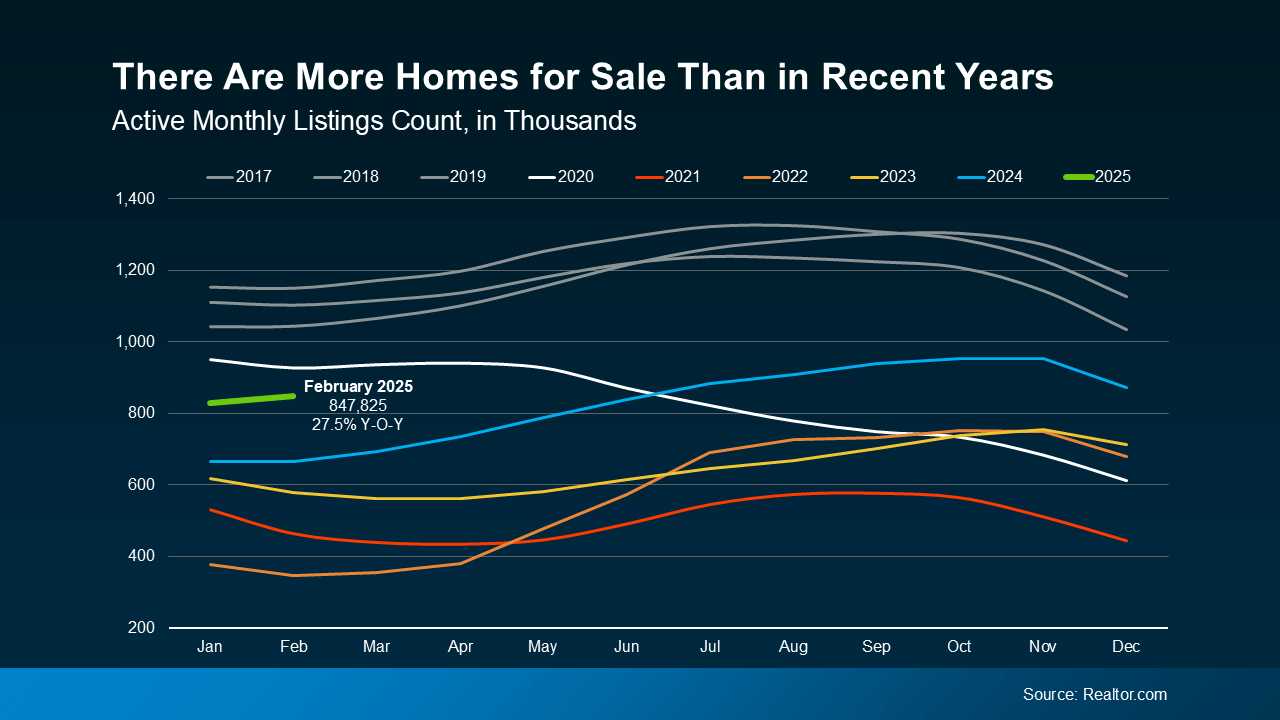
For Buyers: More housing inventory means you have more options and choices. Having options means you can be more selective, and that sellers may be more willing to negotiate with you.
For Sellers: With more homes available, you’re more likely to find the right house to move into. With inventory still below normal levels, your current home will stay in higher demand, at least until home supply normalizes.
As inventory increases, the rate of home price growth is slowing down as prices respond to buyer demand. This will continue through the spring 2025 housing market and beyond into 2026 if the current trend holds steady. With more homes for sale, eager buyers are less pressured to compete for limited inventory. Price growth will continue to slow as supply rises and buyers enjoy more options, but it will generally remain positive. A recent projection from Freddie Mac says:
“In 2025, we expect the pace of house price appreciation to moderate from the levels seen in 2024, while still maintaining a positive trajectory.”
Every housing market is different, so while home prices are rising nationally, this may not be true everywhere. Some markets are actually seeing stronger price growth, while others are slowing or even seeing home prices decline.
For Buyers: Slower home price growth means prices aren’t rising as quickly as before. Still, any home you buy now is likely to appreciate in value over time, helping you build equity.
For Sellers: Home prices are still rising, but you may need to temper your expectations in terms of pricing your home. Pricing too high in a more competitive market could mean your house takes longer to sell. Listing at a price point competitive with your local market is going to become a key factor as prices normalize.
One of the biggest obstacles for buyers – especially new ones – since the pandemic has been higher, less predictable mortgage rates. Fortunately, rates have been slowly stabilizing so far in Q1 of 2025, and have even dropped faster than experts anticipated. These aren’t the 3% rates of 2020, but less volatile rates give buyers more reason to buy with confidence. As Chief Economist at CoreLogic Selma Hepp says:
“With the spring homebuying season upon us, the recent improvements in mortgage rates may help invite homebuyers back into the market.”
For Buyers: When mortgage rates are stable, planning ahead is easier because your future payments are likely to be more predictable. But keep in mind that even though mortgage rates are stabilizing, they’re still far from being completely static. When buying, consult your agent and lender to stay current with rates and how they might affect your plans.
For Sellers: Lower rates starting to stabilize means more buyers are becoming active – especially those who have been patiently waiting. This means increases in housing demand and more potential interested buyers for your house.
With more inventory, slowing price growth, and stabilizing mortgage rates, buyers are gaining confidence and finally reentering the market. Demand is increasing, and recent data from the Mortgage Bankers Association (MBA) shows an uptick in mortgage applications compared to the start of the year.
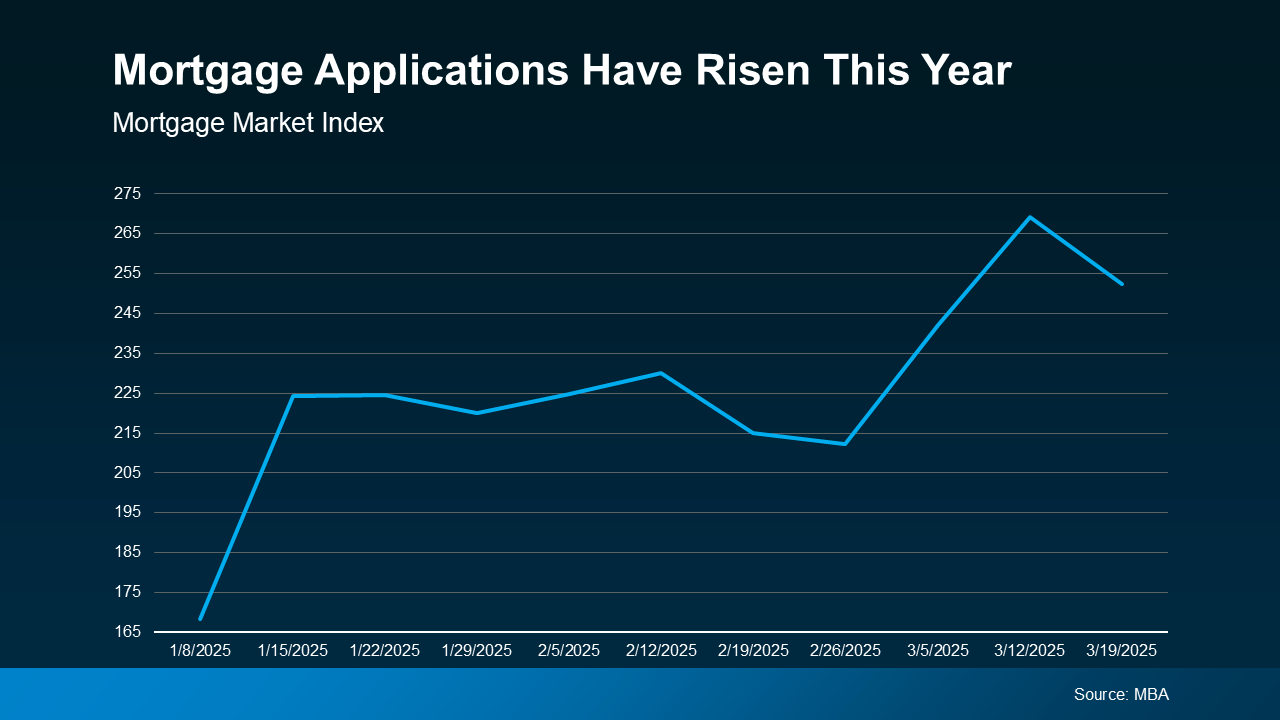
For Buyers: The spring 2025 housing market buying season is quickly heating up. Making your move now and getting a leg up on your competition could be a wise strategy this spring.
For Sellers: Eager buyers wanting to buy a home in the spring or summer are entering the market quickly. Naturally, this is great news for you: more buyers means a better chance of selling your home fast.
Between more homes for sale, slowing price growth, and stabilizing mortgage rates, there’s plenty reason to be positive this spring. Buyers can expect higher housing inventory at more reasonable rates, while sellers can count on a busier market with more activated homebuyers. If you’re wondering how this spring’s trends might affect you, contact us today to get started with an expert agent in your area.

Let’s face it: buying a home can feel like a challenge with today’s mortgage rates. You might even be thinking, “Should I just wait until spring when more homes hit the market and rates might be lower?”
But here’s the thing, no one knows for sure where mortgage rates will go from here, and waiting could mean facing more competition, higher prices, and a lot more stress.
What if Buying a home before spring might actually give you the upper hand? Here are three reasons why that just might be the case.
The winter months tend to be quieter in the real estate market. Fewer people are actively looking for homes, which means you’ll likely face less competition when you make an offer. This makes the process feel less rushed and less stressful.
According to the National Association of Realtors (NAR), homes sit on the market longer in winter compared to spring and summer (see graph below):

Fewer buyers in the market means you’ll likely have more time to make thoughtful decisions. It also means you may have more negotiating power. According to the Alabama Association of Realtors:
“A significant benefit of buying a home in winter is the reduced competition. Because of the perceived benefits of spring, many buyers delay the start of their house hunt. As a result, you will find fewer people competing for the same properties during winter. Less demand can translate into more negotiating power as sellers may be more willing to entertain offers or agree to concessions to get a deal closed quickly.”
With homes staying on the market longer, sellers may be more willing to negotiate. This can lead to better deals for you as a buyer, whether that means a lower price or added incentives, like sellers covering closing costs or making repairs. As Chen Zhao, an Economist at Redfin, points out:
“. . . buying during the off season means less competition from other buyers. That means potentially negotiating a better deal.”
Plus, when demand is lower, sellers often feel more pressure to work with serious buyers. This could give you an edge to negotiate terms that work best for your situation.
3. Lock in Today’s Prices Before They Rise
Historically, home prices tend to be at their lowest point in the winter months, too. According to data from NAR, home prices last year were at their lowest in January, February, and March — right before the spring buying season kicked in (see graph below):
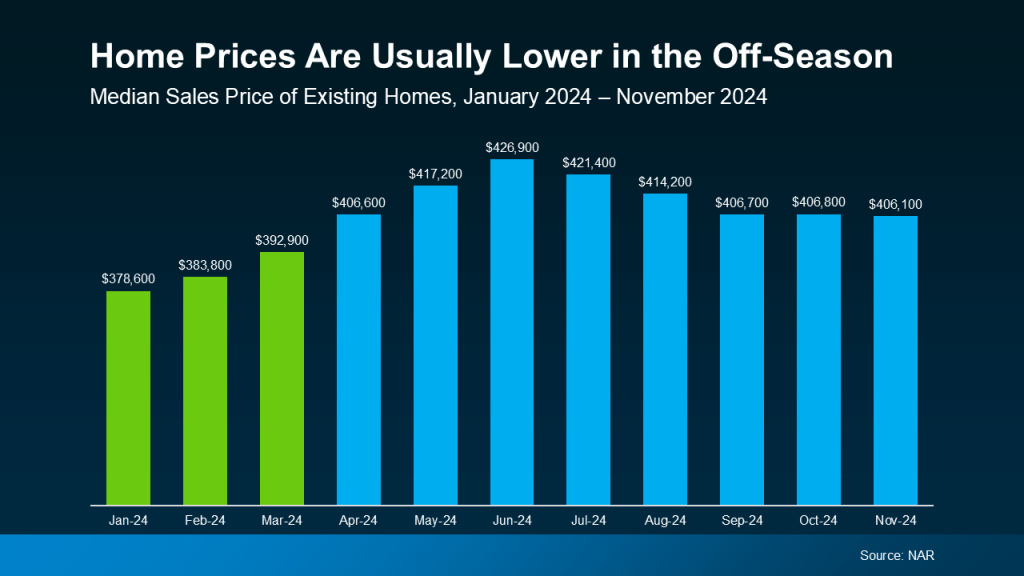
This trend isn’t new — Bright MLS shows between 2010 and 2024, home prices in January and February were, on average, 15% lower than during the month of peak home prices (typically June). Buying in the off-season means you’re more likely to avoid paying the premium prices that come with the high demand of spring.
On top of that, home prices generally appreciate over time, meaning they tend to go up year after year. That means if you’re ready to buy and you can make it happen, you’re not only taking advantage of what might be the lowest prices of the year, but you’re also locking in today’s price before it increases in the future.
While spring may seem like the obvious time to buy, moving before the peak season can give you significant advantages, like less competition, more negotiation power, and lower prices.
Start your home buying journey by visiting our Property Search page.







© 2026 CENTURY 21 Affiliated
©2025 . All rights reserved. CENTURY 21®, the CENTURY 21 Logo and C21® are service marks owned by Century 21 Real Estate LLC. Century 21 Real Estate LLC fully supports the principles of the Fair Housing Act and the Equal Opportunity Act. Each office is independently owned and operated.
This information is deemed reliable but not guaranteed. You should rely on this information only to decide whether or not to further investigate a particular property. BEFORE MAKING ANY OTHER DECISION, YOU SHOULD PERSONALLY INVESTIGATE THE FACTS (e.g. square footage and lot size) with the assistance of an appropriate professional. You may use this information only to identify properties you may be interested in investigating further. All uses except for personal, noncommercial use in accordance with the foregoing purpose are prohibited. Redistribution or copying of this information, any photographs or video tours is strictly prohibited. This information is derived from the Internet Data Exchange (IDX) service provided by San Diego MLS. Displayed property listings may be held by a brokerage firm other than the broker and/or agent responsible for this display. The information and any photographs and video tours and the compilation from which they are derived is protected by copyright. Compilation © 2025 San Diego MLS.
Contact Information: CENTURY 21 Affiliated • Nikki Coppa • CA Department of Real Estate - CA DRE #01897784 • 2020 CAMINO DEL RIO NORTH #800, SAN DIEGO, CA 92108 • (619) 471-2000
