Facebook
 X
X
 Pinterest
 Copy Link
4 Ways To Make Your Home Offer Stand Out This Spring

If you’re planning to buy a home this spring, you may have more options than buyers have had in recent years. Home inventory has improved in many markets, and some sellers are more willing to negotiate than they were during the peak of the market.
But that doesn’t mean every homebuyer has an easy path forward.
In popular neighborhoods or areas where there still aren’t enough homes for sale, competition can pick up quickly. And spring is traditionally one of the busiest seasons for real estate, as many buyers hope to move before summer or get settled before the next school year begins.
That’s why making a strong, thoughtful offer still matters. Even in a more balanced market, the right strategy can help your offer stand out when you find a home you love.
Why Strong Offers Still Matter This Spring
Spring often brings more buyers into the market. Experts at Zillow and Realtor.com often say it’s one of the busiest times of year to purchase a home.
More activity can mean more competition, especially for homes that are priced well, located in desirable areas, or move-in ready. So while buyers may have more leverage than they did a few years ago, local market conditions still play a major role.
Here are four ways to give your offer an edge this spring.
1. Start with a Strong and Realistic Offer
It’s always tempting to make a low offer and hope the seller negotiates. In some markets, that approach may work. But if a home is getting a lot of attention, starting too low could cause the seller to move on to another buyer.
Instead, focus on making an offer that is competitive, realistic, and aligned with your local market.
As Bankrate explains:
“There is no magic formula for an optimal home offer. Any offer will be heavily dependent on asking price and local market conditions . . . Your real estate agent will know the local market well and can advise what a competitive — but fair — offer will look like in your area.”
A strong offer doesn’t always mean offering far above asking price. Most times, it means understanding the home’s value, the seller’s position, and how quickly similar homes are selling nearby.
2. Strategize for Multiple Competing Offers
If you find a home that checks all the boxes, another buyer likely feels the same way. That’s why it helps to talk with your agent ahead of time about what you’re willing to do if multiple offers come in.
One option your agent may discuss is an escalation clause. Investopedia defines it this way:
“An escalation clause is a way to automatically escalate your bid by a certain dollar amount, up to a certain ceiling, to compete with other bids.”
This strategy can help you stay competitive without going beyond your comfort zone. The key is setting a clear maximum price before emotions take over.
Still, there are potential risks to understand and keep in mind. If the home appraises for less than your offer price, you may need to cover the difference out of pocket. Your agent can help you decide whether an escalation clause makes sense for your budget and your market.
3. Keep Your Offer as Clean as Possible
Price is important, but it isn’t the only thing sellers consider. The terms of your offer can also make a big difference.
A clean offer is one that feels simple, straightforward, and easy for the seller to accept. That may mean limiting unnecessary requests, being thoughtful about contingencies, or avoiding terms that could make the transaction feel complicated.
As Redfin says:
“Sellers tend to want clean, straightforward offers with minimal strings attached. Keep your requests simple and focus on the essentials.”
This means working with your agent to decide which terms matter most and where you may have flexibility. The trick is to strike a balance, making an attractive offer without giving up important protections.
4. Be Flexible When It Helps the Seller
Sometimes the strongest offer is about more than price. In some cases, there are things that matter to the seller beyond simple dollar amount.
As NerdWallet explains:
“As you prepare an offer, you tend to focus on what the seller has (a house) and what you want (their house). But you’ll gain a competitive edge by viewing the transaction from the seller’s eyes: What does the seller want?”
For example, does the seller need extra time to move? Are they hoping for a quick closing? Would a flexible possession date make the offer more appealing?
Your agent can communicate with the seller’s agent to better understand what matters most. When you can align your offer with the seller’s priorities, you may have a big advantage over buyers who only focus on price.
Bottom Line: The Right Offer Strategy Can Help You Win
Today’s housing market may offer buyers more breathing room, but strong offers still matter, especially during the busy spring season.
If you’re getting ready to buy, work with a trusted local real estate agent who understands your market. The right strategy can help you move quickly, make a competitive offer, and feel confident when the right home comes along.
Do You Need 20% Down? Most First-Time Buyers Pay Less

If you’ve been waiting to buy a home because you think you need a 20% down payment, you’re not alone. According to Google Trends, searches for house down payment information recently reached a new high, which shows just how many buyers are trying to understand what it really takes to get started.
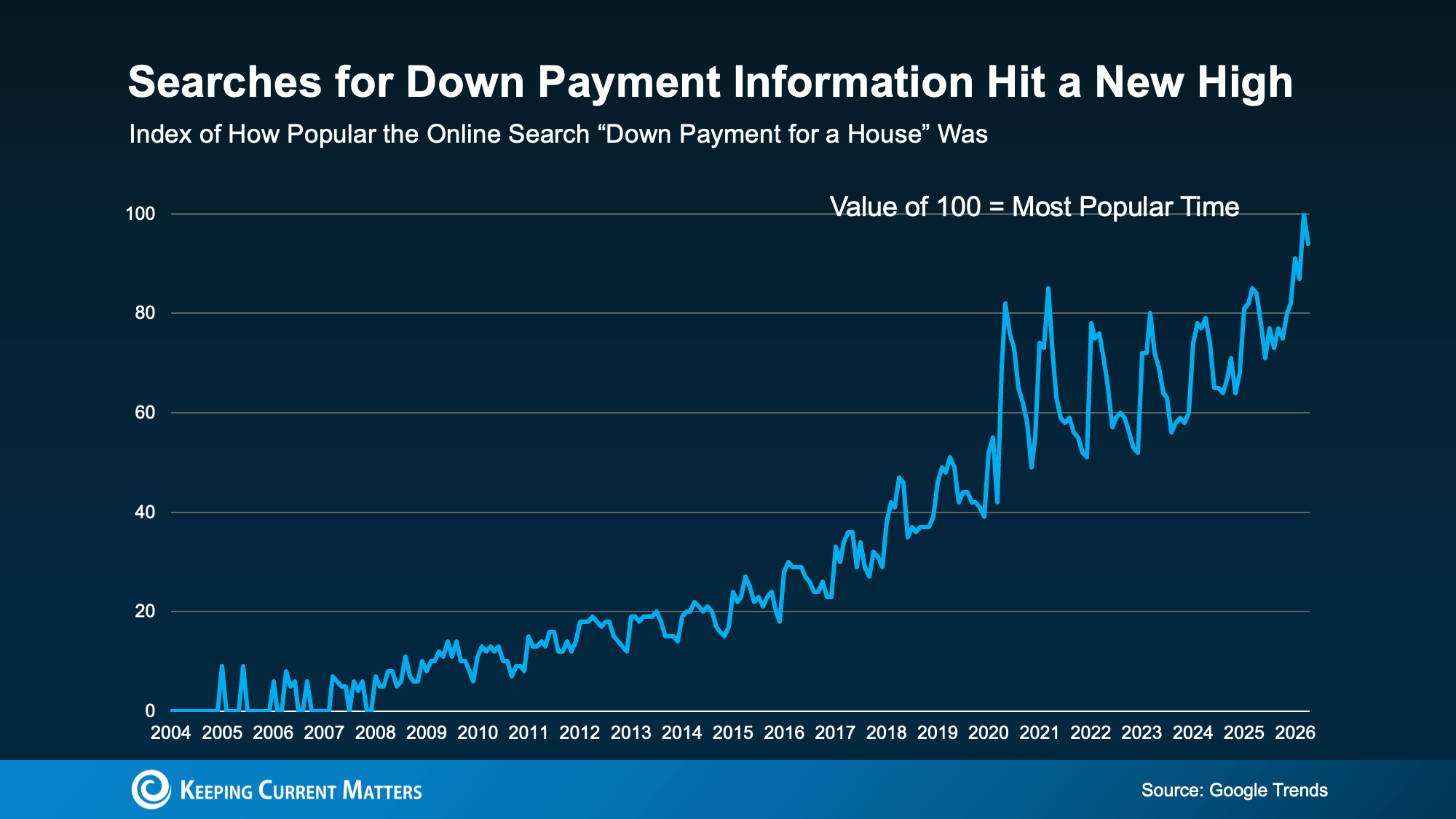
The good news is that 20% down can be helpful, but it usually isn’t required. For many first-time homebuyers, the path to homeownership starts with a smaller down payment, the right loan program, and possibly even down payment assistance.
The 20% Down Payment Homebuying Myth
The idea that you must put 20% down to buy a home is one of the most common misconceptions in real estate. It’s easy to see why the myth sticks. A larger down payment can lower your monthly mortgage payment, reduce the amount you finance, and in some cases help you avoid private mortgage insurance.
But that doesn’t mean 20% is the minimum needed to buy a home.
Unless your lender specifically requires it, you may have options that call for far less money upfront. As The Mortgage Reports explains:
“The amount you need to put down will depend on a variety of factors, including the loan type and your financial goals. If you don’t have a large down payment saved up, don’t worry—there are plenty of options available, and you don’t need to put down the traditional 20% . . . many homebuyers are able to secure a home with as little as 3% or even no down payment at all . . .”
For instance, FHA loans allow down payments as low as 3.5%. VA loans and USDA loans may offer zero down payment options for qualified buyers, including eligible Veterans and buyers purchasing in qualifying areas.
Saving for 20% can take longer than many buyers expect. If you’re delaying your plans only because you believe 20% down is a hard requirement, you may be waiting extra long to buy.
What First-Time Homebuyers Are Actually Putting Down
But if most first-time buyers aren’t putting down 20%, what are they putting down?
According to the National Association of Realtors (NAR), the median down payment for first-time homebuyers is 10%. That’s half of the 20% many people assume they need.
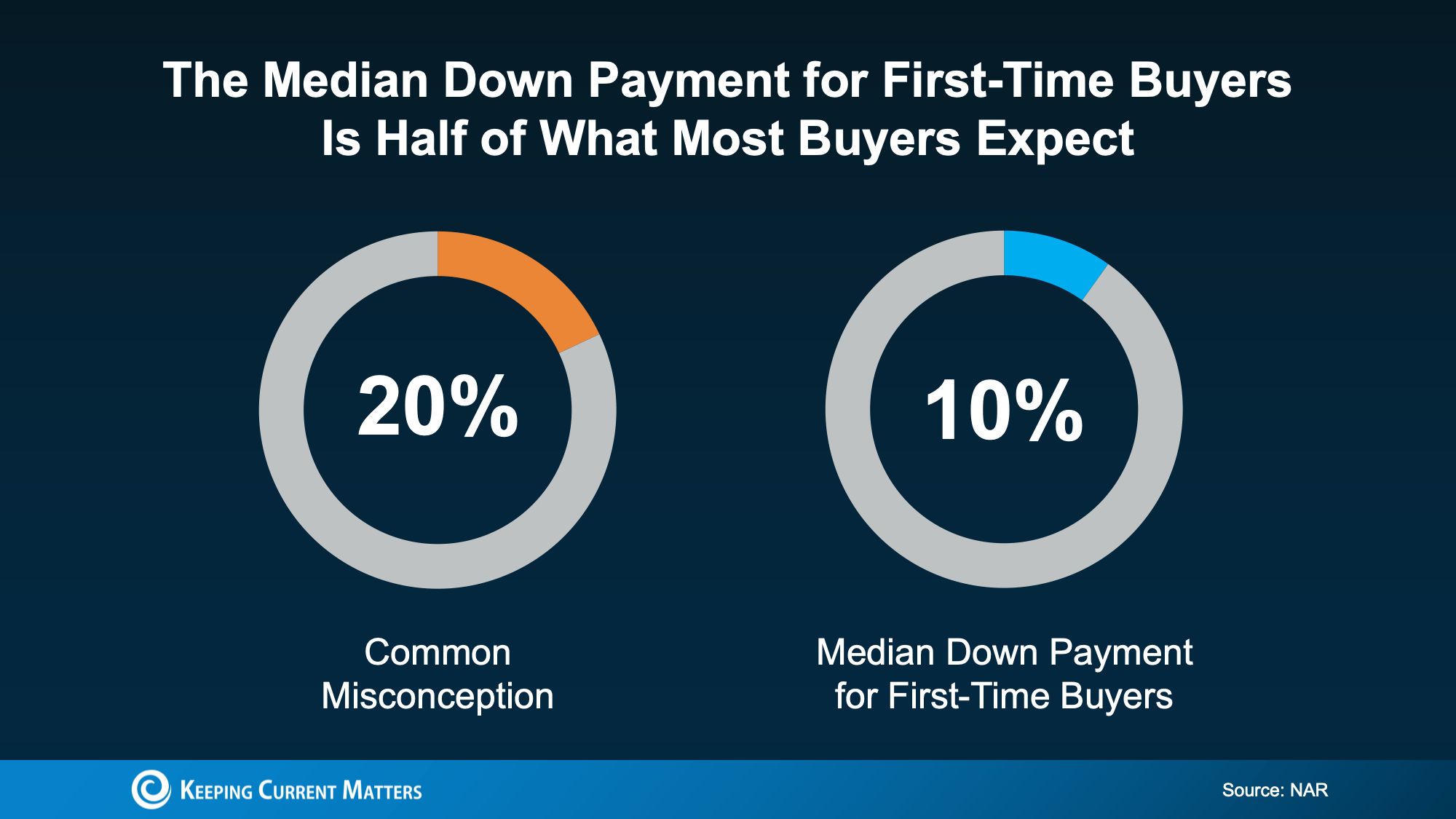
This doesn’t mean 10% is the right amount for every buyer. Your ideal down payment depends on your credit, income, loan type, home price, monthly payment goals, and how much cash you want to keep available after closing.
But it does show that first-time buyers are finding ways to purchase without waiting until they have 20% saved. And for some buyers, the number may be even lower depending on the loan program they use.
Down Payment Assistance Could Help You Buy Sooner
There’s another reason the 20% myth can hold buyers back: many people don’t realize how much help may be available.
Down payment assistance programs are designed to help qualified buyers cover part of their upfront costs. These programs may come in the form of grants, forgivable loans, low- or no-interest second loans, tax credits, or other forms of support. Eligibility can vary based on income, location, property type, profession, or whether you complete a homebuyer education course.
Research from Realtor.com found almost 80% of first-time homebuyers qualify for down payment assistance (DPA), but only 13% take advantage.
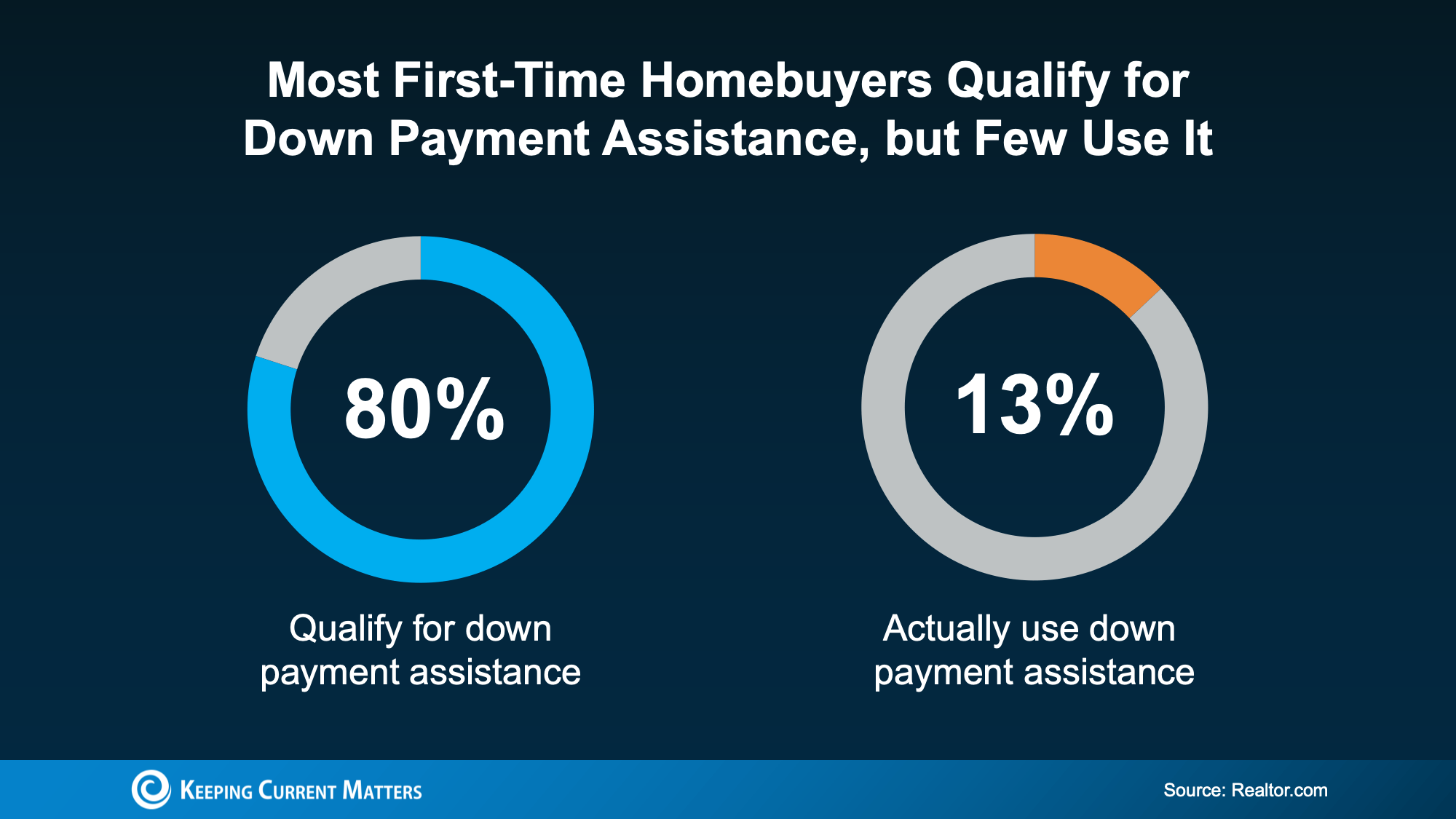
That gap is important. It means many would-be buyers may be leaving valuable assistance on the table simply because they don’t know what programs exist or how to apply.
In the U.S., there are more than 2,600 homeownership programs available, and many provide meaningful financial support. As Down Payment Resource explains:
“With an average benefit of $18,000, down payment assistance (DPA) remains one of the most essential tools for addressing the nation’s affordability challenges. Programs continue to expand in scope, serving a broader range of incomes, property types and borrower needs, including first-generation, military and repeat buyers.”
For some buyers, that kind of assistance could make a major difference. It may help cover part of the down payment, reduce closing costs, or make it easier to keep emergency savings intact after the purchase. In some cases, buyers may even be able to combine multiple programs for additional support.
The Bottom Line: Explore Your Options
Most first-time homebuyers do not put 20% down, and you may not need to either. While saving is important, the real question is whether you know which loan programs and assistance options fit your situation.
Before you rule out buying, connect with a trusted lender and a knowledgeable real estate professional. They can help you understand what you really need to save, what programs you may qualify for, and whether homeownership could be closer than you think.
3 Things That Aren’t Going To Happen in Today’s Housing Market

There’s no shortage of uncertainty in today’s housing market, and that’s naturally fueling a lot of dramatic headlines. And if you’re trying to buy a home, that kind of noise can make your decision feel a lot more complicated.
In fact, a recent CNBC study asked homebuyers what they’re most concerned about, and the same three topics kept rising to the top:
- Mortgage rates
- The number of homes for sale
- Home prices
The challenge is that much of what people are hearing about these topics is driven by misconceptions, not facts. Let’s separate the headlines from what the data is really showing.
Misconception #1: “I Should Wait Because Mortgage Rates Are Going To Fall Dramatically”
One of the most common ideas circulating on social media is that mortgage rates are about to drop sharply, so waiting to buy is the smarter move.
But is that what experts are expecting?
While mortgage rates have eased a little in recent weeks, forecasts still aren’t predicting any major declines. It’s more likely that rates will stay in the low 6% range this year.
And that’s not a remarkable shift from the rates we’re seeing today:
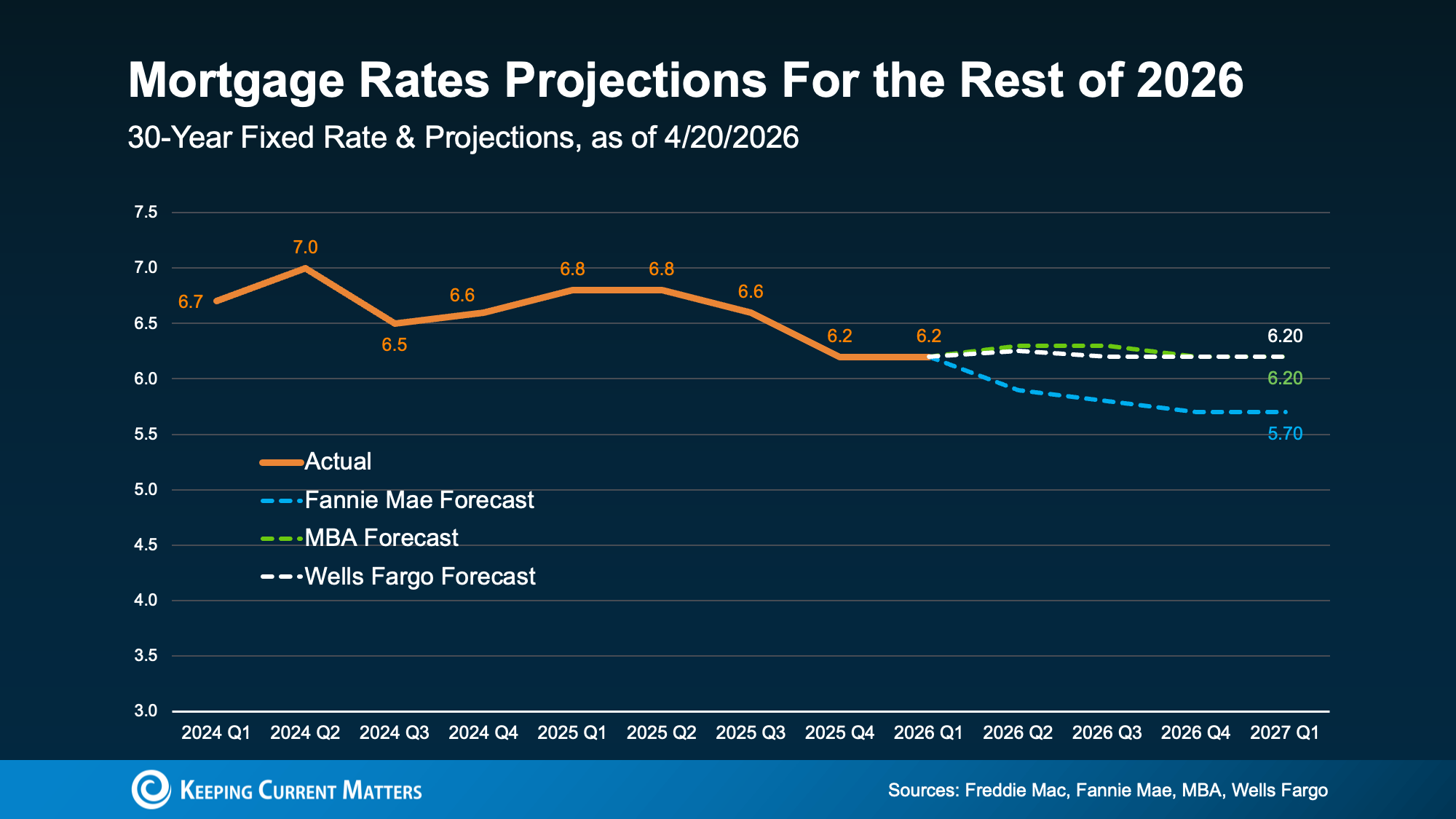
Obviously, a lot depends on inflation and the broader economy. But based on what we know right now, waiting for a big drop in mortgage rates may not play out the way many buyers hope. As U.S. News explains:
“Mortgage rates aren’t expected to change much over the next several quarters . . .”
And even with rates where they are today, buying a home is already more affordable than it was a year ago. Even if rates don’t drop in the near future, home affordability is better now than a year ago.
Misconception #2: “There Are Too Many Homes for Sale”
You may have heard that housing inventory is rising. Nationally, that’s true: the number of homes for sale is 8% higher than it was at this time last year. But that’s not bad news. In lots of markets, it’s easing the pressure on buyers.
The problem is that some headlines make good news sound like bad news. They focus on the fact that inventory is at its highest level since 2019 or highlight how many new homes builders are adding. That can make it sound like supply is growing too much, too fast.
But the bigger picture tells a different story.
According to new Realtor.com data, even though inventory is up over last year, it’s still nearly 14% lower than it was in the last normal housing market from 2017 to 2019:
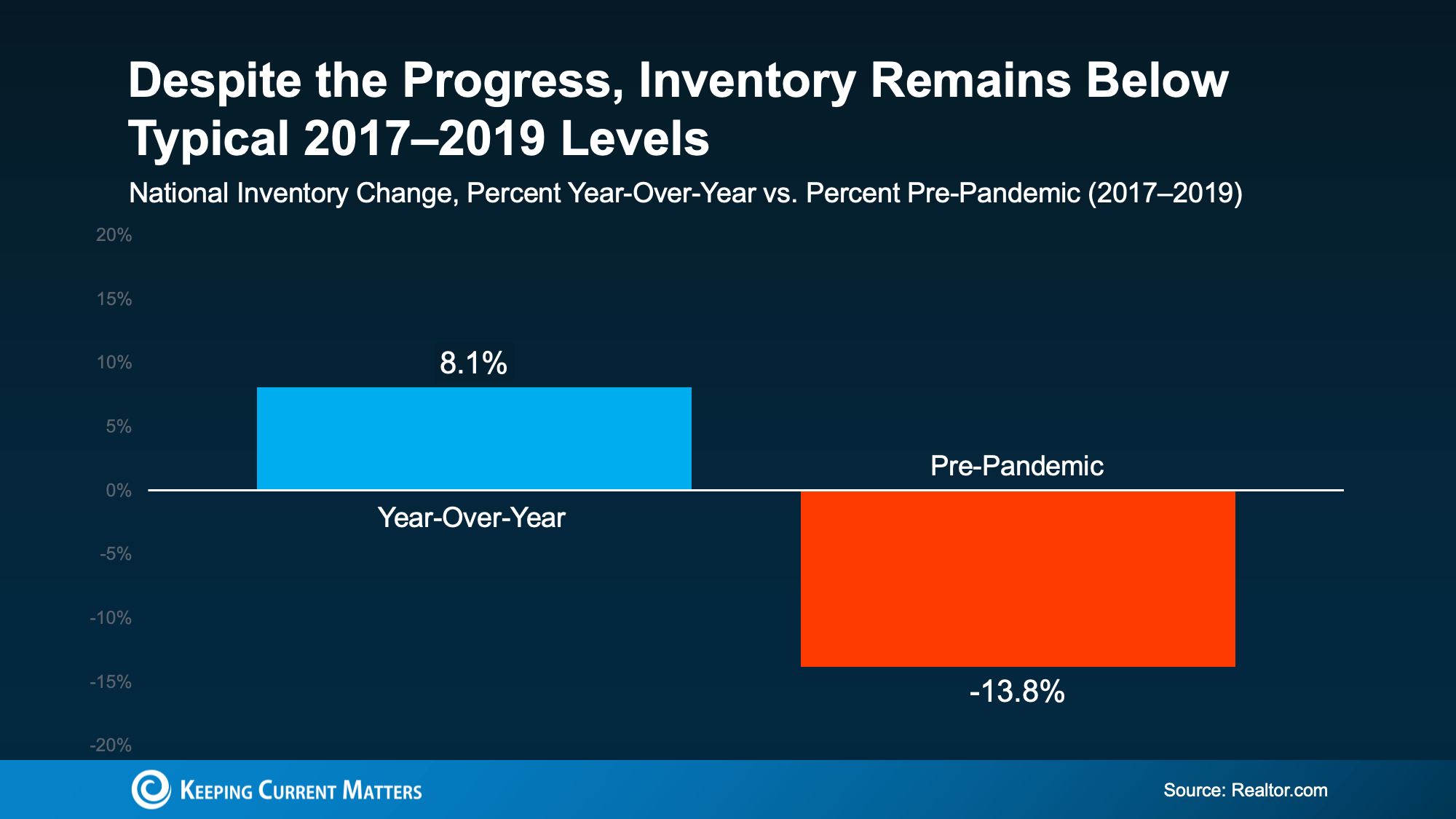
And while local conditions vary, only 9 states have more inventory now than they did before the pandemic. That’s a major reason there aren’t enough homes for sale to trigger anything like the 2008 housing crash.
Misconception #3: “Home Prices Are About To Crash”
This is another common headline you’ve probably seen. This misconception comes from the fact that a few metros are actually seeing small price declines. Influencers are pointing to this to claim home prices are crashing. But this is absolutely not true nationally.
In most markets, home prices are still rising, not falling. Here’s why:
- Many homeowners are choosing not to sell to avoid giving up the low mortgage rate they locked in a few years ago. That continues to limit how much inventory can grow.
- Inventory remains below pre-pandemic norms. There still aren’t enough homes for sale to cause a widespread price crash.
- Even in markets with more listings, some sellers are pulling their homes off the market instead of making major price cuts.
Those are three big reasons home prices are not on track for a crash.
And even in the areas seeing small price declines, those drops are nowhere near enough to erase the huge gains most homeowners have built over the past five years:
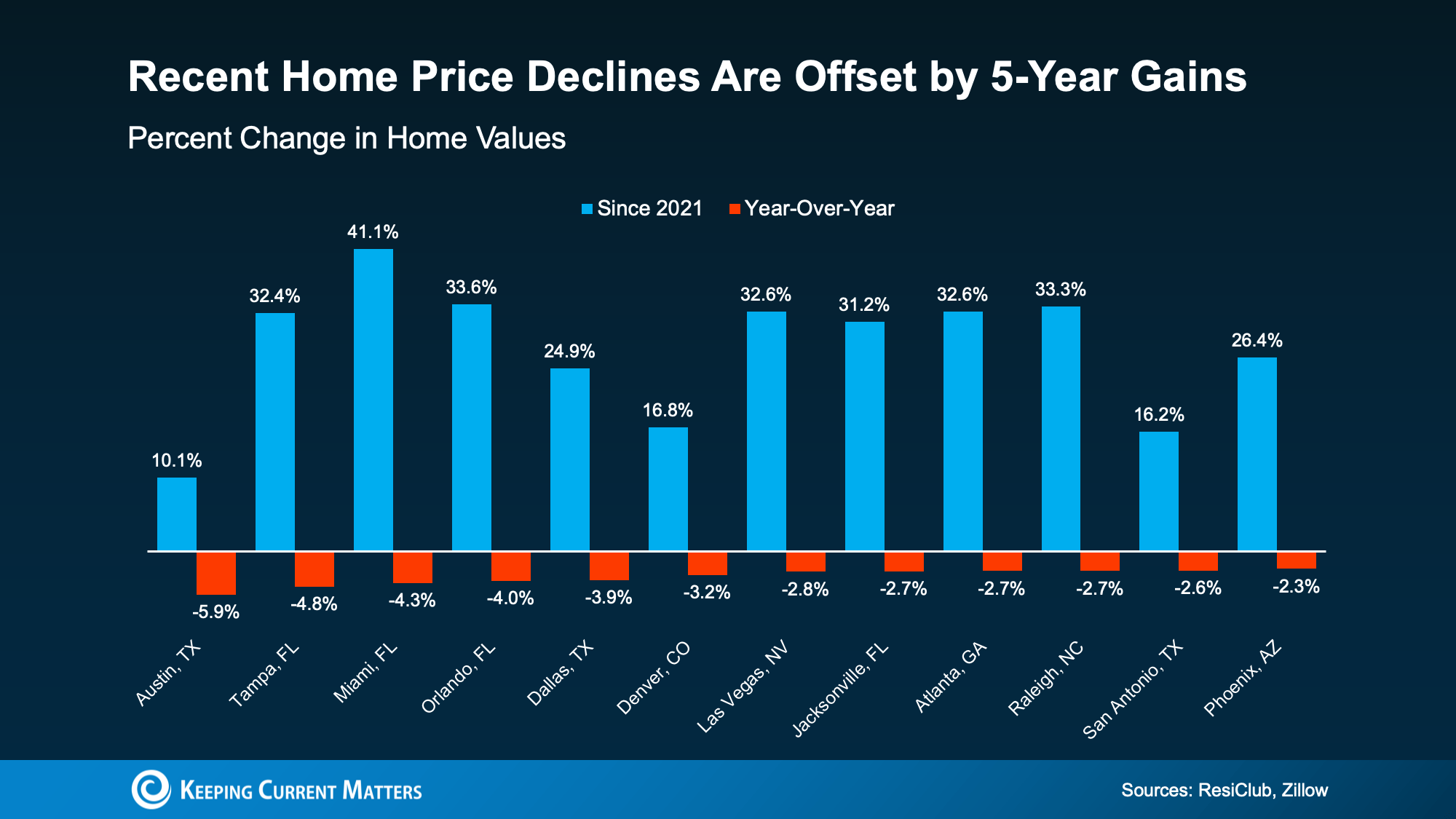
These drops don’t signal a crash. They show the market settling after a few years of record-breaking spikes in prices.
Bottom Line: Get the Facts on Your Market
The discussions we see online can often exaggerate the negative and ignore the positive, especially in housing. If you want a clearer, truer idea of what’s happening with mortgage rates, housing inventory, and home prices in your market, talk to a trusted real estate professional.
Connect with a local real estate agent so you have an expert who can give you the real story on your local housing market.
Top 10 Best Housing Markets for First-Time Home Buyers This Spring

For many hopeful buyers, purchasing a first home has lately felt less like a goal and more like a long shot.
Not because you weren’t financially responsible. Not because you weren’t ready to make a move. But because, every time you checked the numbers, homeownership still didn’t feel realistic.
That’s why so many first-time buyers have put their plans on hold.
Now, after years of watching from the sidelines, this spring may finally bring new opportunities. Especially in certain housing markets where affordability and inventory are starting to improve.
The 10 Best Markets for First-Time Buyers
Zillow recently released its list of the top 50 metro areas for first-time home buyers this spring, and the top 10 housing markets stand out for good reason.
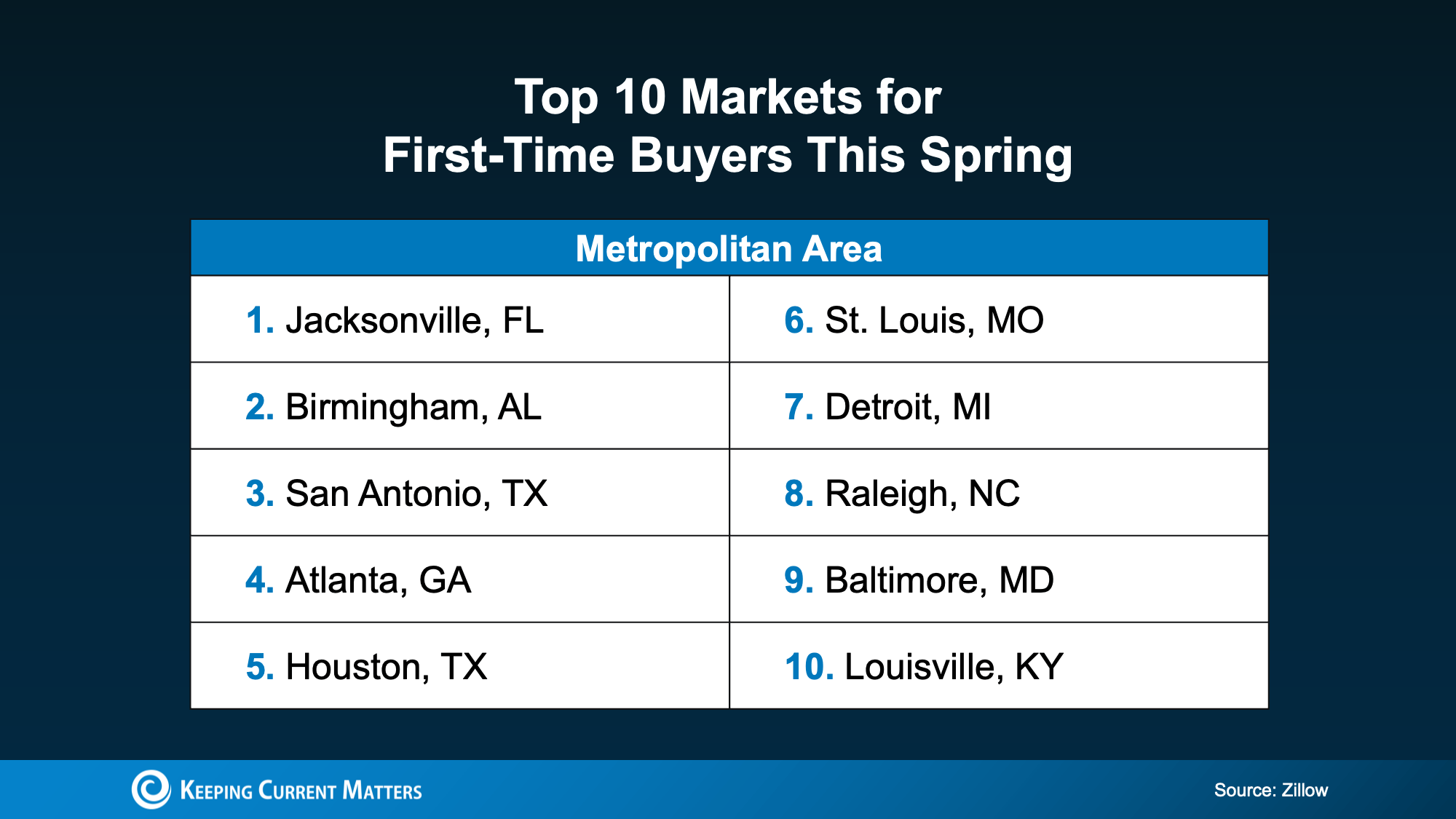
Here are Zillow’s top 10 best markets for new buyers in 2026:
- Jacksonville, FL
- Birmingham, AL
- San Antonio, TX
- Atlanta, GA
- Houston, TX
- St. Louis, MO
- Detroit, MI
- Raleigh, NC
- Baltimore, MD
- Louisville, KY
In these higher-ranked metros, Zillow says median-income households can afford 68% of all homes currently for sale.
This is a major shift, and one that could give buyers real options in some areas.
Not long ago, many buyers felt lucky to find even a few homes within reach. Today, in some markets, there are finally more realistic options for first-time buyers trying to break into the market.
What Makes These Housing Markets Stand Out?
These markets aren’t becoming more favorable for any single reason. Rather, several smaller trends are beginning to work together.
As Orphe Divounguy, Senior Economist at Zillow, explains:
“First-time buyers are finally seeing some light at the end of the tunnel. Affordability is still a challenge, but rising incomes, stabilizing prices and improving inventory are creating real opportunities in parts of the country. In the strongest markets for first-time buyers, they’ll find more choices, less competition and a clearer path to homeownership than they’ve had in years.”
That shift comes down to three key factors:
1. More Homes Are Coming to Market
According to Realtor.com, housing inventory is up 8.1% compared to last year.
More homes for sale means buyers have more choices. It can also reduce the pressure that comes with low-inventory markets, where bidding wars and quick decisions often make it harder for new buyers to compete.
2. Home Price Growth Is Slowing
While affordability is still a challenge in many areas, home prices aren’t rising as quickly as they were in recent years.
Slower price growth can help keep more homes within reach, and in some markets, prices may even be easing enough to bring new neighborhoods back into play.
3. Incomes Are Rising
Wage growth is also helping improve the picture for buyers.
When household income increases, it can offset part of the affordability challenge, even when mortgage rates remain elevated. As Mark Fleming, Chief Economist at First American, explains:
“Income growth has outpaced house price growth for 19 straight months, boosting house-buying power even as mortgage rates remain elevated.”
Taken together, these trends are creating better conditions for new buyers in select markets across the country.
What If Your Market Didn’t Make the List?
If your city did not make Zillow’s top 10, or even the top 50, there’s no reason to worry. You’re not out of options.
Opportunities exist in any market. The key is knowing where to look and having the right guidance along the way.
Even within the same metro area, one buyer’s experience can be very different from another’s. A lot depends on local knowledge and strategy. The right real estate agent can help you identify overlooked opportunities, such as:
- Neighborhoods where prices have not climbed as fast.
- Areas with more available inventory.
- New construction communities offering builder incentives.
These kinds of opportunities may not make national headlines, but they can make a meaningful difference when trying to buy your first home.
Bottom Line: More Options for First-Time Home Buyers
For a long time, first-time home buyers have felt stuck, waiting for the market to shift in their favor.
This spring, that may finally be happening in certain markets.
With more inventory, slower price growth, and rising incomes, buying a first home may feel more realistic than it has in years. And even if your market isn’t on Zillow’s list, there may still be neighborhoods or communities nearby offering a better chance to get started.
If you want to find out where those opportunities exist in your local market, connect with a trusted real estate agent who knows where to look.
Is an Adjustable-Rate Mortgage Right for You? A Homebuyer’s Guide

If you’ve been shopping for a home lately, you’ve likely felt the pressure of today’s affordability challenges. Higher home prices and mortgage rates have made it harder for many buyers to stay within budget. That’s one reason adjustable-rate mortgages, or ARMs, are getting more attention again.
For some homebuyers, an ARM can offer welcome savings upfront. But before you go that route, it’s important to understand how these loans work, why they appeal to certain buyers, and what the long-term risks might be.
What Is an Adjustable-Rate Mortgage?
An adjustable-rate mortgage is a home loan that starts with a fixed interest rate for a set number of years. After that initial period ends, the rate can adjust at scheduled intervals based on market conditions.
As Business Insider explains:
“With a fixed-rate mortgage, your interest rate remains the same for the entire time you have the loan. This keeps your monthly payment the same for years . . . adjustable-rate mortgages work differently. You’ll start off with the same rate for a few years, but after that, your rate can change periodically. This means that if average rates have gone up, your mortgage payment will increase. If they’ve gone down, your payment will decrease.”
That’s the biggest difference between a fixed-rate mortgage and an ARM. A fixed-rate loan offers predictability, while an ARM may give you a lower payment at first but less certainty later.
It’s true that costs like property taxes and homeowners insurance can still change with a fixed-rate mortgage. But the principal and interest portion of the payment generally stays steady. With an ARM, your monthly payment can rise or fall once the fixed period ends.
Why More Home Buyers Are Considering ARMs
The main reason buyers look at adjustable-rate mortgages is simple: lower initial costs.
Business Insider puts it this way:
“Because ARM rates are typically lower than fixed mortgage rates, they can help buyers find affordability when rates are high. With a lower ARM rate, you can get a smaller monthly payment or afford more house than you could with a fixed-rate loan.”
That upfront savings can matter, especially in a market where every dollar counts. Recent reporting from Mortgage News Daily and The Wall Street Journal show that ARM rates have been coming in lower than 30-year fixed mortgage rates.
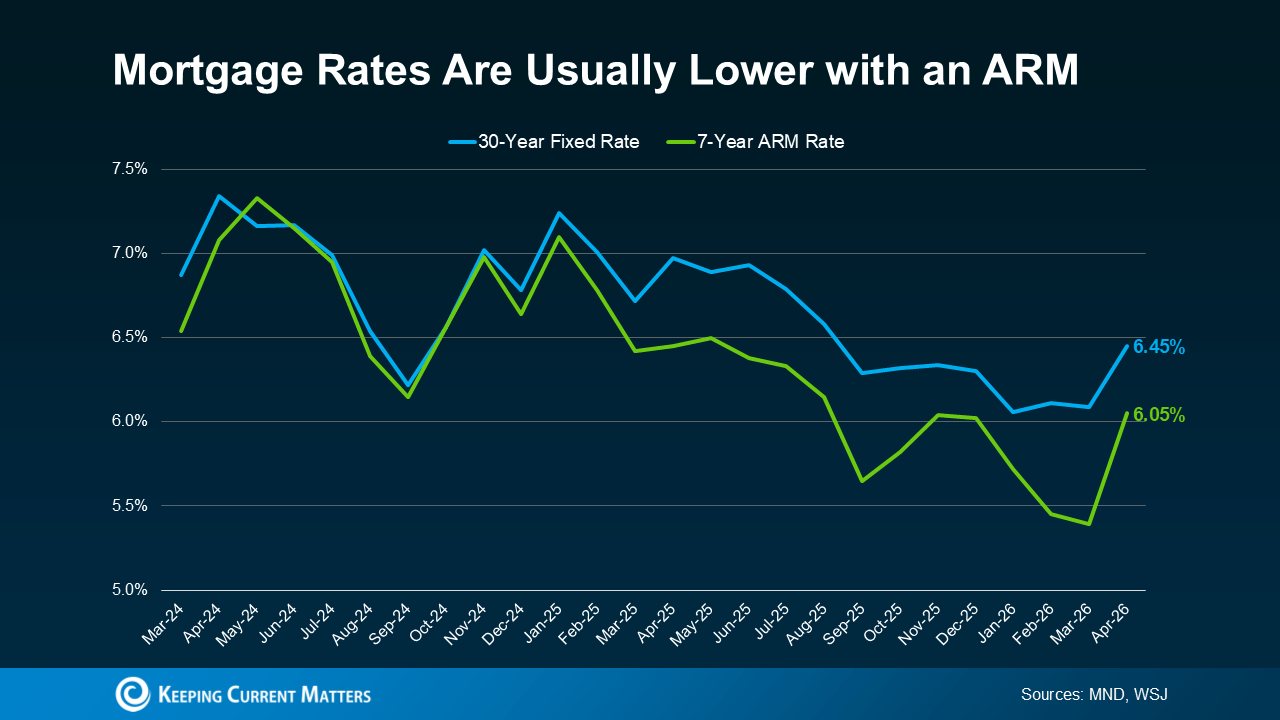
For many buyers, even modest monthly savings can make a difference. For example, Redfin found that a typical buyer could save about $150 per month by choosing an ARM instead of a 30-year fixed mortgage. Savings like that can help some buyers qualify for a home sooner or make their monthly budget more manageable.
Why Adjustable-Rate Mortgages Are Making a Comeback
More homebuyers are deciding that a lower payment today is worth considering, even if it means taking on more uncertainty later.
Recent reports from the Mortgage Bankers Association (MBA) show that the share of buyers choosing ARMs has increased in recent years. That doesn’t mean ARMs are becoming the right fit for everyone. But, it shows that some buyers are using them as a strategy to deal with affordability challenges in the current market.
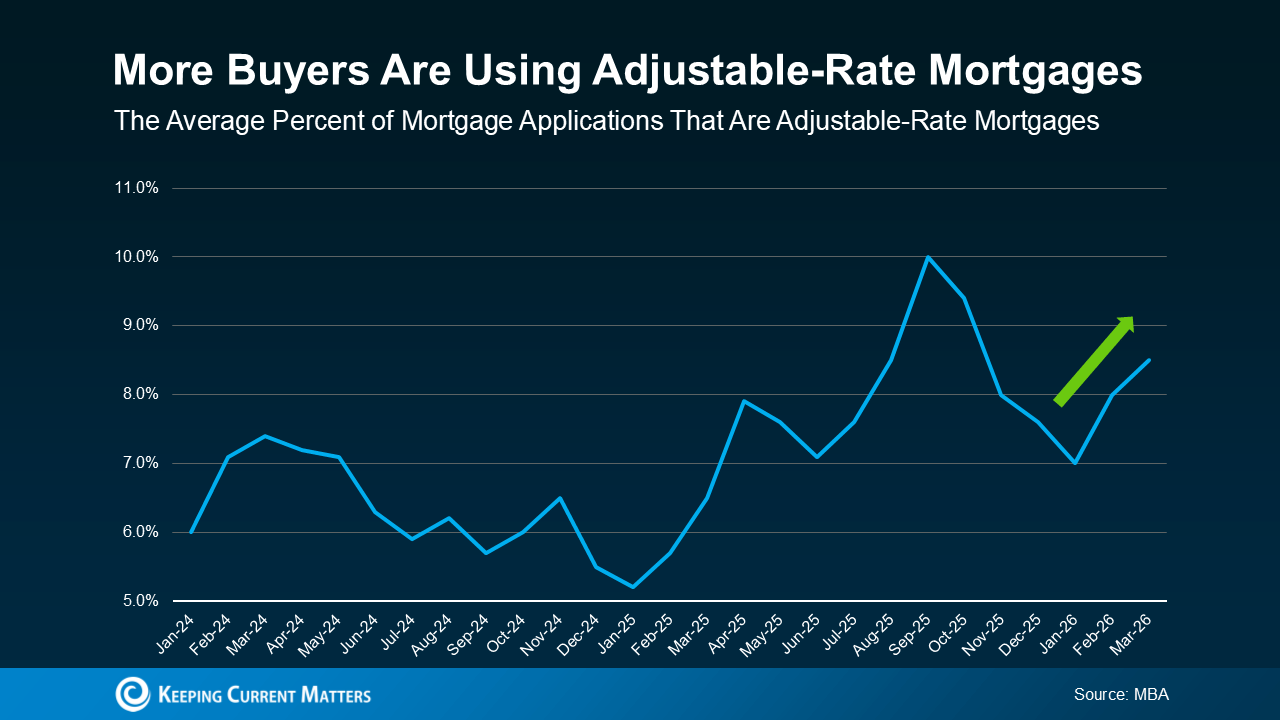
For anyone who remembers the 2008 housing crash, this trend may sound concerning at first. But today’s lending environment is very different.
In the past, some borrowers were approved for loans they couldn’t realistically afford once the interest rate adjusted. Today, lending standards are tighter, and lenders generally evaluate whether borrowers could still manage the payment if rates rise. So while ARMs are becoming more common again, that alone doesn’t point to another housing crisis.
The Pros and Risks of an ARM
An adjustable-rate mortgage can make sense in the right situation, but it depends on your financial plan and your comfort with risk.
An ARM may be worth considering if:
- You expect to move before the rate adjusts.
- You believe your income will increase over time.
- You need a lower initial payment to make homeownership possible now.
Still, there are trade-offs to consider.
Once the fixed-rate period ends, your interest rate can change, and your monthly payment could increase significantly depending on where mortgage rates are at that point. There’s also no guarantee rates will fall in the future, which means refinancing later may not be as easy or as beneficial as some buyers hope.
That’s why it’s important to think beyond the introductory rate. Make sure you understand how long the fixed period lasts, how often the rate can adjust, and how much your payment could increase over time. Most importantly, talk through your options with a trusted lender and financial advisor before making a decision.
Bottom Line: Is an ARM Right for You?
Adjustable-rate mortgages are regaining popularity because they can make buying a home more affordable in the short term. For some buyers, that lower upfront payment can be a helpful tool. But an ARM isn’t necessarily the right move for everyone.
The best decision comes down to understanding how the loan works, weighing the risks, and making sure it fits your long-term goals.
If you’re considering an adjustable-rate mortgage yourself but are still on the fence, reach out to us today. We can connect you with a qualified lender in your area who explore your options with you.
Should You Still Buy a Home Right Now? What Buyers Need To Know

Between nonstop economic headlines, global uncertainty, and ongoing concerns about affordability, it’s understandable to wonder whether now is still a smart time to buy a home.
The good news is this: current events may be influencing the housing market, but they have not taken homeownership off the table. For many buyers, the opportunity is still there. It just may require a more thoughtful strategy than it did a few months ago.
Mortgage Rates Have Risen Slightly. Here’s What’s Behind It
After trending downward for much of 2025, mortgage rates have climbed again over the past month. Experts point to a mix of global events and broader economic pressures as key reasons why.
As Mark Fleming, Chief Economist at First American explains:
“Mortgage rates have recently moved higher, driven by geopolitical uncertainty and rising energy costs that are contributing to inflation concerns.”
So what does that mean if you’re thinking about buying a home? Should you wait for conditions to settle before making a move?
Not necessarily.
Your Opportunity To Buy Hasn’t Disappeared
There’s no denying that buying felt a bit more affordable when mortgage rates were closer to 6%. Now that rates are hovering in the mid-6% range, monthly payments are naturally a little higher.
But it helps to take a step back and look at the bigger picture.
For example, if you’re financing a $500,000 home, a rate in the mid-6s could still mean a monthly payment that is roughly $300 lower than what buyers were facing early last year.
That means today’s higher rates have not erased all the progress we’ve seen. In fact, buying a home can still be more affordable than it was just a year ago.

Yes, your payment may have been lower a few weeks ago. But trying to perfectly time the market rarely works in your favor. Conditions can shift quickly, and hindsight always makes past decisions look easier.
Instead of waiting for the “perfect” moment, focus on making the best decision based on your goals, finances, and today’s market conditions.
Expect Mortgage Rate Volatility
One thing buyers should be prepared for is continued movement in mortgage rates.
Rates may keep rising or falling in the weeks and months ahead as new economic reports are released and world events continue to unfold. That kind of uncertainty can feel frustrating, but it’s also part of today’s market.
The truth is, you can’t control what happens with inflation, global events, or mortgage rates next week. What you can control is how prepared you are when the right opportunity comes along.
That preparation can make all the difference.
If You Need To Move, You Still Have Options
For many buyers, the decision to move is not just about market timing. Life keeps moving, even when the market feels unpredictable.
Maybe your family is growing. Maybe you’re relocating for work. Maybe your current home no longer fits your lifestyle or needs. Those reasons still matter, and they may be more important than waiting for rates to change.
Buyers who are moving forward right now are often doing so because their personal situation makes it the right time.
And the good news is there are still strategies that can help make a purchase more manageable.
For example, some buyers are exploring adjustable-rate mortgages (ARMs) to secure a lower initial rate. That approach is not right for everyone, but it’s one example of how flexibility and planning can create opportunities in today’s market.
A Smart Plan Starts With the Right Experts
In a market like this, having a plan matters more than ever.
Working with a trusted real estate agent and lender can help you:
- Understand what you can realistically afford at today’s rates
- Review financing options, including ARMs and buyer assistance programs
- Stay informed as market conditions shift
- Make confident decisions based on your goals, not just the headlines
The right professionals can help you look beyond the noise and focus on what makes sense for your specific situation.
Conclusion
Uncertainty in the market does not mean you’re out of options.
If you need or want to move, buying a home may still be the right decision. The key is to go in with a solid plan, the right support, and a clear understanding of your financing options.
Homeownership is still possible. You just need the right strategy for today’s market.
Mortgage Rate Volatility: What You Can Control as a Buyer

Mortgage rates have been moving up and down lately, and that can make buying a home feel harder to plan for. When rates are unpredictable, many buyers wonder whether they should wait, move forward, or try to time the market.
Here’s the good news: while you can’t control where mortgage rates go next, you can control several factors that may help you secure a better rate. The first step is understanding what’s driving today’s market and knowing where to focus your time and effort.
Mortgage Rate Volatility Is Normal
Recent data from Freddie Mac show that mortgage rates have been fluctuating. After trending downward for well over a year, rates ticked up again this month.
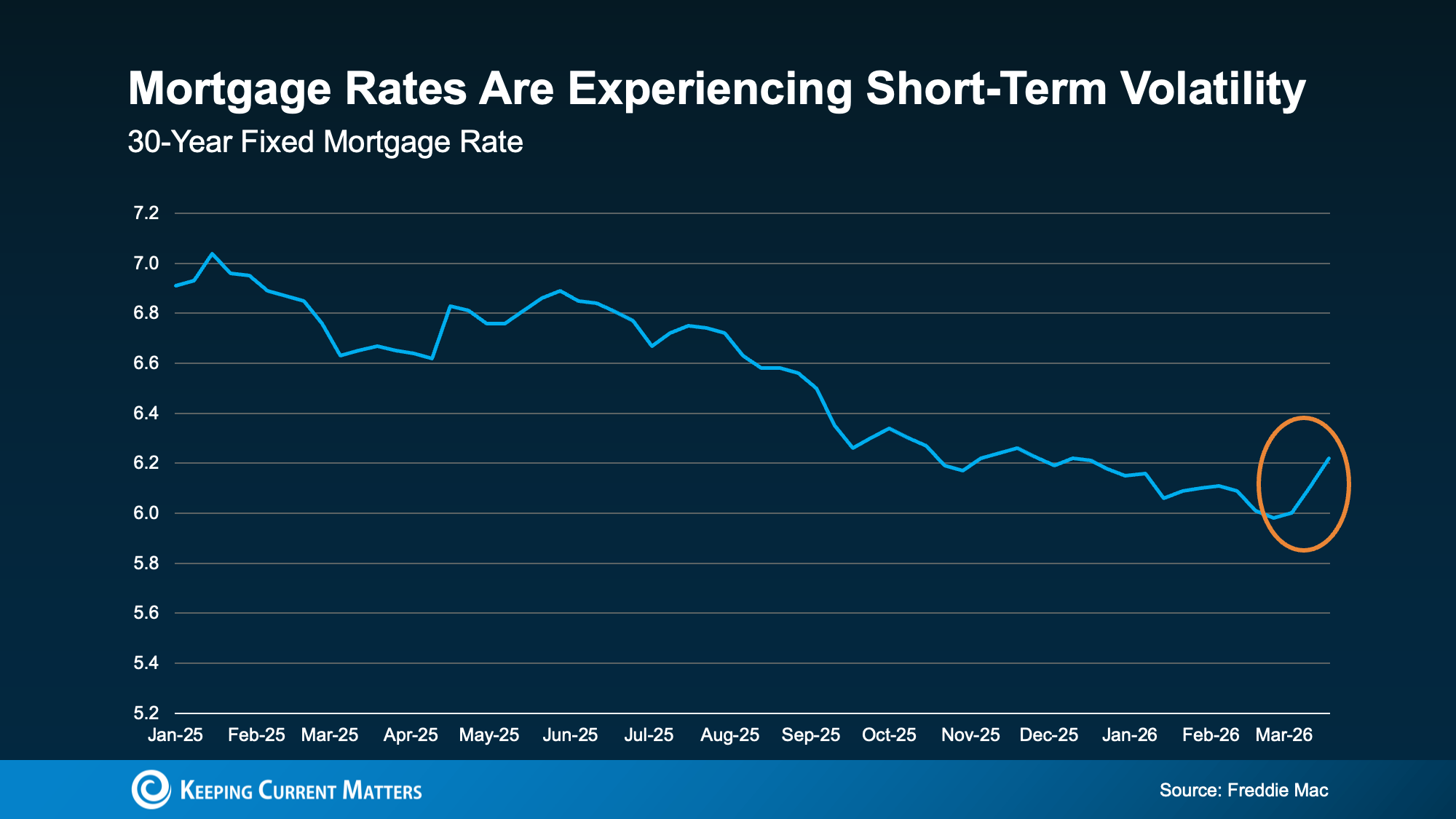
That kind of movement can feel frustrating, especially when you’re doing your best to budget for a home purchase. But occasional increases and decreases are a normal part of the mortgage market. Even over the past year, there have been periods when rates jumped before settling back down.
This is another one of those moments, and it helps to keep that in mind.
When there’s economic uncertainty or major global events unfolding, mortgage rates often respond quickly. As Investopedia explains:
“Mortgage rates don’t move in isolation. When global events inject uncertainty into financial markets . . . that can ripple through to borrowing . . . mortgage costs can respond quickly to geopolitical developments. As long as uncertainty remains elevated, rate swings may continue.”
That’s exactly why trying to predict the perfect time to buy usually doesn’t pay off. Rates can change fast, and waiting for the market to cooperate may not give you the outcome you want.
Focus on What You Can Control
You may not be able to influence the market, but you can take steps put yourself in a better position as a buyer. If your goal is to get the best mortgage rate possible, these are the areas that matter most.
Your Credit Score
Your credit score is one of the biggest factors that affects the rate you qualify for. In many cases, even a modest improvement in your score can lead to better loan terms and a lower monthly payment.
As Bankrate explains:
“Your credit score is one of the most important factors lenders consider when you apply for a mortgage. Not just to qualify for the loan itself, but for the conditions: Typically, the higher your score, the lower the interest rates and better terms you’ll qualify for.”
That’s why it’s worth taking steps to strengthen your credit before applying for a mortgage. Paying bills on time, reducing outstanding debt, and avoiding new credit inquiries can all help. If you’re not sure where your score stands or what improvements would make the biggest difference, a trusted loan officer can help you create a plan.
Your Loan Type
The type of mortgage you choose also affects your rate. There are many different types of loans, and each comes with different eligibility requirements, benefits, and pricing.
The Consumer Financial Protection Bureau (CFPB) explains:
“There are several broad categories of mortgage loans, such as conventional, FHA, USDA, and VA loans. Lenders decide which products to offer, and loan types have different eligibility requirements. Rates can be significantly different depending on what loan type you choose.”
This is why exploring your mortgage options is so important. A conventional loan may be the right fit for one buyer, while an FHA, USDA, or VA loan may offer better advantages for another. Comparing programs and speaking with more than one lender can help you understand which path makes the most sense for your financial situation.
Your Loan Term
The length of your loan term matters, too. Most lenders offer 15-year, 20-year, and 30-year mortgage options, and the term you choose can affect both your interest rate and your monthly payment.
Freddie Mac explains it this way:
“When choosing the right home loan for you, it’s important to consider the loan term, which is the length of time it will take you to repay your loan before you fully own your home. Your loan term will affect your interest rate, monthly payment, and the total amount of interest you will pay over the life of the loan.”
A shorter loan term may come with a lower interest rate, but the monthly payment is often higher. A longer term may give you more flexibility in your monthly budget, even if you pay more interest over time. The right choice depends on your goals, your budget, and how long you plan to stay in the home.
Conclusion
If you’re in the market for a home right now, the best strategy is not to focus on trying to predict where mortgage rates will go next.
Instead, focus on what you can control. Improve your credit score, explore different loan types, and choose a loan term that fits your needs. Most importantly, work with a trusted lender who can guide you through your options. If you need help connecting with trustworthy lender, reach out to us today.
Mortgage rates may be out of your hands, but the steps you take to prepare are not. And when you focus on what you can change, you give yourself a much better chance to move forward with confidence.
3 Key Steps for First-Time Home Buyers

Buying your first home is exciting, but it can feel a bit overwhelming. When you’ve never gone through the buying process before, it’s easy to wonder where to start and what to do first.
The good news is that you don’t need to figure out everything out on your own, or all at once. The best approach is to take it all step by step.
If you’re getting ready to buy your first home, here are the three most important steps to focus on first.
1. Build Your Team: Don’t Do It Alone
Buying a home is not a solo project. Having the right professionals on your side can make the entire experience smoother, less stressful, and more successful.
Here are two key people every first-time home buyer should have in place early:
A local real estate agent
A knowledgeable local agent will guide you from your first showing all the way to closing day. They can help you understand the market, explain each step of the process, and make sure you feel confident in the decisions you make.
A trusted lender
A lender will help you explore your mortgage options, estimate your monthly payment, and understand what price range makes sense for your budget. Having that info early helps you shop smarter and avoid unwanted surprises later.
When you have the right team in place, you can find your new home with more clarity and confidence.
2. Prep Your Finances: Build a Strong Foundation
It goes without saying that your finances play a major role in the homebuying process. They affect what you can afford, how competitive your offer may be, and how comfortable you’ll feel once you own the home.
Here are the main financial steps first-time home buyers should take:
Check your credit score
Your credit score can affect the loan programs available to you and the mortgage rate you receive. Checking it early gives you time to improve it if needed.
Save for your down payment and closing costs
Many buyers focus only on the down payment, but closing costs are also an important part of the equation. Saving for both can help reduce last-minute stress.
Research first-time buyer assistance programs
There are programs designed to help first-time home buyers with upfront costs. Depending on where you live and your financial situation, you may qualify for assistance that helps you buy sooner than expected.
Talk to a lender about your mortgage options
Fixed-rate, adjustable-rate, FHA, VA, and conventional loans all work differently. Understanding the pros and cons of each option can help you choose the loan that best fits your needs.
Get pre-approved
A mortgage pre-approval gives you a clearer picture of how much a lender may be willing to lend you. It also helps you set a realistic price range and shows sellers you’re serious when it’s time to make an offer.
Set a realistic monthly budget
Your mortgage payment is only part of the cost of homeownership. You also need to account for utilities, home insurance, maintenance, and everyday living expenses. Setting a realistic budget helps ensure your home feels affordable, not overwhelming.
Being confident in your finances before you start house hunting can help you feel more prepared and better positioned in a competitive market.
3. Gather Your Documents: Save Time and Reduce Stress
Once you’re ready to move forward, your lender will need to verify your income, assets, and financial history. Gathering your documents ahead of time can help speed up the loan process and avoid unnecessary back-and-forth.
Here are some of the most common documents lenders may ask for:
W-2s and tax returns from the past two years
These help verify your income history and show consistency over time.
Recent pay stubs, usually from the last one to two months
These confirm your current income and employment.
Bank statements from the past two to three months
These show your available funds, spending patterns, and where your down payment money is coming from.
Investment account statements from the past two to three months
If investments are part of your financial picture, your lender may want to review them as well.
A copy of your driver’s license
This is used to verify your identity during the loan process.
Your residential history for the past two years
Lenders may request this to confirm your housing background and stability.
Statements for outstanding debts from the past two months
This may include student loans, car loans, and credit cards. These debts help lenders calculate your debt-to-income ratio.
Proof of supplemental income
If you receive bonuses, commissions, freelance income, or child support, you may need documentation to show that income can be counted.
Keep in mind that document requirements and timelines can vary by lender. Still, having these items ready is a smart way to stay organized and avoid potential hiccups.
Conclusion
Buying your first home doesn’t mean you need to have every detail figured out from day one. It just means starting your journey with a plan.
When you gather the right people, prepare your finances, and organize your documentation early, you give yourself a much better chance to buy with confidence.
If you want help understanding any part of the process or are ready to take the first step to homeownership, connect with a trusted real estate agent.
Home Affordability Improved in All 50 States: What Buyers Need To Know

For the past few years, affordability has been one of the biggest reasons buyers have put their home search on hold. Maybe you did the same.
At some point, you may have looked at the numbers, saw what a monthly mortgage payment would be, and decided to wait for the market to become more manageable. But there’s encouraging news you may have missed.
Over the past year, housing affordability has improved in all 50 states. Yes, every single one.
That’s according to new research from First American. And while buying a home is still more expensive than what’s historically normal, the affordability pressure many buyers have felt over the last several years is finally starting to ease.
Some Markets Are Seeing Bigger Improvements
One of the most important things to understand is this isn’t limited to one part of the country or just a few select markets. Affordability is improving almost all over the country.
Of course, real estate is always local. Conditions can vary a lot from one state, city, or neighborhood to the next. But overall, the market is becoming more favorable for buyers. In fact, affordability has improved in 48 of the top 50 metros over the past year.
That same research also highlights the top 10 cities seeing the biggest gains in affordability:
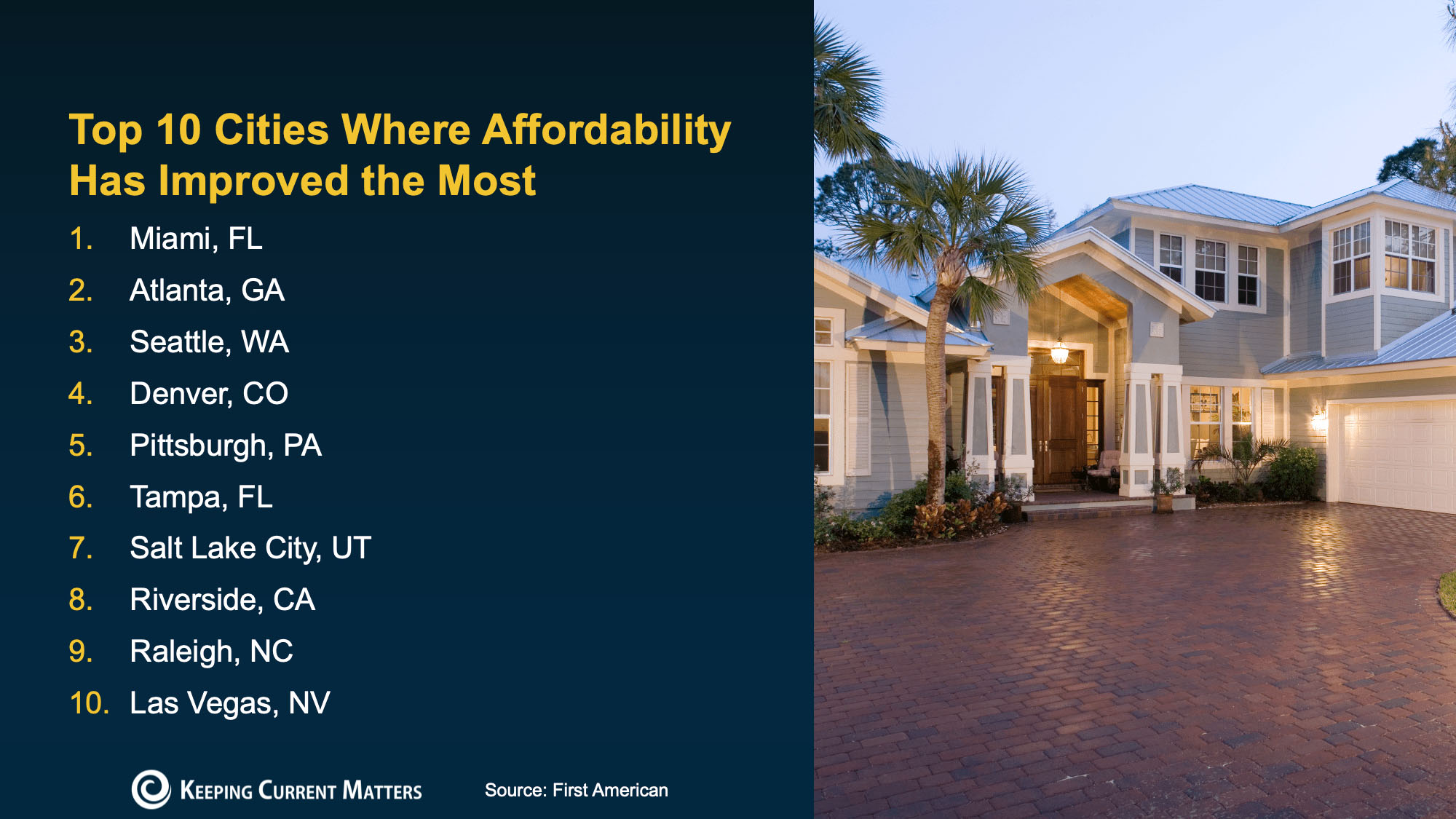
Top 10 Cities Where Home Affordability Has Improved the Most
- Miami, FL
- Atlanta, GA
- Seattle, WA
- Denver, CO
- Pittsburgh, PA
- Tampa, FL
- Salt Lake City, UT
- Riverside, CA
- Raleigh, NC
- Las Vegas, NV
If you’re wondering why some markets are improving faster than others, a lot of it comes down to home inventory.
When there are more homes for sale, the market becomes more balanced. This can help improve affordability by giving buyers more negotiating power. With more options available, buyers may have a better chance of finding a home that fits their budget, and they may also be in a stronger position to ask for seller concessions, price reductions, or closing cost assistance.
That can make a bigger difference than many people expect.
What Does This Mean for Buyers?
Home affordability challenges haven’t disappeared altogether, obviously. Buying a home is still a major financial decision, and housing prices remain high in many markets. But the overall nationwide trend is moving in a direction that gives buyers more opportunity than they’ve had in recent years.
As Chen Zhao, Head of Economic Research at Redfin, explains:
“The housing affordability crisis is showing signs of easing. . . opening the door for more Americans to make the jump to homeownership.”
Conclusion
If you’ve been waiting on the sidelines for affordability to improve, this may be the sign you’ve been hoping for. To find out what’s happening in your local market and how much buying power you may have today, connect with a trusted local real estate agent.
Housing Inventory Is Improving in 2026: What That Means for Buyers

After a long stretch of buyers competing for too few homes, housing inventory is finally improving. Over the past year, more listings have come to market, and depending on where you live, that shift can open up your options in a meaningful way.
According to Realtor.com, the number of homes available for sale in January 2026 was the highest it’s been since 2020. That matters because getting closer to pre-pandemic levels signals a gradual return to a more typical market, where buyers aren’t forced to make rushed decisions with limited choices.
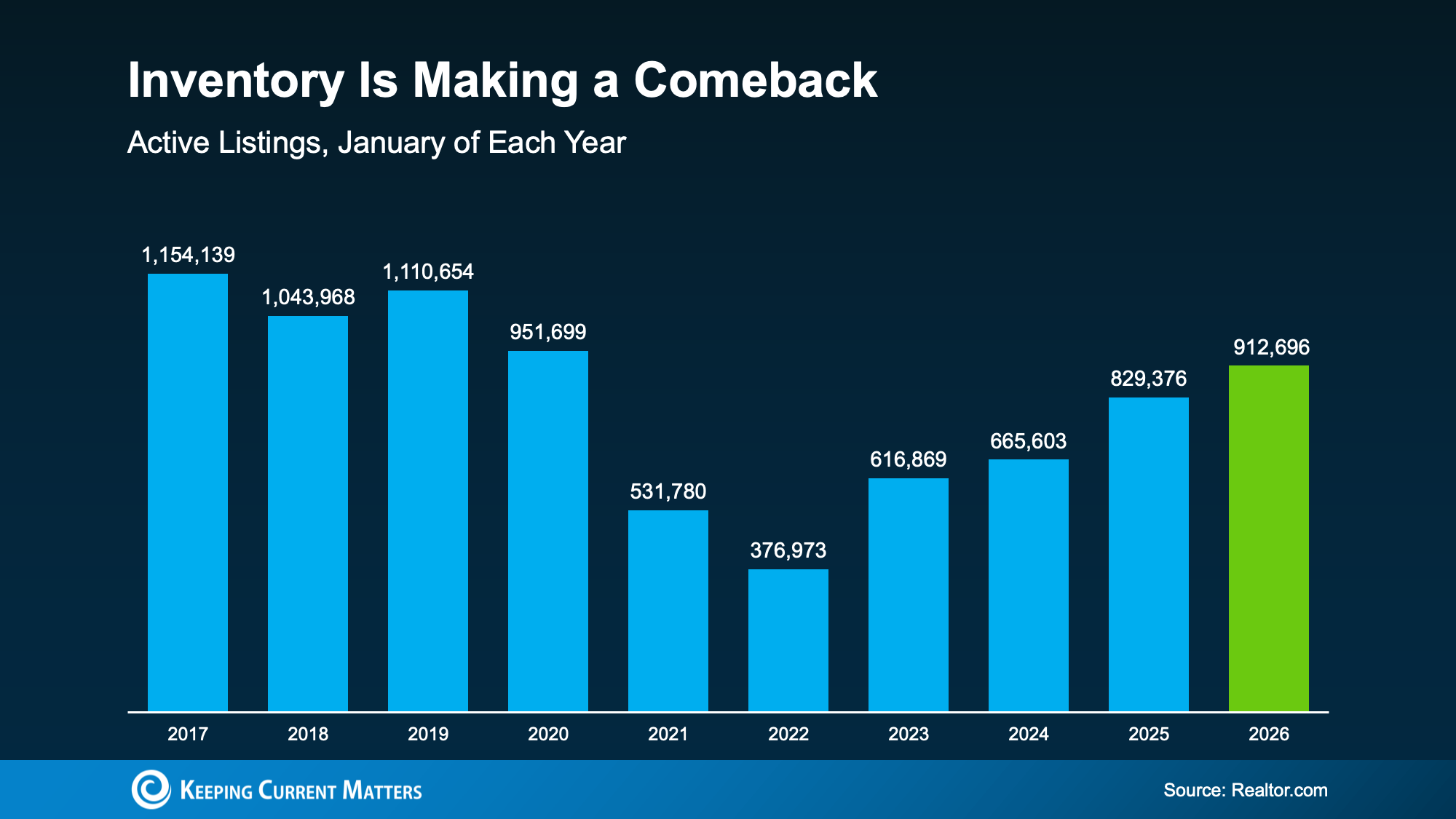
That said, inventory is not back to normal everywhere. And even with growth, more listings alone won’t “fix” affordability or fully rebalance the market overnight. But the changes we’ve seen recently can still have a real impact on how competitive it feels to buy.
When Supply Rises, Buyers Gain Breathing Room
In a low-inventory market, the pressure ramps up fast. Buyers often feel like they have to move immediately, waive protections, or offer well above asking just to stay in the running.
More inventory can reduce that intensity. When there are more homes for sale, buyers typically gain:
- More time to tour homes and think through a decision
- More options across neighborhoods, home styles, and price points
- More leverage to negotiate on price, repairs, closing costs, or timelines
In other words, more listings can shift the experience from stressful to manageable, even if the market still leans competitive in certain areas.
A Growing Share of the Country Is Getting Back to Typical Inventory
Inventory growth is not uniform nationwide. Some markets are seeing a stronger rebound, while others are still tight.
According to Lance Lambert, Co-Founder of ResiClub, in January 2025, just a little over one year ago, only 41 of the 200 largest metros were back to normal inventory-wise.
By around the end of the year, almost half (90) of the largest 200 metro areas were back at or above typical levels. That is a big improvement in roughly a year, and the trend is still moving forward.
Why This Matters for Your Local Home Search
If your area is one of the metros where inventory has returned to typical levels, you may notice:
- More new listings each week
- Fewer “must-bid-now” situations
- More realistic negotiations, especially on homes that sit longer
If your market is still below normal, you may still see multiple offers on well-priced homes. The difference is that, nationally, the direction is improving, and more markets are joining that list over time.
Inventory Is Expected to Keep Growing in 2026
Looking ahead, forecasts suggest the number of homes for sale could rise another 10% this year. If that happens, even more markets should move closer to balanced conditions.
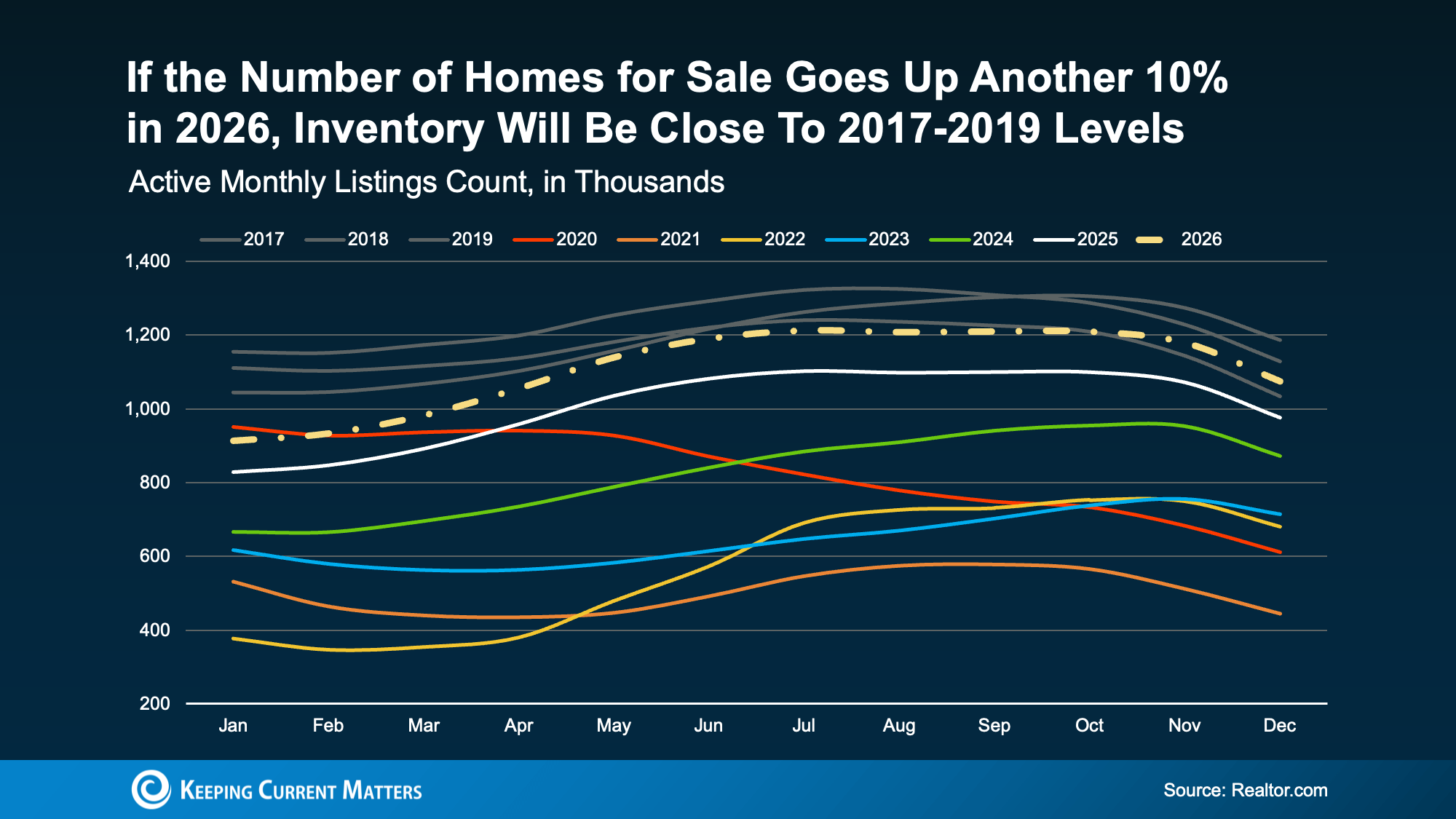
That potential growth could push inventory closer to the levels we saw in 2017–2019 by roughly this fall, which would be a huge milestone for buyers. Of course, reaching something closer to “normal” nationally wouldn’t mean every market feels the same. But, it would increase the odds that more buyers in more markets can find a home without feeling boxed in by a lack of choices.
As Hannah Jones, Senior Economic Research Analyst at Realtor.com, says:
“. . . housing market conditions are gradually rebalancing after several years of extreme seller advantage. Buyers are beginning to see more options and modest negotiating power as inventory improves . . .”
That is the key takeaway: the market is starting to work with buyers again, not against them.
Conclusion
Inventory may not be fully back to normal everywhere, but it’s moving in the right direction. And some markets, it’s already there.
If you have been waiting for a moment when you have more options and a little breathing room, 2026 is shaping up to be the strongest setup buyers have seen in years.
If you want the latest on inventory in your local market, talk to an agent who can break down inventory trends, pricing, and what that means for your next move. And if you’re not sure where to start, you can always reach out to us at CENTURY 21 Affiliated.