Facebook
 X
 Pinterest
 Copy Link

If you’re getting ready to buy a home, it’s easy to treat the score in your credit app as a yes-or-no answer. But credit scoring changes are giving lenders new ways to evaluate some borrowers, but an app alone cannot tell you whether you qualify. Before ruling yourself out, find out which model and mortgage requirements apply to you.
1. Mortgage Credit Requirements May Be Different Than You Think
Fannie Mae has studied consumers’ mortgage knowledge since 2015. In its 2023 study, respondents’ median estimate of the minimum credit score was 652, above the 620 benchmark the report cited for loans backed by Fannie Mae and Freddie Mac.
That familiar 620 figure needs context today. Fannie Mae’s Desktop Underwriter, an automated system that evaluates applications, no longer requires a minimum credit score. Its manually underwritten fixed-rate loans generally retain a 620 minimum, with exceptions and additional requirements. Freddie Mac also lists 620 for certain fixed-rate loans, subject to its Guide. Your lender and loan program still determine the requirements for your application.
A Veterans United survey published in May 2026 shows how these perceptions can linger. Among 400 respondents planning to buy within three years:
- 66% believed near-perfect credit was necessary to get the best mortgage rates.
- 57% believed a score of at least 660 was needed to qualify.
- 34% believed they needed 700 or higher.
Of course, these are just beliefs, not actual lending requirements. Qualifying for a mortgage and receiving a lender’s lowest rate are also very different questions. Assuming you need any particular score could keep you from exploring options that may fit.

Figures reported in Veterans United’s May 4, 2026 survey article. Survey of 400 prospective buyers, March 13-24, 2026. These are consumer beliefs, not loan requirements.
2. Credit Scoring Changes Give Lenders More Options
For decades, loans sold to Fannie Mae and Freddie Mac generally relied on Classic FICO scores. To encourage competition and broaden credit assessment, the Federal Housing Finance Agency approved VantageScore 4.0 and FICO 10T in 2022.
Implementation of VantageScore 4.0 with lenders has moved at different speeds. As of November 3, 2026, all approved Fannie Mae and Freddie Mac lenders may use VantageScore 4.0 for eligible loans, following a September 9 expansion. Classic FICO remains available. FICO 10T is approved for future use but isn’t yet eligible for loan delivery to those companies.
The newer models may help lenders evaluate people with limited or less-recent credit activity. VantageScore reports that research published in July 2026 found its 4.0 model could generate scores for approximately 33 million more U.S. adults than Classic FICO. That’s an estimate of additional people who can receive a score from the model, not a count of approved borrowers.
A different model can also produce a different number for the same person. As the Consumer Financial Protection Bureau explains, scores vary with the formula, reporting source, and type of loan. The number you checked last month may differ from the mortgage score your lender uses.
3. Keep Building Credit While You Explore Your Options
The models are changing, but the everyday habits that support your credit still matter. Use this checklist as a starting point:
- Know your score. Monitor changes over time and review your credit reports for errors. Ask which scoring model an app displays.
- Build a consistent payment history. Pay bills on time and keep credit card balances low relative to your limits. You don’t need to carry a balance to build credit.
- Consider new credit carefully. Additional loans and account applications can affect your profile. Ask your loan officer before making changes during a mortgage application.
- Talk with a mortgage professional. Review your credit, budget, and loan options together so you understand the next steps for your situation.
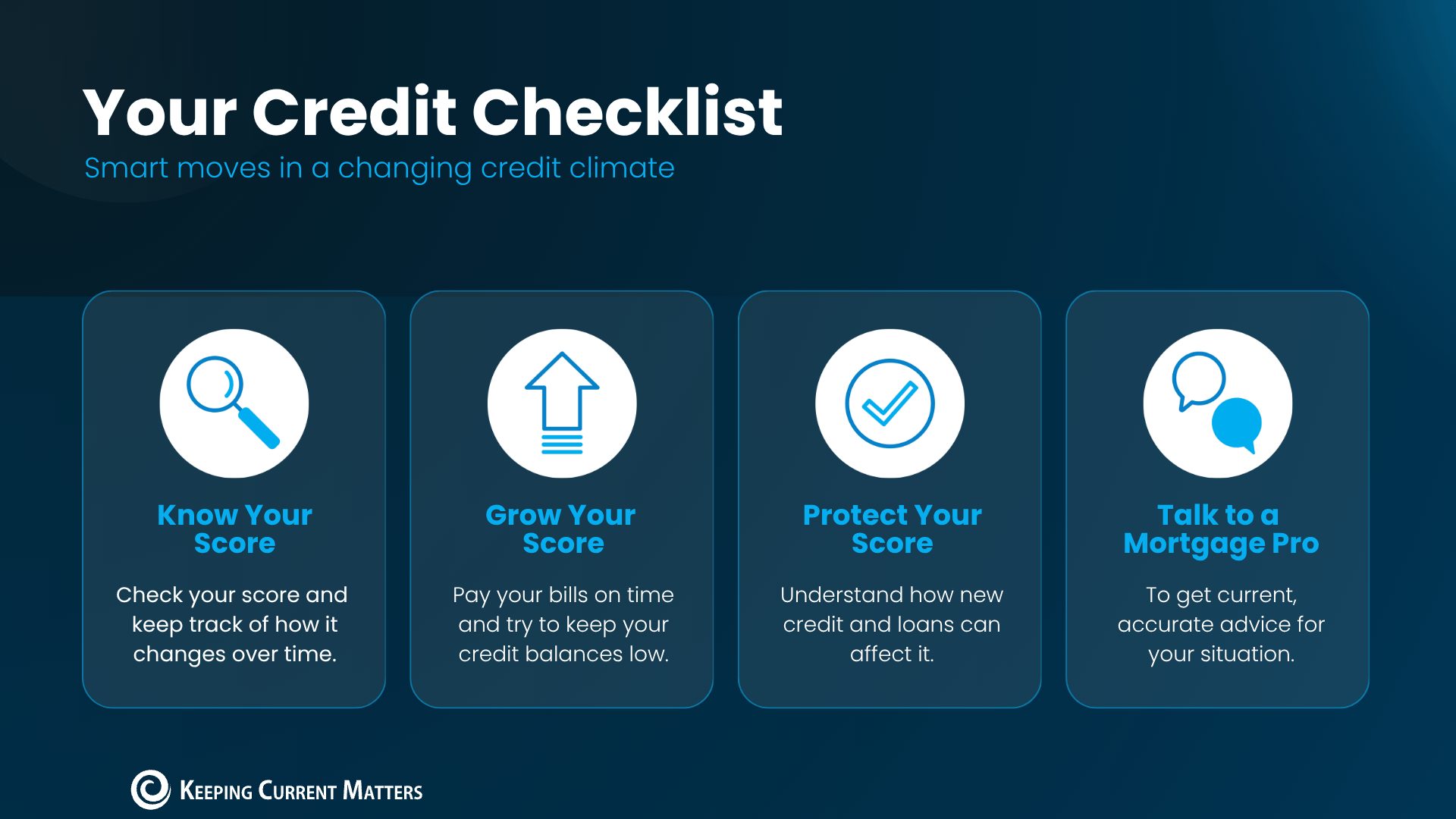
Monitor your credit, maintain payment habits, review new borrowing, and speak with a loan officer.
Make a Plan Before You Start House Hunting
You don’t need an exact moving date to speak with a loan officer or learn what credit scoring changes affect you. Ask which score model applies, what the lender requires, and how your income, existing debts, and available savings affect the application. That conversation can give you a clearer starting point than a chart, an app, or even a friend’s experience.
When you’re ready to plan your home search, connect with a local CENTURY 21 Affiliated agent. We can help you explore available homes around the budget and timing you establish with your lender.