Facebook
 X
X
 Pinterest
 Copy Link

If mortgage rates have kept you waiting to buy a home, the calendar may give you another reason to revisit your search. Buying a home in the fall can bring more active listings, asking prices below summer highs, and sellers who may be more open to negotiation. That’s why Hannah Jones, Senior Economist at Realtor.com, says:
“We always see that the best time to buy window usually falls in the early fall around October.”
These advantages are patterns, not guarantees. Inventory, pricing, and competition vary by location, property type, and price range. Still, fall may be worth a closer look.
1. Fall Often Brings More Homes To Choose From
Realtor.com data summarized in the chart below shows that average active listings were highest from September through November across 2016-2026: 994,707, compared with 983,198 in summer, 851,750 in spring, and 837,494 in winter.
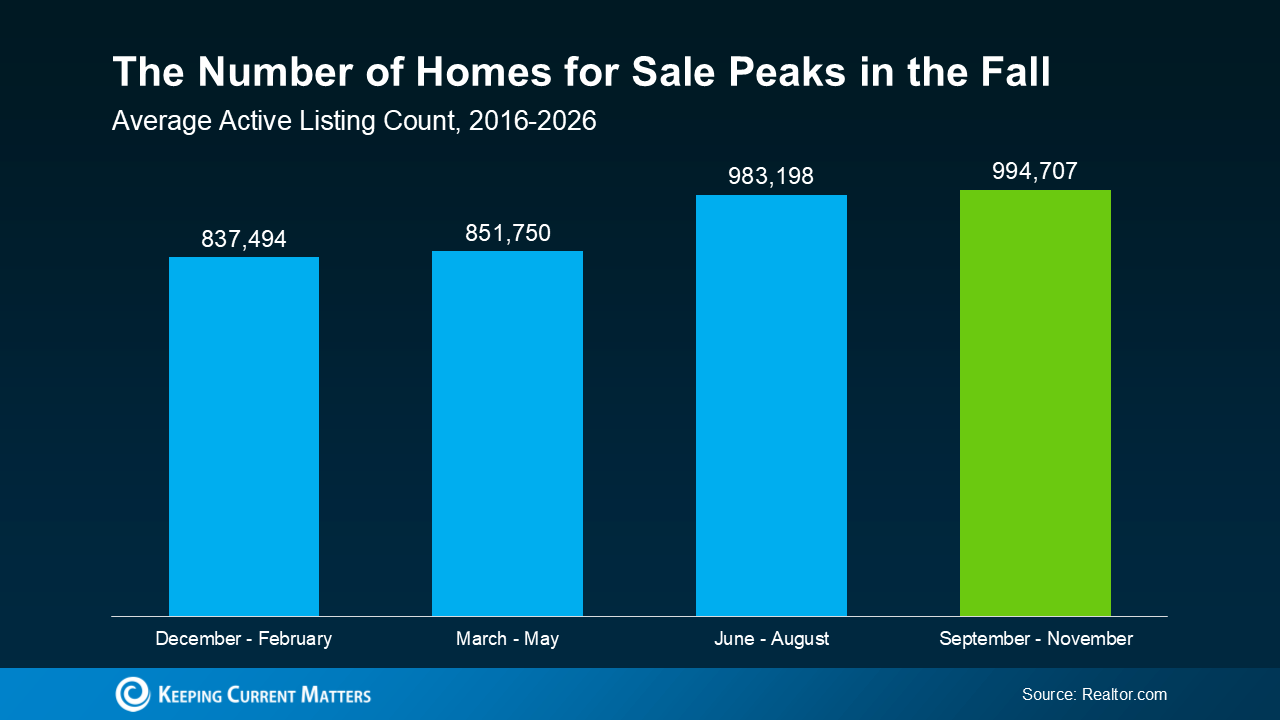
Average active listings were highest from September through November across 2016-2026. Source: Realtor.com.
Why does inventory grow? Not every home listed in spring or summer sells immediately, while new listings continue to arrive. Higher-for-longer mortgage rates can also slow demand, allowing active listings to accumulate. Some fall options may have been on the market longer, so review each home’s condition, history, and price.
More choices can mean fewer compromises and a better chance of finding a home that fits your needs and budget.
2. Asking Prices Tend To Ease in Fall
Data from HousingWire in the chart below shows that, across 2022-2026, the median list price for single-family homes averaged $452,685 in summer and $426,548 in fall. The averages were $440,334 in spring and $414,955 in winter.
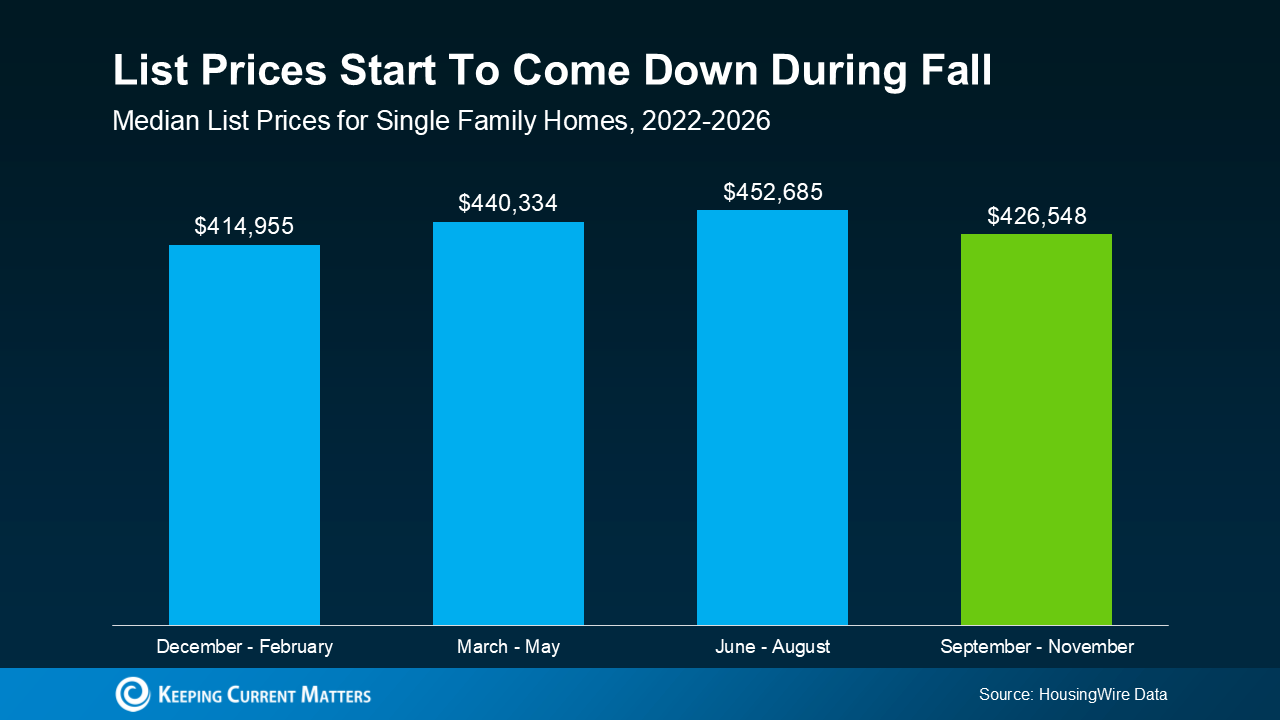
Median single-family list prices averaged $426,548 from September through November across 2022-2026. Source: HousingWire.
Spring and early summer are typically active buying periods, which can give sellers more confidence when pricing. As activity cools in fall, some sellers lower asking prices to attract buyers.
Remember, a list price is not a final sale price, and national averages don’t predict what a particular home will cost. Local supply, demand, condition, and comparable sales all matter.
3. Buyers May Have More Room To Negotiate
The fall real estate market brings more than stronger supply and lower asking prices. It also tends to give buyers more room to negotiate with sellers more eager to make a deal.
Realtor.com data in this third chart shows that the share of listings with a price cut averaged 16.9% in fall across 2016-2026. That compares with 16.8% in summer, 13.4% in spring, and 12.5% in winter. The summer-to-fall difference is small, but fall still had the highest average.
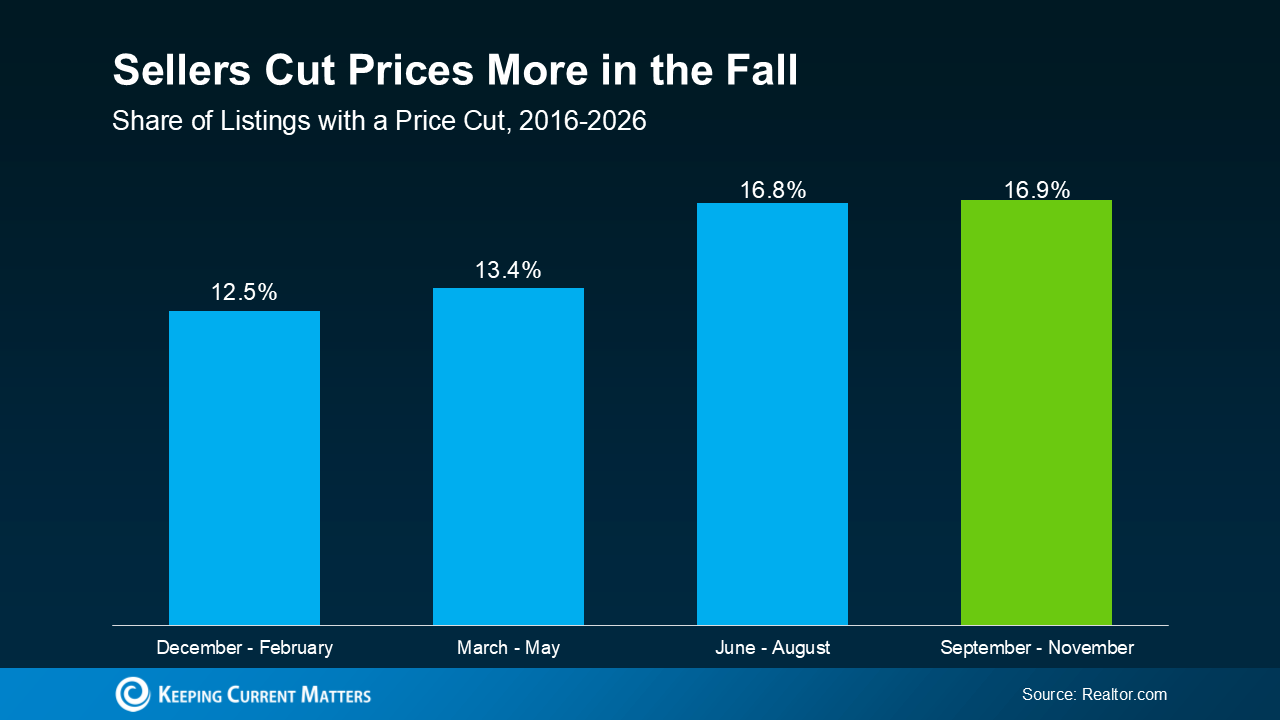
The share of listings with a price cut averaged 16.9% from September through November across 2016-2026. Source: Realtor.com.
A home that remains on the market in fall may belong to a seller who wants to close before the holidays. With fewer buyers competing, that can create an opening for a thoughtful offer. If typical seasonality holds, buyers may have more room to negotiate this fall than in the more active first half of 2027, though that’s not guaranteed. As the National Association of Realtors (NAR) says:
“Less competition can lead to better deals. While homes are not selling as fast as during the summer, sellers may be more willing to negotiate.”
When it comes to homebuying, even a small price cut can make a big difference. For example, a 5% reduction on a $500,000 home is $25,000. That could reduce your total mortgage, preserve your savings, create room for updates, or make your monthly payment more manageable. Actual payments depend on the loan and other costs, so review the numbers with qualified professionals.
How To Decide Whether a Fall Move Fits Your Plans
The calendar alone shouldn’t determine when you buy. Before starting your home search:
- Refresh your financing. Ask a qualified lender to update your pre-approval and estimate the full monthly housing cost.
- Review local conditions. Have your agent compare inventory, days on market, price reductions, and recent negotiations in your target area.
- Stay focused on fit. More options only help when the property, condition, payment, and timeline align with your priorities.
Bottom Line
Every market moves differently, but fall often brings more active listings, lower seasonal asking prices, and sellers who may be motivated to reach an agreement. If you’ve waiting for a more workable market, this fall is worth another look.
Connect with a local CENTURY 21 Affiliated agent to review your local market conditions, find a home you love, and build an offer strategy that works for you.