Facebook
 X
X
 Pinterest
 Copy Link

If you’re thinking about buying or selling, talk of a housing crash can make it harder to plan your next move. You may be hoping lower prices will put a home within reach or wondering how a downturn could affect the equity you’ve built. Housing experts offer some perspective: the average forecast in Fannie Mae’s Q3 2026 Home Price Expectations Survey calls for national home prices to rise each year through 2030. That outlook can help inform your plans, even if local markets follow a different path.
Affordability concerns help explain why some people hope a crash does happen. In Clever Real Estate’s June 2026 survey, 58% of respondents wanted a housing market crash to make ownership more affordable. The survey covered 1,000 U.S. Gen Z adults who were college students or recent graduates, rather than a sample limited to active homebuyers.
What the Housing Crash Forecast Actually Shows
Fannie Mae’s quarterly survey, produced with Pulsenomics LLC, gathers forecasts from more than 100 housing experts. The Q3 2026 survey was conducted August 5-14.
The survey workbook puts average cumulative national price growth at about 14.6% across 2026-2030. The most pessimistic quarter of the panel averages about 6.6% growth over that period, while the most optimistic quarter averages 22.7%.
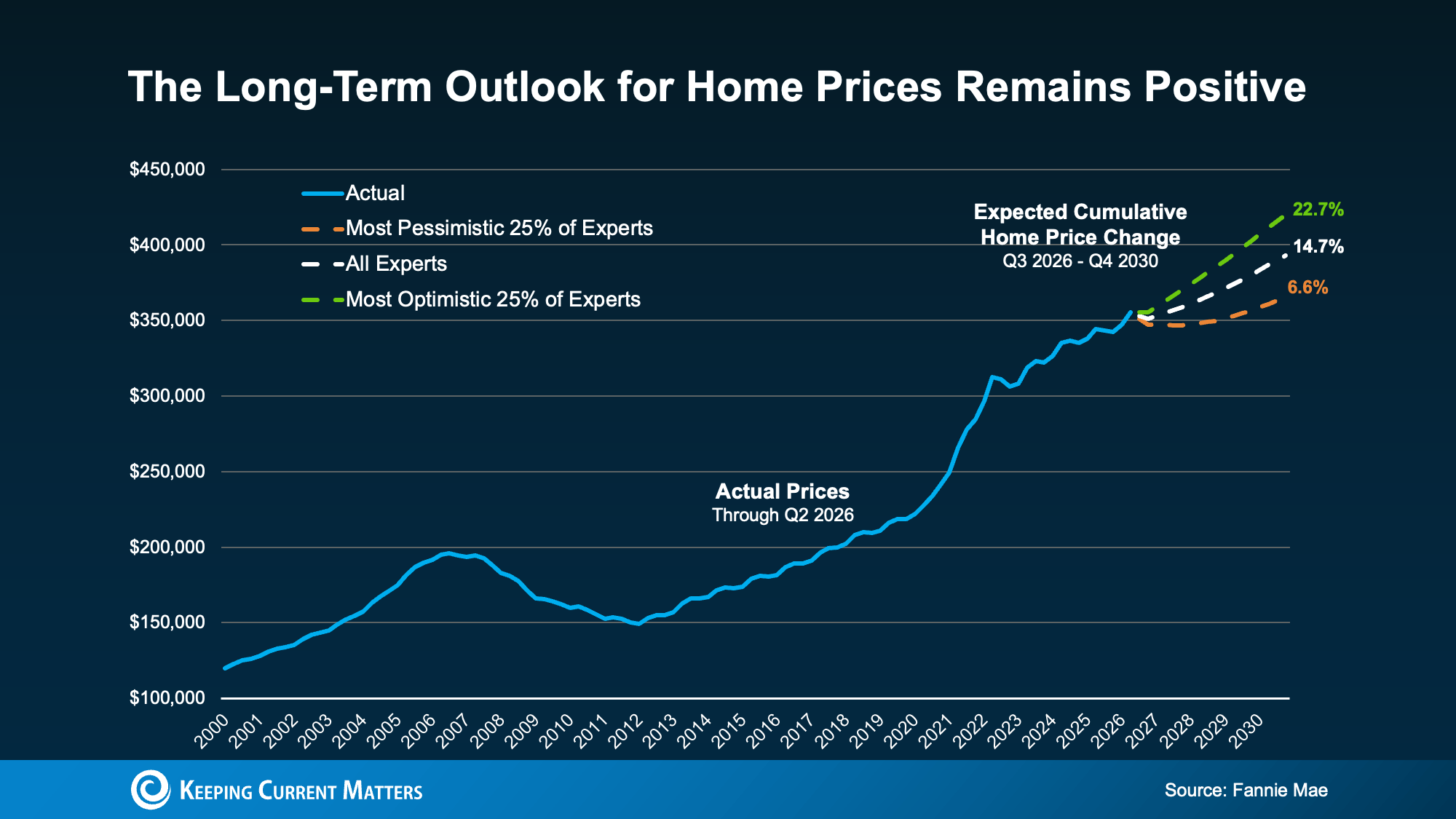
Projected cumulative national home price growth from year-end 2025 through year-end 2030. The all-panel mean is 14.7%. Source: Fannie Mae.
Remember that these are group averages. Some individual panelists forecast declines, so a positive average doesn’t mean everyone expects prices to rise. These projections are also national, and aren’t adjusted for inflation.
Your own area could see stronger growth, flat prices, or even losses depending on the market. National home prices generally rise over time with downturns along the way, but local conditions and the price you pay still matter.
How the Forecast Changed Since Last Year
The Home Price Expectations Survey runs four times a year, making it possible to compare expectations for the same future years. In Q3 2025, the panel expected 2026 prices to increase about 2.1%. In Q3 2026, that forecast rose to 2.5%.
Expectations for 2027, 2028, and 2029 moved lower. The earlier forecasts were 2.9%, 3.5%, and 3.6%; the latest were 2.2%, 2.7%, and 3.1%, respectively. Each average still represents annual growth, despite the differing rates.
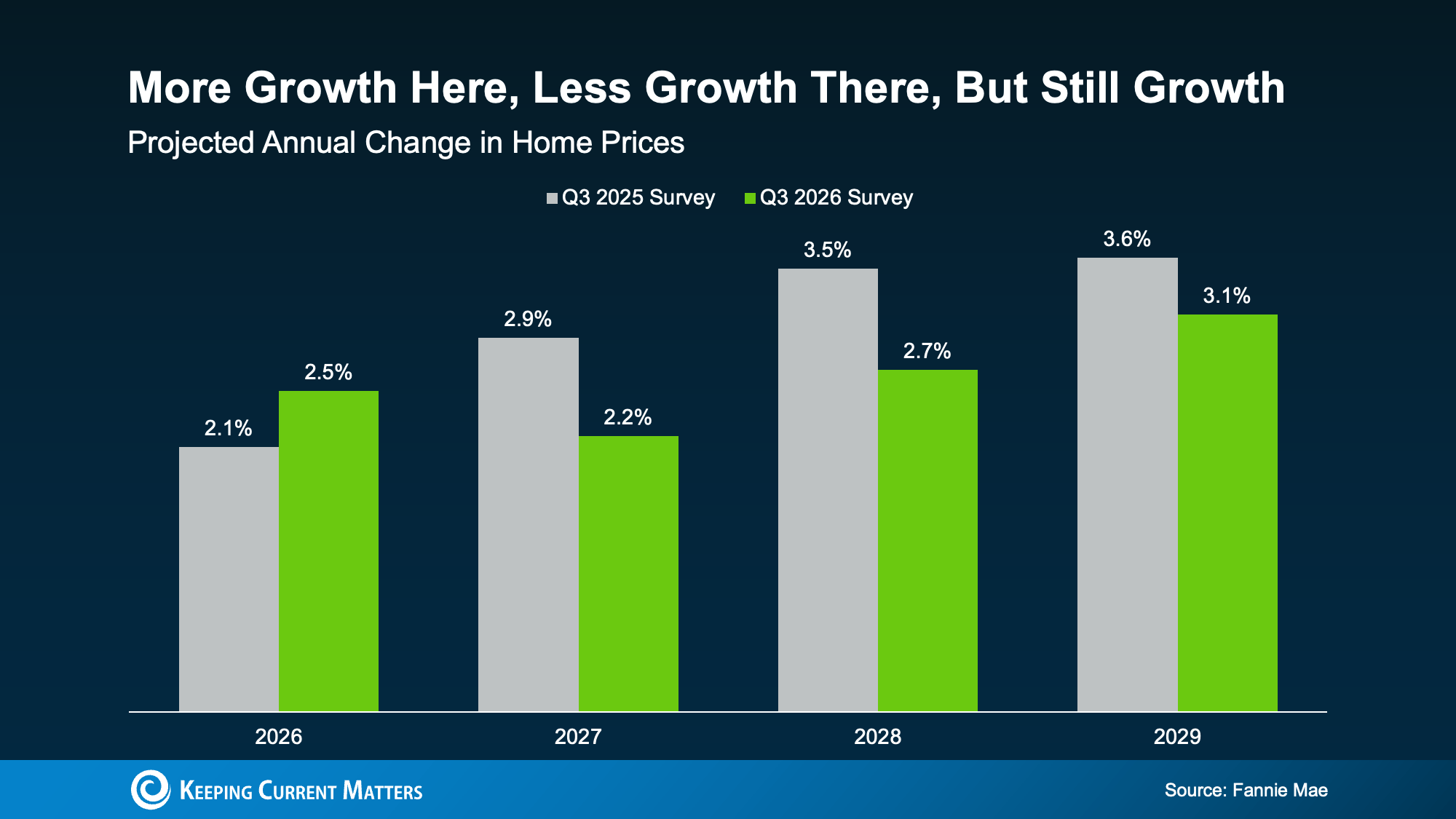
Annual forecasts compare each year-end with the preceding year-end. Averages are positive, while expectations for 2027-2029 are lower than a year earlier. Sources: Pulsenomics LLC and Fannie Mae.
A higher full-year forecast doesn’t mean prices will certainly rise every month. Pulsenomics notes that prices had already risen 3.7% through the first half of 2026. The panel’s precise 2.52% full-year forecast therefore implies roughly a 1.1% decline during the second half.
The outlook is for a slower pace of appreciation than the rapid gains of the pandemic period. Remember that no forecast is final; a single survey can inform your future planning, but it shouldn’t be the only factor.
How Projected Price Growth Could Affect Equity
Consider a hypothetical $400,000 home purchased in January 2026. Applying the survey’s annual growth forecasts, rounded to two decimal places, produces an estimated value of $458,314 by January 2031. That’s about $58,000 in hypothetical appreciation over five full calendar years.
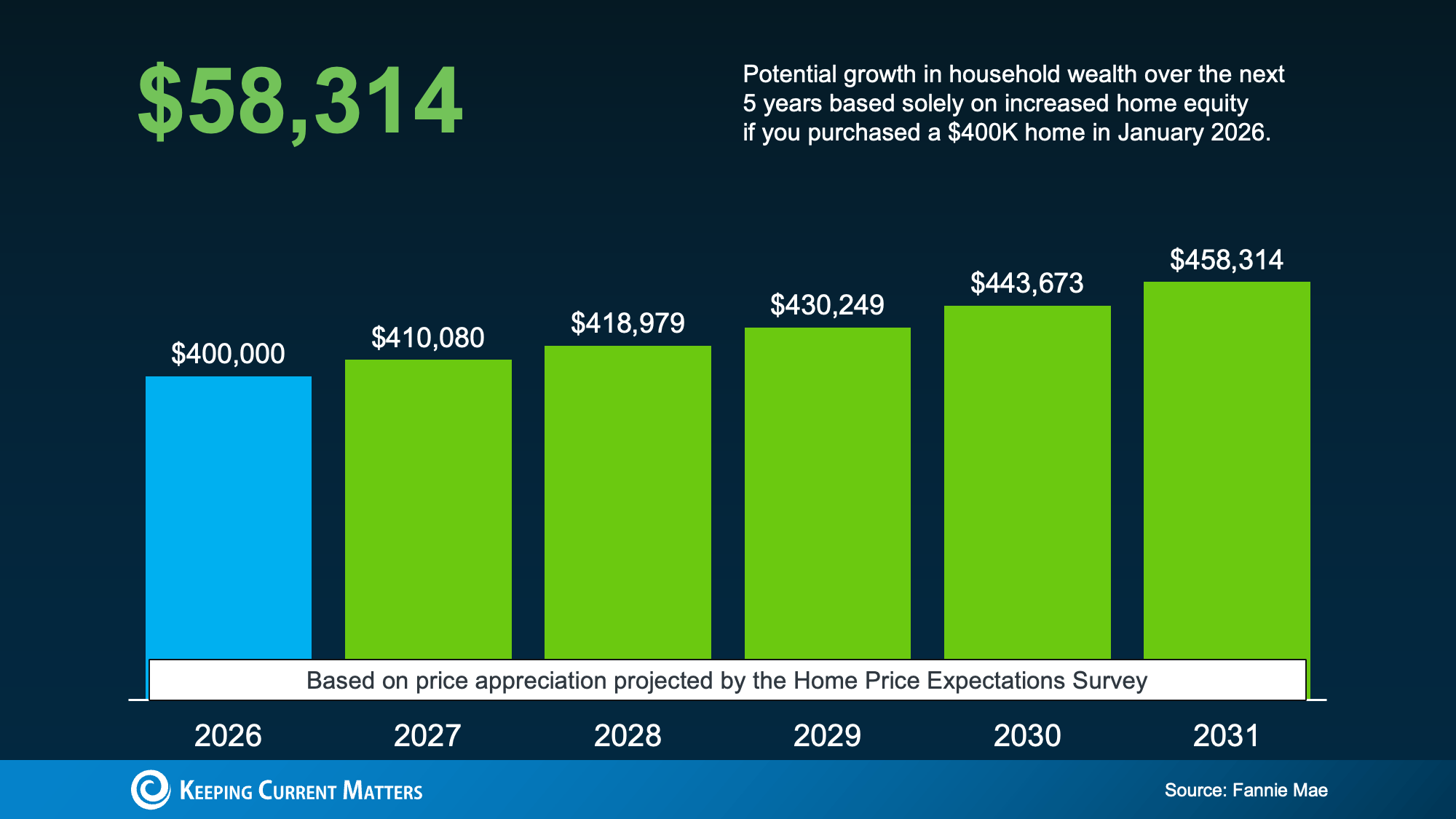
A January 2026 starting value compounds the 2026-2030 annual forecasts. January 2031 represents the end of 2030. Values exclude loan repayment, ownership and selling costs, and inflation. Sources: Pulsenomics LLC and Fannie Mae.
Appreciation can contribute to equity, which is your home’s value minus the debt secured by it. This example measures only the potential value increase. It excludes principal repayment, interest, taxes, insurance, maintenance, selling costs, and inflation, so it doesn’t represent cash profit or a guaranteed return.
The starting date matters too. This is a January 2026 scenario, not a fresh five-year projection for someone buying today. An individual property could perform differently, or even see its value slip.
Planning Your Next Move With Local Information
If prices follow the national forecast, waiting could mean paying more for a similar home. But projections and forecasts alone aren’t a reason to stretch your budget. Compare today’s total housing costs with your savings, plans, and ability to handle unexpected expenses.
Buyers should ask their agent about recent comparable sales and available inventory. Sellers can use those same local details to discuss a realistic asking price. Both can benefit from understanding their market with a local expert’s help.
Connect with a local CENTURY 21 Affiliated agent to review what these forecasts mean in your market. Consult a qualified lender or financial professional about financing and affordability before deciding when to move.