Facebook
 X
 Pinterest
 Copy Link
Credit Scoring Changes: 3 Things Homebuyers Should Know

If you’re getting ready to buy a home, it’s easy to treat the score in your credit app as a yes-or-no answer. But credit scoring changes are giving lenders new ways to evaluate some borrowers, but an app alone cannot tell you whether you qualify. Before ruling yourself out, find out which model and mortgage requirements apply to you.
1. Mortgage Credit Requirements May Be Different Than You Think
Fannie Mae has studied consumers’ mortgage knowledge since 2015. In its 2023 study, respondents’ median estimate of the minimum credit score was 652, above the 620 benchmark the report cited for loans backed by Fannie Mae and Freddie Mac.
That familiar 620 figure needs context today. Fannie Mae’s Desktop Underwriter, an automated system that evaluates applications, no longer requires a minimum credit score. Its manually underwritten fixed-rate loans generally retain a 620 minimum, with exceptions and additional requirements. Freddie Mac also lists 620 for certain fixed-rate loans, subject to its Guide. Your lender and loan program still determine the requirements for your application.
A Veterans United survey published in May 2026 shows how these perceptions can linger. Among 400 respondents planning to buy within three years:
- 66% believed near-perfect credit was necessary to get the best mortgage rates.
- 57% believed a score of at least 660 was needed to qualify.
- 34% believed they needed 700 or higher.
Of course, these are just beliefs, not actual lending requirements. Qualifying for a mortgage and receiving a lender’s lowest rate are also very different questions. Assuming you need any particular score could keep you from exploring options that may fit.

Figures reported in Veterans United’s May 4, 2026 survey article. Survey of 400 prospective buyers, March 13-24, 2026. These are consumer beliefs, not loan requirements.
2. Credit Scoring Changes Give Lenders More Options
For decades, loans sold to Fannie Mae and Freddie Mac generally relied on Classic FICO scores. To encourage competition and broaden credit assessment, the Federal Housing Finance Agency approved VantageScore 4.0 and FICO 10T in 2022.
Implementation of VantageScore 4.0 with lenders has moved at different speeds. As of November 3, 2026, all approved Fannie Mae and Freddie Mac lenders may use VantageScore 4.0 for eligible loans, following a September 9 expansion. Classic FICO remains available. FICO 10T is approved for future use but isn’t yet eligible for loan delivery to those companies.
The newer models may help lenders evaluate people with limited or less-recent credit activity. VantageScore reports that research published in July 2026 found its 4.0 model could generate scores for approximately 33 million more U.S. adults than Classic FICO. That’s an estimate of additional people who can receive a score from the model, not a count of approved borrowers.
A different model can also produce a different number for the same person. As the Consumer Financial Protection Bureau explains, scores vary with the formula, reporting source, and type of loan. The number you checked last month may differ from the mortgage score your lender uses.
3. Keep Building Credit While You Explore Your Options
The models are changing, but the everyday habits that support your credit still matter. Use this checklist as a starting point:
- Know your score. Monitor changes over time and review your credit reports for errors. Ask which scoring model an app displays.
- Build a consistent payment history. Pay bills on time and keep credit card balances low relative to your limits. You don’t need to carry a balance to build credit.
- Consider new credit carefully. Additional loans and account applications can affect your profile. Ask your loan officer before making changes during a mortgage application.
- Talk with a mortgage professional. Review your credit, budget, and loan options together so you understand the next steps for your situation.

Monitor your credit, maintain payment habits, review new borrowing, and speak with a loan officer.
Make a Plan Before You Start House Hunting
You don’t need an exact moving date to speak with a loan officer or learn what credit scoring changes affect you. Ask which score model applies, what the lender requires, and how your income, existing debts, and available savings affect the application. That conversation can give you a clearer starting point than a chart, an app, or even a friend’s experience.
When you’re ready to plan your home search, connect with a local CENTURY 21 Affiliated agent. We can help you explore available homes around the budget and timing you establish with your lender.
Can Higher Mortgage Rates Increase Housing Inventory?

When they’re usually being talked about, mortgage rates are considered an affordability challenge. But rates can also affect how many homes remain available for sale on the market. When borrowing costs rise, buyer demand may cool, homes can take longer to sell, and active inventory can grow.
The way mortgage rates and housing inventory move together sometimes feels counterintuitive, but it might mean more options for buyers waiting for the right home.
Housing Inventory Growth Has Slowed but Remains Positive
According to Realtor.com’s July 2026 report, the country had 1,126,252 active listings last month. That was a 2.1% increase from both June 2026 and July 2025. Inventory was still growing, but the annual pace had slowed sharply from 10.0% in January 2026 and 31.5% in May 2025.
The last three bars in the chart below, 2.2% in May, 1.9% in June, and 2.1% in July, show more stability than the long decline that came before them. That may indicate growth is nearing a floor, but it’s too early to call it a lasting turn.
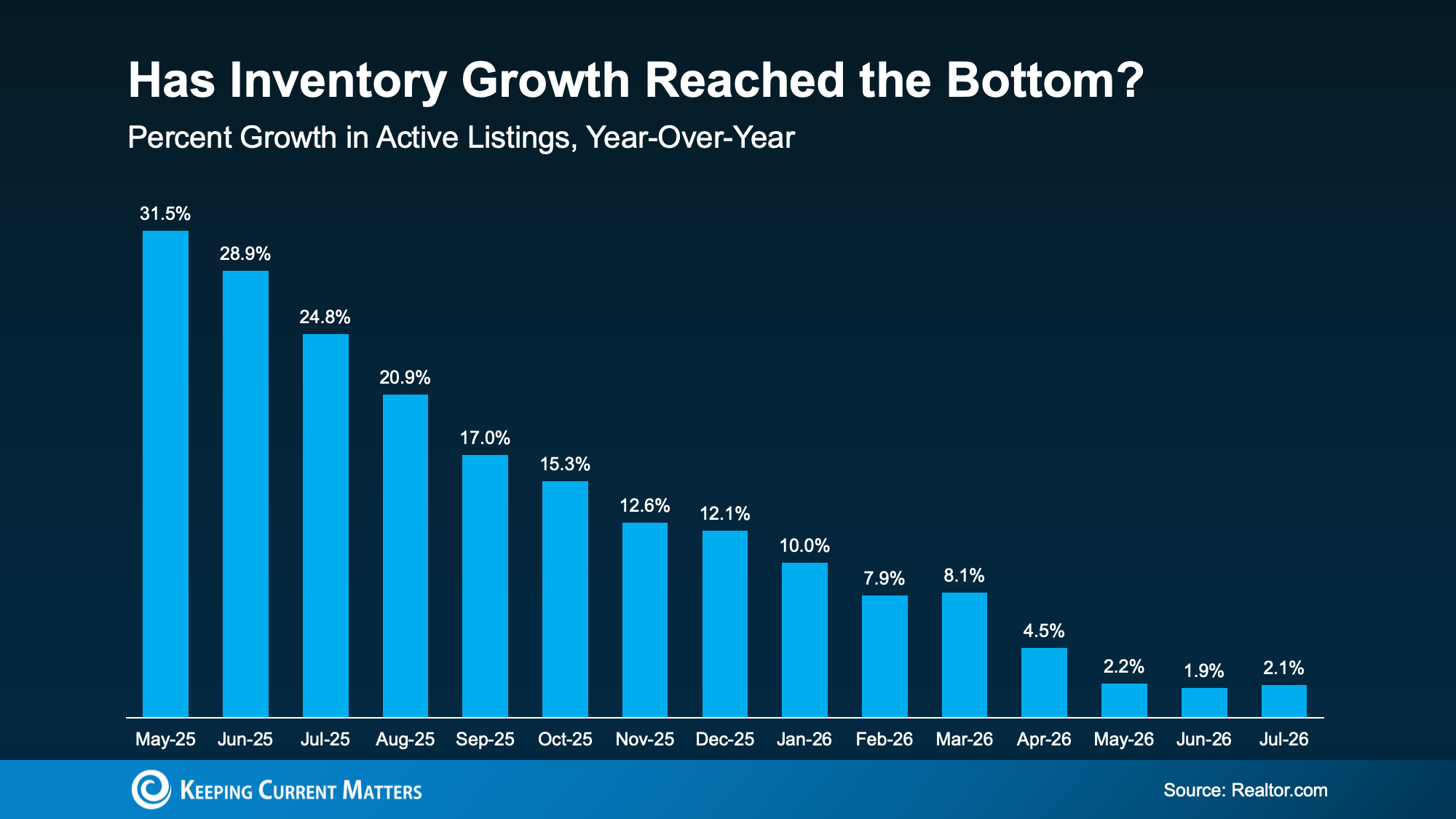
Year-over-year active-listing growth slowed from 31.5% in May 2025 to 2.1% in July 2026. Source: Realtor.com.
Housing Inventory Reached Its Best July Level Since 2019
The national listing count has now increased year over year for 33 consecutive months. July 2026 also marked the highest July inventory level since 2019. Compared with the 2021 low of 546,697 active listings, the July 2026 total had more than doubled.
Even so, supply wasn’t fully back to normal. Realtor.com reported that July inventory remained 11.6% below the typical 2017–2019 level and 9.1% below July 2019. The market is still suffering a gap of about 150,000 listings compared to pre-pandemic inventory levels. But experts think that gap could close before the end of the year thanks to mortgage rates.
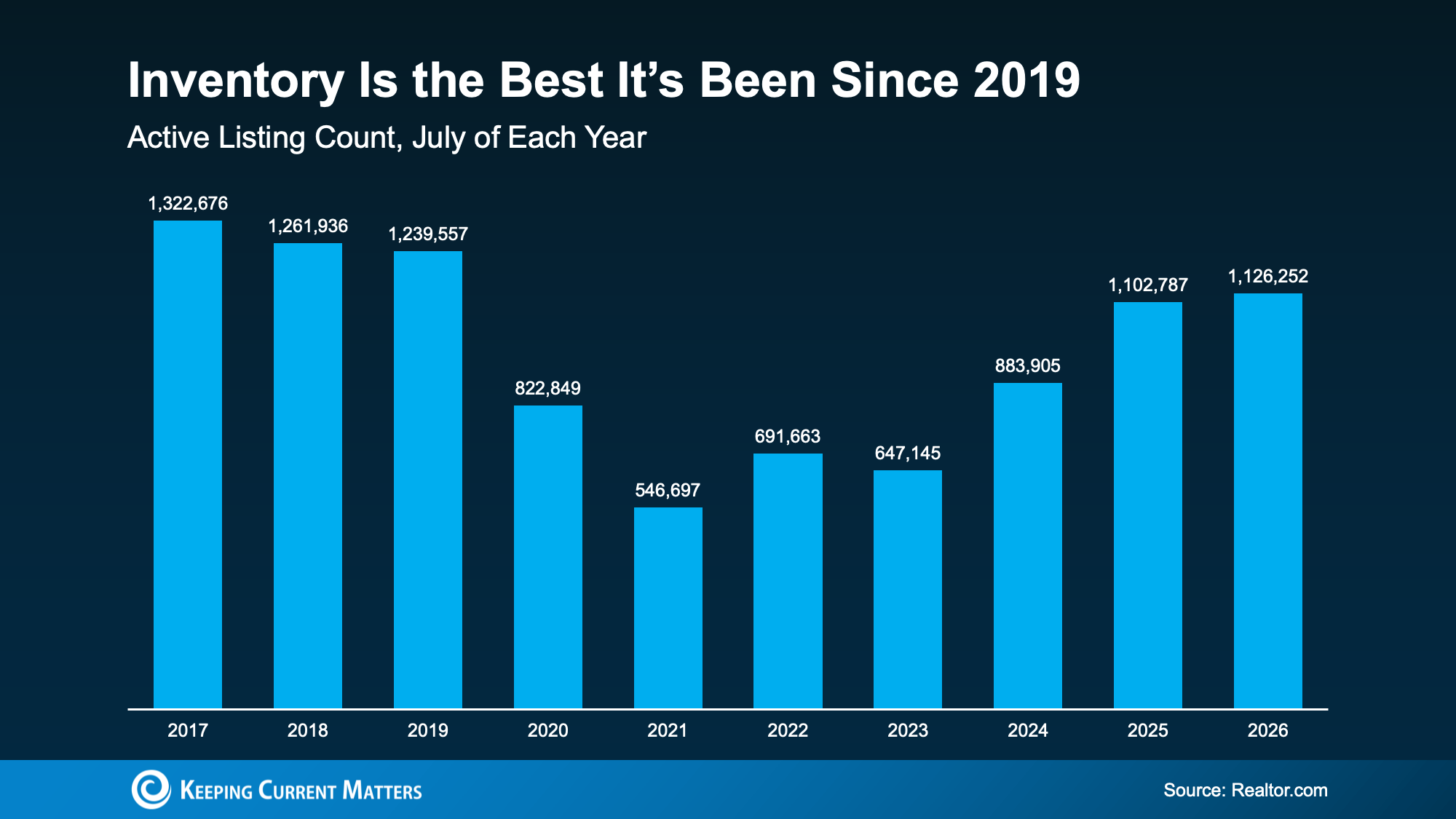
July 2026 had 1,126,252 active listings, the highest July total since 2019. Source: Realtor.com.
How Mortgage Rates and Housing Inventory Move Together
Compass Chief Economist Mike Simonsen summarizes the pattern this way:
“When rates rise, inventory rises. When rates fall, inventory falls.”
He noted that if rates stay elevated, active supply may have a chance to build during the second half of 2026.
It’s worth noting how this mechanism works. Higher rates don’t necessarily persuade more homeowners to list. Instead, they can reduce buyer activity, so available homes take longer to move into pending or closed status. Those listings remain on the market and add to the active-inventory count.
Freddie Mac reported an average 6.65% rate for a 30-year fixed mortgage on August 20, 2026. Realtor.com’s July midyear forecast projected a 6.3% average and year-end rate and a 3.6% year-over-year increase in existing-home inventory for 2026. But remember that those are forecasts, not guarantees.
What More Homes for Sale Could Mean for You
- For buyers: More active listings may give buyers a broader selection and more time to compare properties. In some markets, buyers may also have more room to discuss price, repairs, or seller concessions.
- Affordability still matters: Higher rates still affect monthly payments and purchasing power. Buyers should compare the full cost of each loan and property with qualified mortgage and real estate professionals.
- For sellers: When supply builds, sellers may face more competition from comparable homes. Accurate pricing, property preparation, and attention to current buyer feedback can become more important.
- Local demand still matters: National inventory doesn’t determine the outcome for any one property. Demand can vary by metro area, neighborhood, price range, condition, and property type.
Use Local Housing Inventory To Guide Your Next Move
National reports show the direction of the broader market. Meanwhile, local MLS data shows what buyers and sellers are actually facing. Ask a local agent to review active and new listings, pending sales, days on market, price reductions, concessions, and months of supply.
An accurate local view can help buyers decide how quickly to act and can help sellers set a realistic pricing and negotiation strategy.
Bottom Line
Higher mortgage rates remain an affordability hurdle, but they can have a secondary effect: slower buyer demand may allow active housing inventory to grow. July 2026 brought the strongest July supply since 2019, although national inventory was still below typical pre-pandemic levels.
Connect with a local CENTURY 21 Affiliated real estate agent to compare national trends with current MLS data and understand what the available supply in your market means for your move.