Facebook
 X
X
 Pinterest
 Copy Link
2025 Housing Market Predictions: What Do the Experts Say?
Wondering how the housing market is expected to change in 2025? And more specifically, what it all means for you if you plan to buy or sell a home? As always, the best way to get that information is to consult the pros.
Experts are constantly refining their predictions in response to changes in the market and overall economy. Here’s the latest information on two key factors sure to influence the housing market in 2025: mortgage rates and home prices.
Will Mortgage Rates Come Down?
Mortgage rates remain one of the strongest factors influencing the market, and everyone is waiting for them to come down. The real question is: will they drop, and how quickly?
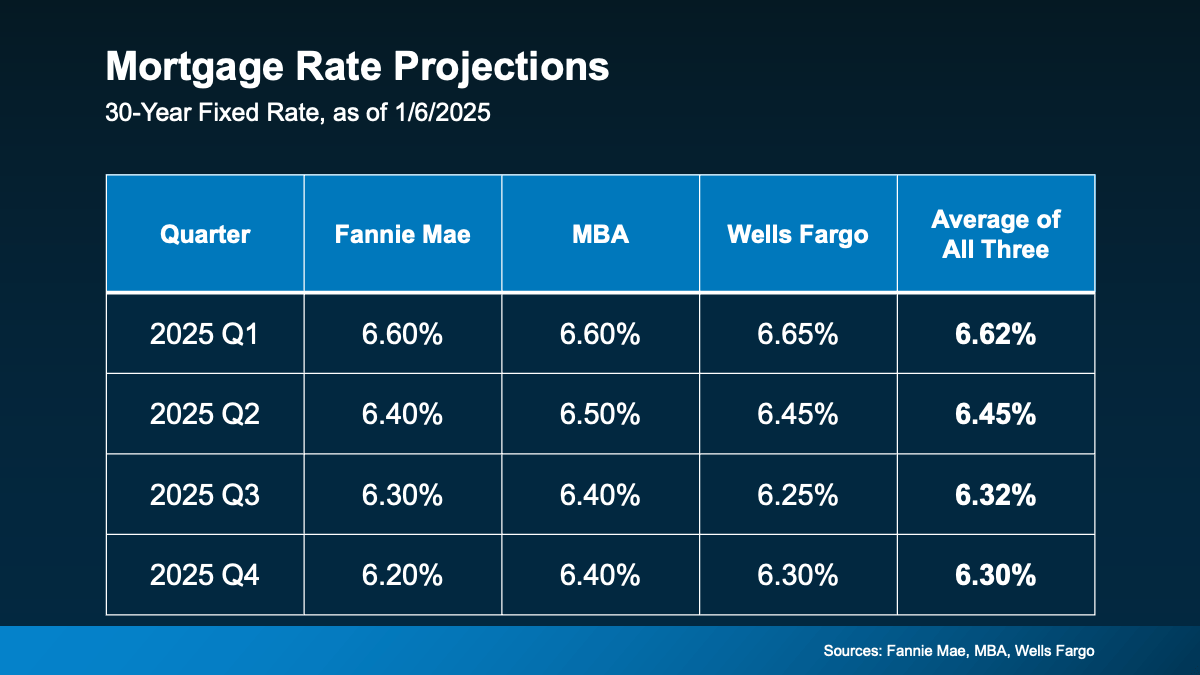
The good news is that mortgage rates are indeed projected to ease a bit in 2025, falling into the mid-6% range on average. But experts say not to expect a return to 3-4% mortgage rates, at least not this year. As Lawrence Yun, Chief Economist at the National Association of Realtors (NAR), says:
“Are we going to go back to 4%? Per my forecast, unfortunately, we will not. It’s more likely that we’ll go back to 6%.”
Other experts agree with Yun’s 6% prediction. They’re forecasting rates could settle in the mid-to-low 6% range by the end of 2025 (see chart below):
But remember that the market can change quickly, and experts will revise their predictions as the new year continues. Market forecasts are based on what experts know right now. And since everything from inflation to economic drivers have an impact on where rates go from here, some ups and downs are still very likely. So, don’t get caught up in the most exact numbers and try to time the market. Instead, focus on the overall industry trend and on what you can actually control.
A trusted lender and a local agent partner will make sure you’ve always got the latest data and the context on what it really means for you and your financial goals. With their help, you’ll see that even a small decline in mortgage rates can help bring down your future mortgage payment when you decide to buy.
Will Home Prices Fall?
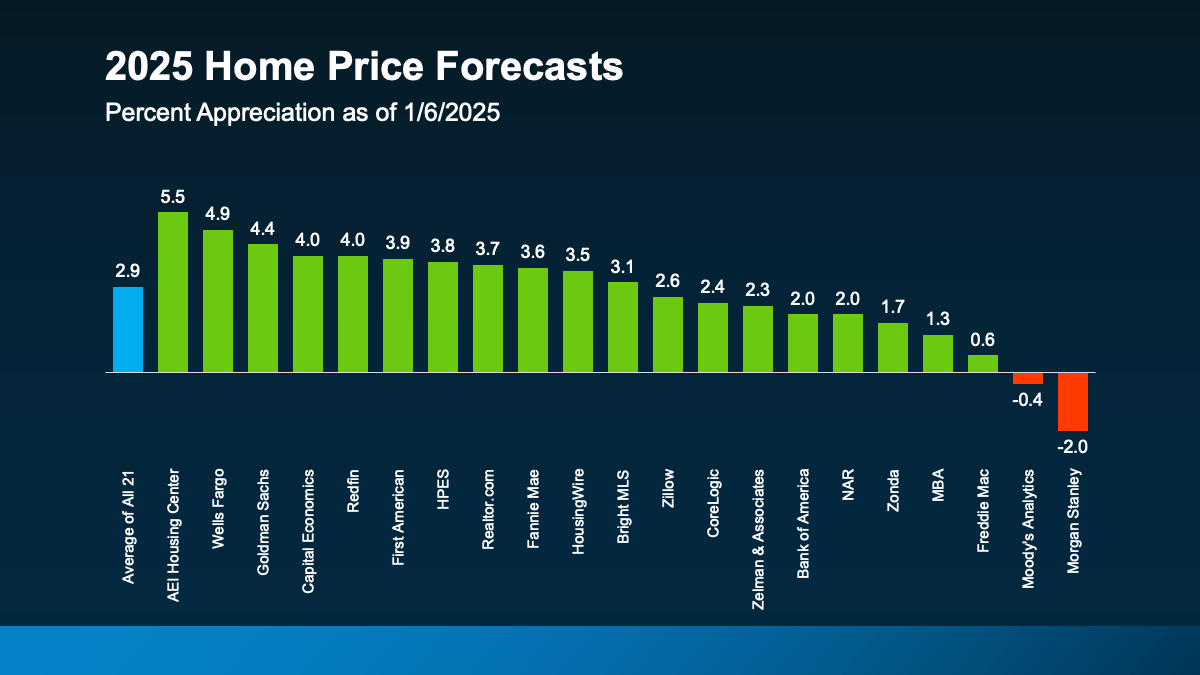
The short answer? Not likely. While mortgage rates are expected to ease, home prices are projected to keep climbing in most areas – but at a slower, more normal pace. If you average the expert forecasts together, you’ll see prices are expected to go up roughly 3% next year, with most of them hitting somewhere in the 3 to 4% range. But this is a much more typical and sustainable rise in prices compared to (see graph below):
If you’re thinking of buying in 2025, don’t expect a sudden drop to score you a big deal. That may sound disappointing if you’re hoping for home prices to come down, but this means you won’t have to deal with the steep increases we saw in recent years. You’ll also likely see any home you do buy go up in value after you get the keys in hand, and this can turn into a great investment over time.
Like many buyers, you might be wondering how it’s even possible that home prices are still rising. The answer all comes down to supply and demand. Even though there are more homes for sale now than there were in 2024, it’s still not enough to keep up with all the active home buyers on the market. As Redfin explains:
“Prices will rise at a pace similar to that of the second half of 2024 because we don’t expect there to be enough new inventory to meet demand.”
Keep in mind that the housing market is hyper-local, so this will vary by area. Some markets will see even higher prices, and some may see prices level off or even dip if inventory is up in that area. In most places though, prices will continue to rise as they usually do.
If you want to find out what’s happening in your local housing market, it always helps to lean on an agent who can explain the latest trends and what they mean for your homeownership plans.
Conclusion
The housing market is always changing, and 2025 will be no different. With mortgage rates likely to ease down to the 6% range and prices rising at a slower, more sustainable pace, it could be a great time to finally buy or sell. As always, it’s all about staying informed and making a plan that works for you.
If you’re in the market to buy or sell a home in 2025, let’s connect you with a local agent who can give expert advice on what’s happening in your area and make sure your next move is a smart one.
Dan Kruse of CENTURY 21 Affiliated Recognized Among the Industry’s Most Influential Leaders

[Madison, WI] – January 13, 2025 – CENTURY 21 Affiliated is proud to announce that its President and CEO, Dan Kruse, has been ranked #109 on the prestigious 2025 Swanepoel Power 200 (SP 200), a definitive ranking of the most powerful and influential leaders in the residential real estate industry.
The Swanepoel Power 200, published annually by T3 Sixty, evaluates leaders based on their achievements, influence, and contributions to the real estate industry. The ranking underscores Kruse’s dedication to innovation, leadership, and commitment to providing unparalleled value to CENTURY 21 Affiliated agents, clients, and communities.

Dan Kruse – CEO and President of CENTURY 21 Affiliated
“I am incredibly honored to be recognized among so many trailblazers in our industry,” said Dan Kruse. “This acknowledgment is a reflection of the extraordinary efforts of all our CENTURY 21 Affiliated real estate professionals. Together, we are setting a standard of excellence for agents and clients alike.”
Under Kruse’s leadership, CENTURY 21 Affiliated has solidified its position as one of the largest and most successful CENTURY 21 franchises in the world, with a steadfast focus on agent support, cutting-edge technology, and community engagement. His forward-thinking strategies have led to record-breaking achievements for the company, including expanding its footprint across multiple states, fostering a culture of growth and innovation, and holding the record for most transactions by a single CENTURY 21 franchise.
Kruse’s inclusion on the SP 200 highlights his role as a visionary leader driving success not only for CENTURY 21 Affiliated but also for the real estate industry as a whole.
For more information about CENTURY 21 Affiliated and its innovative approach to real estate, please visit C21Affiliated.com.
About CENTURY 21 Affiliated
CENTURY 21 Affiliated is a member of multiple listings services in California, Illinois, Michigan, Minnesota and Wisconsin with more than 1,400 sales professionals and 60+ offices. CENTURY 21 Affiliated also specializes in worldwide relocation. At CENTURY 21 Affiliated, the customer comes first. The complete commitment to this philosophy is what has made CENTURY 21 Affiliated such a powerful force in the real estate industry. CENTURY 21 Affiliated has been ranked the No. 1 CENTURY 21® franchise in the world for eleven years.
###
Closing on a House: A Step-By-Step Buyer’s Guide

The process of closing on a house is the final stretch before home ownership is transferred and the property becomes legally yours. If you’re a new homebuyer, the closing process and its various steps can be confusing and intimidating. This short guide will outline the home closing process and help simplify your final steps to home ownership.
10 Steps to Closing on a House
The closing process can vary from transaction to transaction but generally tends to follow the same basic milestones. Here are 10 major steps of the closing process you’ll need to follow to complete your home purchase.
1. Offer and Acceptance
The closing process typically begins when the seller accepts your offer to purchase the home. This agreement sets the terms, including the purchase price and any contingencies.
2. Open an Escrow Account
Escrow plays a pivotal role in the real estate closing process. An escrow account is established to hold funds and documents until the transaction is finalized. This account is managed by a neutral third party, such as an escrow agent or title company, which also manages the transfer of the property title.
3. Conduct a Title Search and Obtain Title Insurance
A title search ensures the property is free of liens or ownership disputes so you can be sure you’re buying a home with a clear title. Meanwhile, title insurance protects you from future claims against the property and covers legal costs if past owners have unresolved claims. Together, a title search and insurance provide a buyer with legal safeguards and extra peace of mind during the closing process.
4. Schedule a Home Inspection
Hire a professional inspector to evaluate the property’s condition. Address any issues identified during the inspection by negotiating repairs or price adjustments with the seller. While costly, this will save you from any unexpected repairs and expenses after closing.
5. Negotiate Closing Costs
Work with the seller to determine who will cover specific closing costs, which may include loan fees, appraisal fees, and title insurance. Always review your settlement statement thoroughly to understand what costs you’re responsible for and if any are negotiable.
6. Secure Financing
Finalize your mortgage by submitting required documents, locking in your interest rate, and obtaining loan approval. Ensure you receive a Loan Estimate and Closing Disclosure from your lender. Timelines for a mortgage approval can vary, so stay in constant communication with your lender to monitor progress and respond promptly to any additional requests they make.
7. Review All Documents
Carefully review the Closing Disclosure (or settlement statement), which outlines the final loan terms and closing costs. Pay special attention to any discrepancies in loan terms or fees to avoid unexpected expenses in the future. Verify all details are accurate and address any remaining issues immediately.
8. Conduct a Final Walk-Through
Perform a final inspection of the property within 24-48 hours before closing. Confirm the property is in the agreed-upon condition and that all negotiated repairs have been completed. Following a walk-through checklist can be a convenient way to personally check each area of the home ands its condition.
9. Attend the Closing Meeting
At the closing meeting, sign all necessary documents, including the deed, mortgage, and promissory note. Pay the remaining closing costs and down payment. Address any potential closing delays, such as remaining problems from the title search or home inspection.
10. Transfer of Ownership
Once all documents are signed and funds are transferred, the title is recorded, and ownership officially transfers to you. You’ll receive the keys to your new home and will finally be ready to begin moving in. Congratulations!
Conclusion: From Buyer to Homeowner
With the closing transaction complete, it’s time to enjoy your new home! Before putting your closing behind you, take care of any post-closing responsibilities you may still have to a third party other than your lender. Next, you’re ready to begin your transition into the next step of your journey as an official new homeowner.
Interested in closing on a house or making that first leap into home ownership but unsure where to start? Contact us today to connect with an expert real estate agent for help on your homebuying journey, or start a property search in your local area now.
How to Get a Real Estate License in Wisconsin

Are you considering embarking on a career in real estate sales in the Dairy State? First, you’ll need to become officially licensed.
A real estate license is your ticket to a rewarding realty career, opening doors to numerous opportunities. But how do you get a real estate license in Wisconsin?
In this guide, we’ll walk you through the process of how to get a real estate license in Wisconsin. From meeting eligibility criteria to passing the Wisconsin real estate license exam, we’ve got you covered. Let’s get started.
Understanding Wisconsin Real Estate Licensing Requirements
Before getting started, make sure you understand the basic licensing requirements. In Wisconsin, these are set by the Wisconsin Department of Safety and Professional Services (DSPS).
The requirements include specific education, exam, and application steps. These ensure you’re well-prepared for your real estate career.
Here’s a quick overview of the requirements:
- Be at least 18 years old
- Complete 72 hours of pre-licensing education
- Pass the Wisconsin real estate license exam
- Apply for the license with DSPS
- Find a sponsoring broker
Step 1: Meet the Eligibility Criteria
The first step is to ensure you meet the basic eligibility criteria. You must be at least 18 years old to apply for a real estate license in Wisconsin.
Also, you must have a high school diploma or equivalent. This is a standard requirement across most states.
Step 2: Complete Pre-Licensing Education
Next, you need to complete the required pre-licensing education. This is a 72-hour course approved by the DSPS and administered at a board-approved institution.
The course covers key topics like real estate law, contract law, and principles of real estate. It prepares you for the Wisconsin real estate license exam. We offer our own board-approved licensing course taken totally online and available at a discounted rate.
Upon completion of an approved course, you will receive a certificate. This is proof of your successful completion of your pre-licensing education and must be provided to DSPS when applying for your license.
Alternatively, you can also complete 10 academic semester hour credits in real estate or real estate-related law at an approved institution of higher learning.
Step 3: Register for the Wisconsin Real Estate License Exam
After completing your pre-licensing education, it’s time to register for the exam. You can do this through Pearson VUE, which the state has partnered with to administer real estate exams.
The Wisconsin exam consists of two parts: the national portion and the state-specific portion. Both parts must be passed to qualify for a license.
Remember to schedule your exam date well in advance to secure your preferred timeslot.
Step 4: Study and Pass the Wisconsin Real Estate License Test
The Wisconsin real estate license test is a comprehensive exam. It covers a wide range of topics, from property laws to ethical guidelines.
To pass, you’ll need to study diligently. Consider using study guides and practice tests to prepare. These resources can help you understand the exam format and the types of questions you’ll face.
Remember, passing the exam is a crucial step in getting your real estate license in Wisconsin. So, take your preparation seriously.
Step 5: Apply for Your Real Estate License
Once you pass the exam, it’s time to apply for your license. You’ll need to submit an application to the Wisconsin DSPS online LicensE platform.
The application process involves providing proof of your education and exam results. You’ll also need to pay the required fees.
Remember, the DSPS will review your application before issuing your real estate license, so ensure that all your information is complete and accurate.
Step 6: Choose a Sponsoring Broker
After getting your license, you’ll need to find a sponsoring broker. This broker will guide you through your early career stages.
Choose a broker who aligns with your career goals. They should offer support, training, and a conducive work environment.
If you’re interesting in joining one of the largest real estate brokerages in Wisconsin, consider earning your license with us at CENTURY 21 Affiliated.
Maintaining Your Real Estate License in Wisconsin
Once you have your license, it’s crucial to keep it active. This involves meeting certain requirements set by the DSPS and reapplying every two years.
These include:
- Completing approved continuing education courses.
- Renewing your license every two years or on every even-numbered year by December 14.
- Staying updated on changes in real estate laws and regulations.