Facebook
 X
X
 Pinterest
 Copy Link
Home Affordability Improved in All 50 States: What Buyers Need To Know
For the past few years, affordability has been one of the biggest reasons buyers have put their home search on hold. Maybe you did the same.
At some point, you may have looked at the numbers, saw what a monthly mortgage payment would be, and decided to wait for the market to become more manageable. But there’s encouraging news you may have missed.
Over the past year, housing affordability has improved in all 50 states. Yes, every single one.
That’s according to new research from First American. And while buying a home is still more expensive than what’s historically normal, the affordability pressure many buyers have felt over the last several years is finally starting to ease.
Some Markets Are Seeing Bigger Improvements
One of the most important things to understand is this isn’t limited to one part of the country or just a few select markets. Affordability is improving almost all over the country.
Of course, real estate is always local. Conditions can vary a lot from one state, city, or neighborhood to the next. But overall, the market is becoming more favorable for buyers. In fact, affordability has improved in 48 of the top 50 metros over the past year.
That same research also highlights the top 10 cities seeing the biggest gains in affordability:
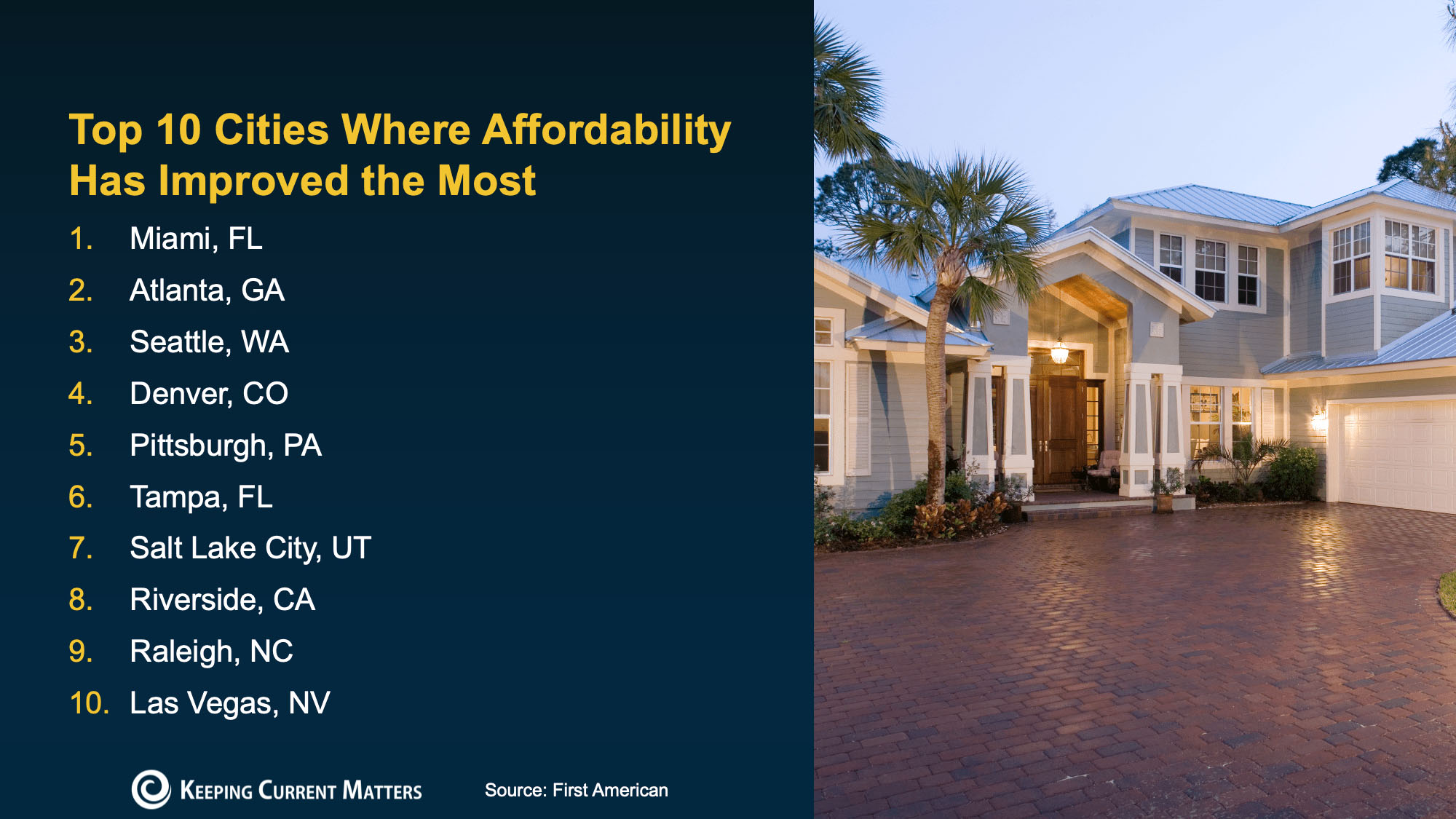
Top 10 Cities Where Home Affordability Has Improved the Most
- Miami, FL
- Atlanta, GA
- Seattle, WA
- Denver, CO
- Pittsburgh, PA
- Tampa, FL
- Salt Lake City, UT
- Riverside, CA
- Raleigh, NC
- Las Vegas, NV
If you’re wondering why some markets are improving faster than others, a lot of it comes down to home inventory.
When there are more homes for sale, the market becomes more balanced. This can help improve affordability by giving buyers more negotiating power. With more options available, buyers may have a better chance of finding a home that fits their budget, and they may also be in a stronger position to ask for seller concessions, price reductions, or closing cost assistance.
That can make a bigger difference than many people expect.
What Does This Mean for Buyers?
Home affordability challenges haven’t disappeared altogether, obviously. Buying a home is still a major financial decision, and housing prices remain high in many markets. But the overall nationwide trend is moving in a direction that gives buyers more opportunity than they’ve had in recent years.
As Chen Zhao, Head of Economic Research at Redfin, explains:
“The housing affordability crisis is showing signs of easing. . . opening the door for more Americans to make the jump to homeownership.”
Conclusion
If you’ve been waiting on the sidelines for affordability to improve, this may be the sign you’ve been hoping for. To find out what’s happening in your local market and how much buying power you may have today, connect with a trusted local real estate agent.
Top 10 Best Real Estate Markets for First-Time Buyers in 2025
If you’re like many aspiring homebuyers, the rising cost of living might feel like a major roadblock. From groceries to gas, and yes, especially home prices, everything seems to be getting more expensive.
But even in today’s market, there are still ways to make your homeownership dreams a reality. The key is knowing the current best real estate markets and how to approach your first home purchase strategically.
Think of Your First Home as a Stepping Stone
One of the biggest misconceptions among buyers is that their first home has to be their dream home. The truth is, your very first home doesn’t need to check every box on your wish list. Instead, think of your first home as a stepping stone to your final destination.
Owning a home allows you to start building equity, which grows over time as home prices increase. That equity can be a powerful tool when you’re ready to upgrade to a bigger home or move to a more desirable location in the future.
Rather than waiting until you can afford your dream home in your ideal neighborhood, consider starting with something that fits your current needs and budget. This approach gets you into the market sooner and may cost you in the short-term, but it sets you up for long-term financial growth. Best of all, it’s a real start to eventually buying your dream home at some point in the future.
Explore the Best Real Estate Markets in 2025
If the price of homes in your preferred area are holding you back, it might be worth broadening your search. With some flexibility in location, you can find more affordable options without sacrificing the amenities most important to you. Many first-time buyers find homebuying success by exploring surrounding areas or even considering a move to a different state.
According to a report from Realtor.com, these are the 10 best real estate markets for first-time homebuyers in 2025:
- Rochester, NY with a Median List Price of $129,900.
- Lansing, MI with a Median List Price of $135,000.
- Harrisburg, PA with a Median List Price of $140,000.
- Lauderdale Lakes, FL with a Median List Price of $154,850.
- North Little Rock, AR with a Median List Price of $160,000.
- Baltimore, MD with a Median List Price of $210,000.
- Wilmington, DE with a Median List Price of $222,000.
- Altamonte Springs, FL with a Median List Price of $229,400.
- Tonawanda, NY with a Median List Price of $229,000.
- Villas, FL with a Median List Price of $236.950.
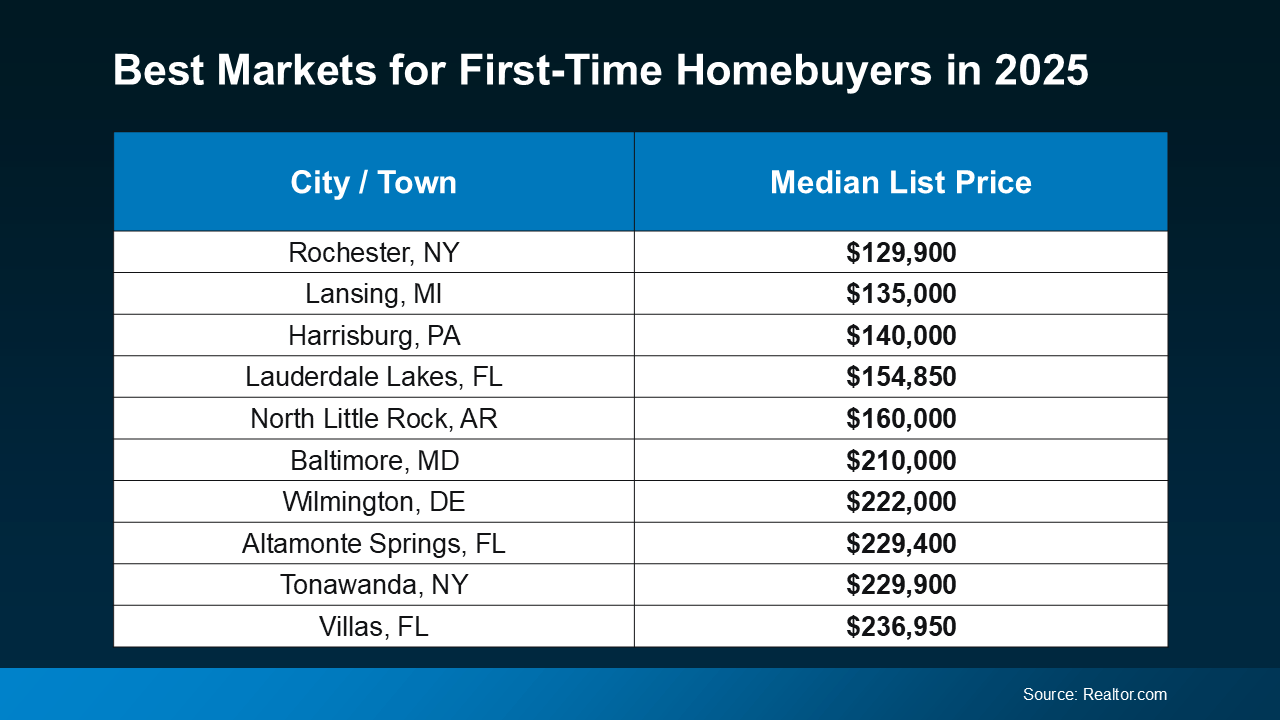
Realtor weighted their market rankings by several factors including median price, location score, number of home listings, average commute time, and others specified in the full report. If one of these cities is in or near your target home location, it’s worth looking to see what properties are available. Even if you don’t find your dream home, you might find the perfect starter home on the path to it.
Stay Local and Look Just Outside Your Preferred Area
If moving to a different state isn’t an option, you can still find affordable homes by expanding your search locally. Sometimes, looking even just 10 to 20 minutes outside your ideal neighborhood can make a significant difference in price. Nearby areas can often offer similar amenities, like access to restaurants, shops, and activities, but at a lower cost.
And the best way to see what’s available is to work with a real estate agent who understands the local market and can help you identify hidden gems nearby. An agent can point you to communities you may not have considered that have lower price tags now and are steadily gaining value and appeal. That way you can buy your first home and be set up to gain equity through the years.
Conclusion
Today’s cost of living is a challenge for many homebuyers, but by exploring 2025’s best real estate markets and working with a knowledgeable agent, you can take that first step toward owning a home this year, and building equity for your future.
How far outside your area would you be willing to look to make your homeownership dreams a reality? Connect with us to discuss your options and find the perfect market for your first home.
Modular Homes vs. Regular Homes: How Do They Compare?
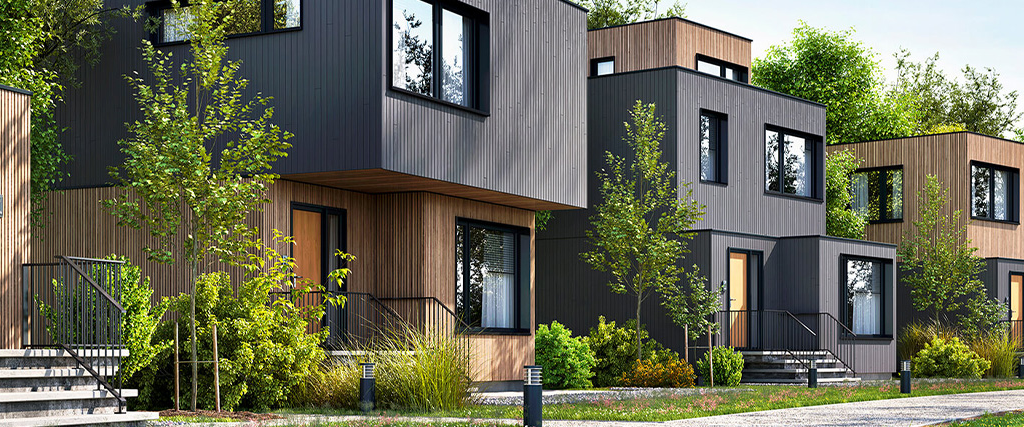
Between the woes of rising home prices and a lack of new inventory, many eager home buyers are exploring newer, more accessible options for achieving home ownership. One increasingly popular choice among new homeowners is the modular home, a type of prefabricated housing designed to offer increased affordability, customizability, and even construction quality over conventional site-built homes. But what exactly is a modular home, and how does it compare to a traditional single-family home? Keep reading for all the information you need to answer these questions and decide if a modular home is right for you.
What is a Modular Home?
Modular homes are a type of prefabricated housing built in individual sections or modules in a factory and then transported to the site for assembly. Unlike other prefab units, modular homes are placed onto a permanent foundation during assembly, and are built to the same building codes and regulations as traditional homes. Because modular homes are composed of different modules or “pieces”, the buyer has much more freedom and control over the design, layout, and style of the final product.
The main difference between modular homes and other prefabricated housing is the construction process. Modular homes begin as individual modules built in a controlled factory environment, which allows for increased efficiency and quality control. Once the modules are completed in the factory, they are transported to the site and assembled to create the finished home. This assembly process typically takes a shorter amount of time compared to traditional home construction, as the modules are already built and only need to be connected together. The result is a quickly-built and affordable new home, custom-tailored to fit the buyer’s preferences and needs.
Despite these differences from traditional site-built homes, modular homes are subject to the same building codes and meet the same standards of quality and safety. However, like any manufactured product, quality of service and construction can vary between sellers, so it’s advisable to buy from a trusted builder.
Quality Construction
One major advantage of modular homes is the quality construction that scaled factory production provides. In addition to following the same building codes as regular homes, the controlled factory environment ensures that modular homes are consistently produced at a set quality standard. Reputable manufacturers also produce home modules using the same materials that regular home builders do, making sure that a completed modular home meets or exceeds the quality of a traditional one. Of course, this may vary between manufacturers, so it’s always a good idea to research and confirm a builder’s practices before choosing one.
Customizable Options
As their nature implies, modular homes offer customization and creative freedom far beyond a traditional home. The ability to choose and combine different modules provides a considerable number of potential floorplans, allowing homeowners to personalize their new living space. Modular homes also offer the flexibility of adding additional modules in the future, providing the option to expand and adapt your home over time. Meanwhile, regular homes often have limited options for expansion, especially in planned communities or developments. This is even truer of starter homes, which can be costly to expand with added square footage thanks to construction costs. Naturally, this leads us to the last and perhaps most attractive strength of modular construction: cost-effectiveness.
Affordability
Modular homes and their owners enjoy considerable advantages in cost and affordability over regular homes. According to SoFi, modular homes tend to be 10% to 20% cheaper than traditional homes. The simplicity and efficiency of large-scale factory production means modular homes can be constructed and assembled at much lower costs than traditional homes. In addition, housing modules made with high quality materials are often more energy-efficient thanks to more effective insulation, which results in savings on utility bills during summer or winter. The combination of these lower costs provides a home that’s not only more affordable to buy, but more affordable to live in as well. In contrast, regular homes can have higher construction costs due to the increased labor required. The potential for weather delays can also extend a new house’s required construction time, driving up the final cost even further.
Is a Modular Home Right for Me?
Modular homes can be a great option for new home buyers who want the option to expand in the future, but there are downsides to consider as well. You’ll need to work with a contractor to purchase a parcel of land for your modular home, and finding suitable land can be difficult. Purchasing a modular home might require a construction loan rather than a mortgage, and some lenders may not finance a modular home due to unfamiliarity and inexperience. Reselling a modular home can also be challenging due to their customization as well as public misconceptions about their quality and desirability.
If you’re considering a modular home but have reservations, it’s always a great idea to consult a real estate professional or financial advisor. Modular homes certainly aren’t for everyone, but they can be the perfect alternative to the costs and long-term commitments of a regular home.