Facebook
 X
X
 Pinterest
 Copy Link
Data centers near homes are becoming a new consideration for buyers, sellers, and homeowners. These buildings house computer servers, but their presence can raise questions about property values, neighborhood changes, and monthly utility costs.
A nearby data center facility doesn’t necessarily mean your home will gain or lose value. Recent research offers useful context, and the details of the project and your property are worth considering.
Why Data Centers Near Homes Are Becoming More Common
According to Realtor.com’s August 2026 report, 12 U.S. ZIP codes contained a large data center in 2015. By June 2026, that count reached 108, with 125 projected by year-end. The report defines large facilities as having at least 50 megawatts of power capacity.
HousingWire highlights Texas, Virginia, Georgia, Pennsylvania, Ohio, Utah, Illinois, Arizona, Indiana, and Nevada as states with substantial development pipelines. As data center facilities expand into more communities, more buyers and homeowners will encounter existing or proposed projects.
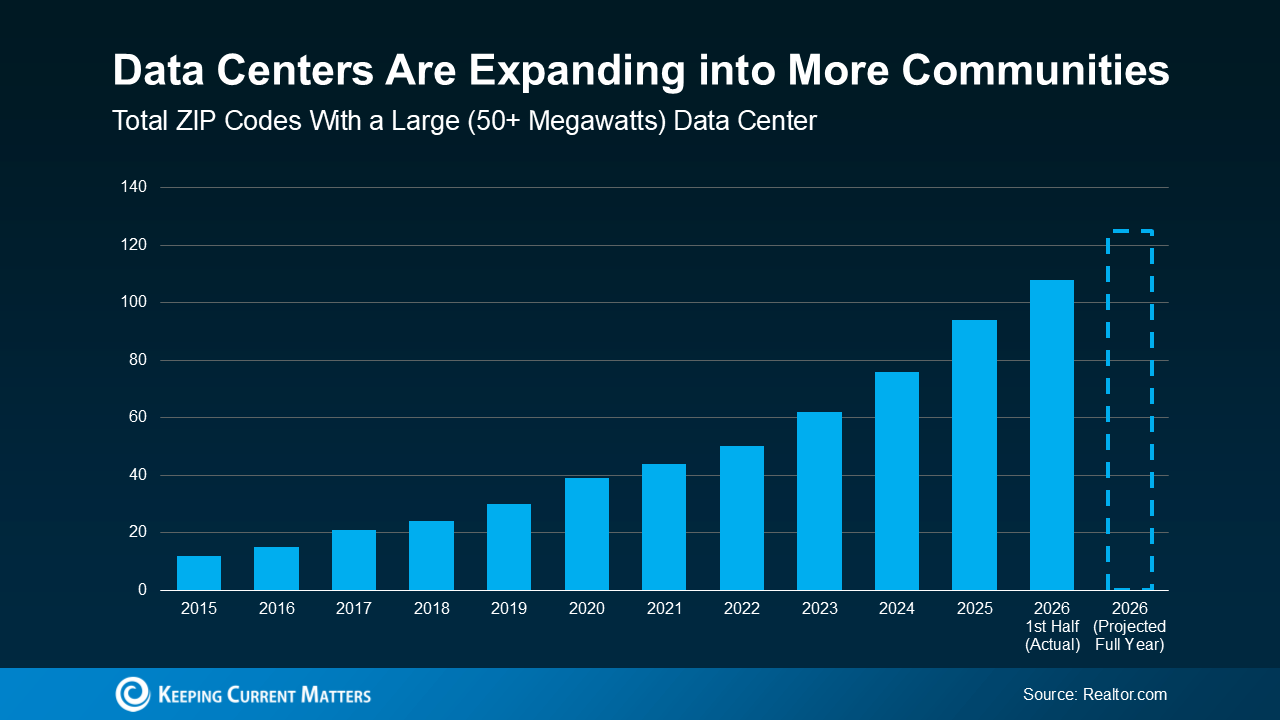
U.S. ZIP codes containing a data center with at least 50 megawatts of capacity. The outlined bar is the full-year 2026 projection. Source: Realtor.com.
What the Research Says About Home Values
Realtor.com compared 43 ZIP codes that received large data centers between 2019 and 2025 with similar communities. HousingWire summarized the findings:
“. . . home values in data center ZIP codes generally tracked their matched communities — with no statistically meaningful gains or losses. Listing prices showed a modest initial increase around openings . . .”
The small initial increase in asking prices faded within two years. The findings don’t support an automatic gain or loss for a home’s value simply because a data center opens nearby.
That said, the study covers only the first two years after opening and excludes Texas and 11 other states without publicly disclosed sale prices. ZIP-code averages can’t predict any individual property’s value. Distance, surrounding development, facility design, and longer-term effects still deserve attention and research.
Potential Benefits and Concerns
Like other major developments and investments, data centers can bring some benefits along with other changes residents may notice.
Potential benefits
- Property-tax revenue may help fund community improvements. The benefit depends on tax incentives and local spending decisions.
- New roads, fiber connections, and power infrastructure may accompany a facility and broader development.
- Construction and operating jobs can support local businesses and housing demand, though their scale and duration vary.
Possible concerns
- Large buildings, transmission lines, substations, and construction can change nearby views and the character of an area.
- Cooling equipment, generators, construction, and truck traffic may create noticeable noise, depending on proximity and site design.
- Significant electricity demand and cooling-related water use can put pressure on infrastructure. Water needs depend on the facility’s cooling system.
How Data Centers May Affect Utility Bills
Growing electricity demand can affect costs, but data centers are one of several potential influences. Your utility, regional power market, and local rules help determine who pays for additional infrastructure.
Ari Peskoe, director of Harvard Law School’s Electricity Law Initiative, told HousingWire:
“Utility rate increases tend to be gradual, and so that’s what I would expect here. Again, a number of factors can drive electricity prices higher and are driving them higher, and this is one of them. There are steps being taken around the country to mitigate the effects of data centers.”
For a home purchase, ask the utility provider about current rates and approved changes. A present-day bill can inform your budget, but it can’t guarantee future costs.
What To Check Before Buying or Selling
- Buyers: Review what’s operating, approved, or proposed nearby. Ask the local planning department about project timelines and future development, and consider distance, noise, views, and utility costs.
- Sellers: Prepare factual information about the facility, construction schedule, noise, and future plans. Work with your agent on comparable sales, and consult an appropriate professional about disclosure requirements.
Have a data center nearby or one proposed? Connect with a local CENTURY 21 Affiliated real estate agent to review the project, discuss your home’s local market position, and plan your best move.