Facebook
 X
X
 Pinterest
 Copy Link
If you’re feeling confused by the housing market right now, you’re not alone.
Mortgage rates have risen. Home sales haven’t picked up as quickly as many experts expected. And buyers and sellers are still waiting for affordability to improve and market activity to turn up.
The short answer? A lot changed during the first half of 2026.
At the end of 2025, economists were forecasting a stronger housing market for the year ahead. Many expected mortgage rates to come down, affordability to improve more noticeably, and home sales to rebound.
But lingering inflation, economic uncertainty, and growing geopolitical tensions overseas pushed mortgage rates higher than expected. With rates staying elevated for longer, many buyers have continued to wait on the sidelines.
Unexpected factors like these have forced experts to revise their housing forecasts for the rest of the year.
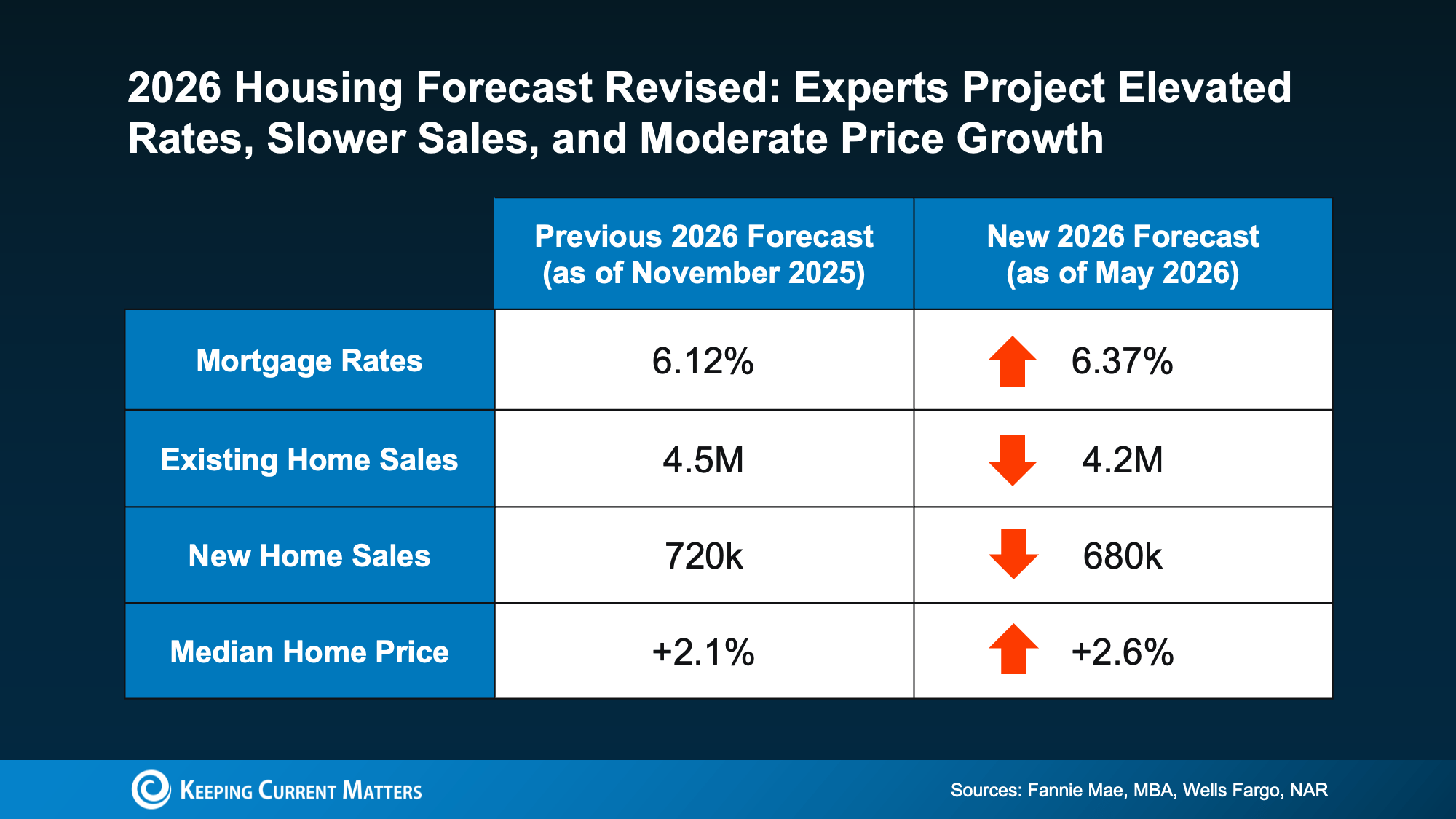
Experts are now projecting elevated mortgage rates (6.37%) and a dip in total home sales. However, home values remain resilient with a projected 2.6% growth in median prices.
So, what does this mid-year housing market update actually mean for you? Let’s break it down.
Mortgage Rates May Stay Elevated Longer Than Expected
Just about everyone would like to see mortgage rates return to the upper 5s or low 6s we saw earlier in the year. But based on current forecasts, experts don’t expect that to happen this year.
Instead, many industry organizations now expect mortgage rates to stay closer to the mid-6% range in 2026. The good news is that this is still lower than rates were a year ago.
Of course, forecasts can change. If inflation cools or overseas conflicts ease, mortgage rates could shift again. But for buyers waiting for a major rate drop, the payoff may not be as big or as immediate as hoped.
For many buyers, the better question may be: Can you comfortably afford a home at today’s rate? If the answer is yes, waiting may not automatically put you in a stronger position.
Existing Home Sales Were Revised Lower
At the end of 2025, experts expected existing home sales to average around 4.5 million in 2026. That forecast has now been revised down to about 4.2 million.
That change tells us something important: affordability is still a challenge, and many buyers remain hesitant.
Higher mortgage rates have made monthly payments harder to manage, especially for first-time buyers. As a result, the market has moved more slowly than originally expected.
But there is still some positive news. Even with the revised forecast, experts still expect more homes to sell this year than last year.
There’s also a pool of buyers who may re-enter the market once rates settle and uncertainty eases. As Lawrence Yun, Chief Economist at NAR, explains:
“There is sizable pent-up demand that could be released into the market.”
Recent improvements in pending home sales also suggest some buyers are starting to move forward again, even with rates still elevated.
For today’s buyers, that’s a big deal. If you can afford a home now, buying before more buyers return could mean less competition than you might face later.
New Home Sales Also Slowed
Builders also expected a stronger year.
Earlier forecasts projected new home sales would top 700,000 in 2026. Now, economists expect new home sales to come in just under that number.
Once again, mortgage rates are a major reason why.
But for buyers, there may be an upside. When new home sales slow, builders may become more motivated to sell available inventory. Depending on the market, that could create opportunities for:
- Builder incentives
- Closing cost assistance
- Price flexibility
- Negotiation on upgrades or finishes
This doesn’t mean every builder will negotiate, and incentives vary by location. But in areas with more new construction, buyers may have more leverage than they would in a a more active market.
Home Prices Are Still Expected To Rise
Here’s one of the biggest takeaways from this mid-year housing market update: even though sales activity has slowed, experts did not revise national home price forecasts downward.
They still expect home prices to rise nationally this year.
Why? Because buyer demand has softened, but the overall number of homes for sale remains relatively limited. That imbalance continues to support prices, even in a slower market.
Local conditions can vary; some markets are cooling more than others, and pricing trends depend heavily on inventory, buyer demand, property condition, and location.
Still, experts are projecting steady price growth rather than a major decline, at least at the national level.
That can be reassuring whether you’re buying or selling. Sellers generally don’t want to see a sharp drop in values. And buyers may feel more confident about a major purchase when prices aren’t expected to fall significantly right away.
What This Means for Buyers
For buyers, the updated 2026 housing market forecast is a reminder to focus on what you can control.
Mortgage rates may not fall as quickly as hoped, but that doesn’t mean buying is off the table. A local real estate agent can help you understand what’s happening in your specific market, including inventory levels, price trends, and negotiation opportunities.
Before making a move, think about reviewing:
- Your current budget
- Estimated monthly payment at today’s rates
- Available homes in your preferred price range
- Local competition from other buyers
- New construction options and possible builder incentives
You should also speak with a trusted mortgage professional to understand loan options, rate scenarios, and affordability based on your situation.
What This Means for Sellers
For sellers, slower sales activity doesn’t point to a stalled market.
Buyers are still active, but many are more selective thanks to tighter affordability. That makes pricing, preparation, and marketing even more important.
A strong selling strategy should include:
- A realistic pricing plan based on current local data
- Thoughtful preparation before listing
- Professional marketing that highlights the home clearly
- Flexibility around buyer questions, timelines, and negotiations
With home prices still expected to rise nationally, many sellers may still be in a strong position. A successful sale will depend on understanding your local market, not relying on broader national headlines.
Bottom Line
The housing market hasn’t rebounded as quickly as experts originally hoped. Still, the market hasn’t totally stalled.
Higher inflation, economic uncertainty, and global tensions caused economists to revise their 2026 housing market forecasts. Mortgage rates are expected to remain higher than originally projected, and home sales forecasts have been adjusted lower.
Even so, more homes are still expected to sell this year than last year, and national home prices are still projected to rise.
The key is to make decisions based on your own local market, budget, and goals.
If you want to understand what this mid-year housing market update means for your next move, connect with our team. We can help you review local trends, explore your options, and decide what makes sense for the rest of 2026.